
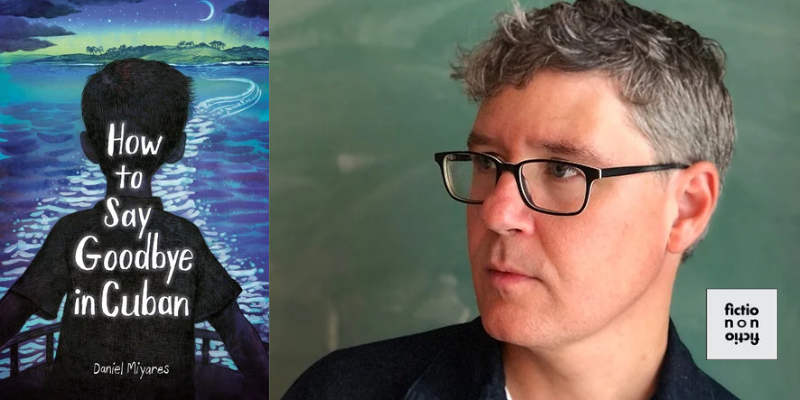
Renowned author and illustrator of children’s picture books Daniel Miyares sits down with co-hosts V.V. Ganeshananthan and Christian Barter to explore his inaugural graphic novel, How to Say Goodbye in Cuban; themes of immigration and Cuban history; and the repercussions of U.S. sanctions on Cuba, a policy that has persisted for years and has grown even tougher under the second Trump administration. Miyares describes choosing to research and portray his family’s journey through a fictionalized account of his father’s youth, and details his father’s transition from Cuba to the United States amid the Cuban Revolution, sharing the diverse political viewpoints within his community. He explains his decision to illustrate the book by hand, using ink and watercolors, and discusses the hurdles of researching and narrating another person’s story. He reflects on what it meant to collaborate with his father and to discuss storytelling, noting that his father passed away before the project reached its end. Miyares also reads from How to Say Goodbye in Cuban.
To hear the full episode, subscribe through iTunes, Google Play, Stitcher, Spotify, or your preferred podcast app (use the forward slashes when searching). You can also listen by streaming from the player below. View video versions of our conversations on the Fiction/Non/Fiction Instagram account, the Fiction/Non/Fiction YouTube Channel, and our show website: https://www.fnfpodcast.net/ This podcast is produced by V.V. Ganeshananthan, Whitney Terrell, Emily Farris, Sydney Perkins, and Emma Ware.
Daniel Miyares
How to Say Goodbye in Cuban • That Is My Dream!: A picture book of Langston Hughes’s “Dream Variation” • Float
Others
US escalates economic campaign against Cuba and targets China-based suppliers • Marco Rubio’s compelling family story embellishes facts, documents show – The Washington Post (October 20, 2011) • New York Times Topics: Cuba
EXCERPT FROM A DISCUSSION WITH DANIEL MIYARES
V.V. Ganeshananthan: Could you describe the artwork included here? How did you envision and craft these illustrations to accompany the text, and what materials did you use?
Daniel Miyares: Absolutely. You noted at the start that this is my first graphic novel, and it carries substantial weight because it documents my family’s history. I couldn’t imagine approaching it in any way other than drawing by hand with ink. When I was about four years old, my father handed me my first bottle of India ink along with a dip pen and let me experiment in the basement. I suspect my mother wasn’t thrilled about the ink stains all over everything. Do you remember those old Commodore 64 computers?
VVG: I do.
DM: And the printing paper back then came in a continuous roll, with holes along the side. I stretched that long sheet across the entire basement and used the ink to draw on nearly every sheet—everywhere the ink touched, there was marks and splashes. It was wonderful, and I’ve carried a lasting affection for drawing with ink since, so I try to weave it into my artwork as much as possible.
But when I began this book, I decided I wanted to render it by hand, in ink, painting with inks, and then scanning everything at the end. I deliberately avoided using digital tools to generate the art, choosing ink as the authentic path to learn the medium and to master storytelling in a graphic form, especially since it was my first foray. I felt that drawing by hand offered a rigorous education, a kind of trial by fire, because any mistake required improvisation—cutting out a new head from paper and gluing it on, then redrawing over it. I relish that push-and-pull process and being attuned to the surface I was creating. Also, in the early sixties, computers weren’t common, so I sensed a meaningful link between ink and watercolor and the solid black waterproof ink. My aim was to fuse all of those connections into my approach.
VVG: It’s truly stunning. Reading this feels as tactile as listening to a vinyl record.
DM: I’m glad you said that. I love that description.
VVG: It feels wonderfully vibrant. I’m struck by a moment in which Carlos moves from the countryside to the city and tries to make new friends, while his peers’ parents hold different political beliefs and cast doubt on his father’s loyalty. His mother warns him about community surveillance, and the bullying stems from supporters of Castro. Earlier, we mentioned Marco Rubio because he has been in the news for announcing sanctions against Cuba. I learned that Rubio’s family left during the Batista era, which is a different migration wave from the one your family experienced after Castro and his rebels gained traction. Am I understanding that distinction correctly? Could you talk about the different waves of emigration as you understand them or as you learned about them from your family?
DM: The more conversations I had with my relatives and the more I researched, the more I realized that the essential question is the motive—the “why” behind a person’s decision. In this case, my grandfather. What compelled him to uproot his entire family and risk everything to leave the country? Those motivations shifted over time and across families depending on circumstances. Early on, some people perceived Cuba’s corruption and exploitation and felt that a better life lay beyond the island; they imagined things wouldn’t improve and wanted to escape.
Batista ruled with an iron fist. He could suspend constitutional rights as easily as anyone, and I think many left early to avoid that fate or to spare their children from exposure to the whim of a leader connected to mobsters and American corporations. That rationale makes sense. But after the revolution, with nationalizations and confiscations of farms, financial reasons also drove people to seek a different life. And there was a sense that the worse was yet to come, that the fighting wouldn’t stay confined to the country or its mountains, and that families needed to protect each other.
But my own family’s history shows my grandfather as stubborn in some respects, yet intensely self-directed. He wasn’t well educated; his craft was furniture making, and he dreamed of turning that skill into a livelihood. Then a stroke of luck came—he won what one might call a lottery, not the lottery in a game, but a fortunate turn that funded their house and his shop. They did carpentry behind the house and upholstery in the city, and for a while he felt he had built something of himself. Yet that fortune was taken away, and he could not bear it. I think this marks the next wave: the educated, the upper-middle-class and those with means who could depart.
When my family left, the borders were sealed. The Cuban Coast Guard kept watch along the shore, and their actions went beyond merely turning people away; there were reports of executions at sea for those attempting to flee. It was widely recognized that those who tried to leave faced brutal treatment. Castro’s regime relied on the support of the country’s poorer residents for its war, yet those from rural areas often lacked the resources to govern effectively; the educated—lawyers and others who could navigate legal systems—were the ones who could escape. This brain drain had to be addressed, at least initially. After that era, emigration became a political instrument in the hands of leaders like Kennedy and Castro, with periods when openings appeared, such as the Pedro Pan flights, where children were sent out of the island while their parents followed later.
Transcribed by Otter.ai. Condensed and edited by Emily Farris, Sydney Perkins, and Emma Ware.
