
This first appeared in Lit Hub’s Craft of Writing newsletter—sign up here.
A typical song opens with a concise preface that creates space, then slides into a verse that carries the narrative forward, shifts through a bridge or a B-section that deepens the predicament, and finally arrives at a chorus that releases the emotional charge. These segments are so compact that achieving a three-minute track almost always requires repeating the entire cycle two or three times.
A four-movement symphony follows the same core logic, but on a completely different tempo and with a markedly different aim. Songs tend to loop back, whereas symphonies push ahead. The force of a song lies in repetition, while a symphony draws its strength from transformation.
In a song, a chorus largely returns in its initial form, but its emotional impact grows through amplification. A symphony rarely affords that luxury. The themes reappear, but altered by what has transpired—darkened or brightened, fractured or reconciled. They carry memory within them.
Historical fiction unfolds similarly. A minor incident from 1905 may resurfacer decades later with an entirely new meaning, because history has reshaped the listener. Epic historical fiction, with its long memory and shifting motifs, naturally leans more toward the symphonic than the song. Yet as writers of historical fiction, we should keep in mind, even while tracing expansive arcs of time and change, that the symphony itself is built from a multitude of small songs.
A song is not a symphony. A symphony is not a play. A play is not a novel. Yet beneath their distinct forms lies a shared grammar of tension, development, transformation, and release.
There are lessons beyond structure to be gleaned from composing music. When I was a boy teaching myself to accompany my guitar and piano, I first conceived music as a collection of blocks—a handful of chords with a melody stacked on top. As an untrained guitarist, when I saw a “G chord” on the page, I would fashion my hand to match the shape I had memorized as a “G chord.” The same misperception extended to the piano. I hadn’t yet learned what a chord truly was. I believed it to be a block in a sequence of blocks, whereas a chord is really a moment where independent voices briefly converge, each of them on its own path. This insight proves valuable for a novelist, too.
“It sounds too much like you’re writing music,” Hans said. “Well, what should I be doing?” I asked him. “Telling the story,” he said.
Many years later, after a long and comparatively successful career in music and with a two-year-old son in my life, I decided I should learn how to work with orchestras, and perhaps explore more film scoring. I spent about three years studying and then applied that imperfect training to Hollywood, composing instrumental cues for films under Hans Zimmer and his remarkable collective of geniuses.
Composing for an orchestra, even when using samplers and synthesis to simulate an ensemble, is radically different from writing a pop song. Far from block chords, most orchestral instruments strike single notes at a time (with exceptions like keyboards, harps, and a few other polyphonic instruments), so every shift in harmony, extension, or dissonance arises from the interplay among this roster of one-note voices. Each line possesses its own color, its own melody, its own will. Consequently, the harmonies and chords remain in constant flux, moving together more like a flock of starlings or a school of minnows than a single frog hopping from stone to stone. Every voice has significance. Each is a character; they all form melodic strands, and together they can yield an organic, almost accidental mosaic or tapestry.
There is another lesson for writers of any stripe to take from Zimmer. Early on in our training, I drafted a three-and-a-half-minute piece that I genuinely liked for an emotional scene. Hans rejected it outright. “It sounds too much like you’re writing music,” he said. “Well, what should I be doing?” I asked him. “Telling the story,” he said.
Which brings us to the other half of a song: Lyrics. Lyrics impart numerous lessons for the novelist as well. I have always treated lyrics as dialogue, or at least as one side of a conversation. Even if it’s a maniac shouting at the universe, or a doomed drunk spilling his life in a bar, or a late-night call to an ex-lover’s dead line, I strive to grasp not only who the singer is but who they are addressing and what they want. To do this consistently and with speed, I’ve learned to think like an actor—almost tricking myself into momentarily becoming the character I’m writing for. This proves invaluable for a novelist.
A lyricist cultivates economy. Lyricists must ensure the audience comprehends the full situation by the end of the first verse. In the case of the first successful track I worked on, Welcome to the Boomtown, the first verse ran to just 29 words.
Ms. Cristina drives a 944
Satisfaction oozes from her pores.
She keeps rings on her fingers,
Marble on her floors.
Cocaine in her dresser,
And bars on her doors.
(My lyrical wellspring at the time came from police reports.)
Words carry both information and rhythm. Sometimes, in our post-Hemingway quest for brief, declarative sentences, we can forget that, like a lyric, a scene must flow, must bear implied melodies. It must pulse. In Murakami’s essential conversations with the esteemed conductor Seiji Ozawa, he is blunt: “I think that someone who writes without rhythm lacks the talent to be a writer.”
There is one final lesson I wish to draw from the great symphonies, and from the storied novels of the past. Discipline. I understood that taking on the writing of The Fire Agent would be no small undertaking. I had never attempted something on this scale, and ultimately it required eight years to complete. It spans a broad swath of history, from 1900 to the dawn of the Cold War. It demanded everything I had learned and exposed every gap I had not. It drew me in, consumed me, and at times nearly overwhelmed me. And without music to guide me through it, I would have sunk from the very beginning.
_______________________________________
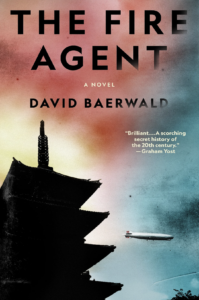
The Fire Agent by David Baerwald is available via Spiegel & Grau.