
If you read this column at, you have caught me referencing the incredible literary podcast Between the Covers. It’s a delight to have its host, the inimitable David Naimon, as a guest to celebrate the reissue of Ursula K. Le Guin: Conversations on Writing with David Naimon. As an interlocutor, Le Guin is magnanimous and playful in these pages. For his part, despite being in the presence of so formidable a mind, Naimon doesn’t crumple. Rather, he engages with Le Guin with rigorous curiosity—the kind of open flexibility that makes for a delightful conversation. (Clearly a deep longtime admirer of her writing and its legacies, Naimon also devoted a year of dazzling conversations with writers about elements of Le Guin’s work entitled “Crafting with Ursula.”)
The discussions between Naimon and Le Guin are divided into outwardly neat sections (“On Fiction,” “On Poetry,” “On Nonfiction”), each with the lovely preamble emblematic of Naimon. Of course, the conversations, unhurried and thoughtful, are varied, roaming from “grammar bullies” and dictators’ fear of poets and the function of myth. Somehow, the book is compact enough to fit into a bag, easy to dip into and draw from Le Guin’s wellspring of wisdoms.
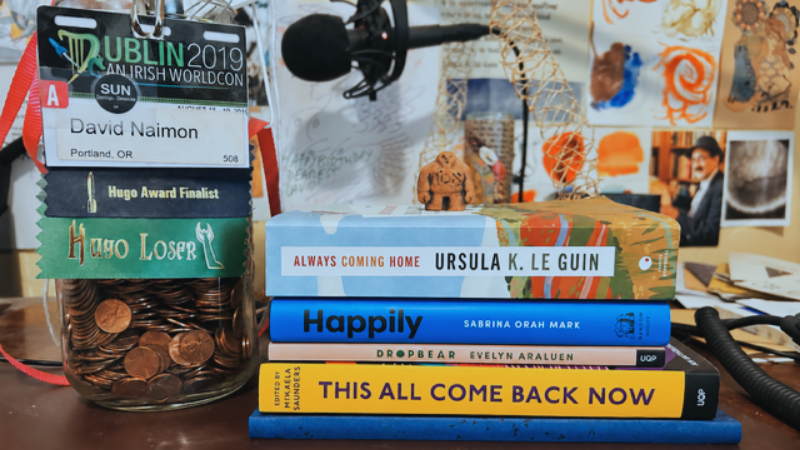
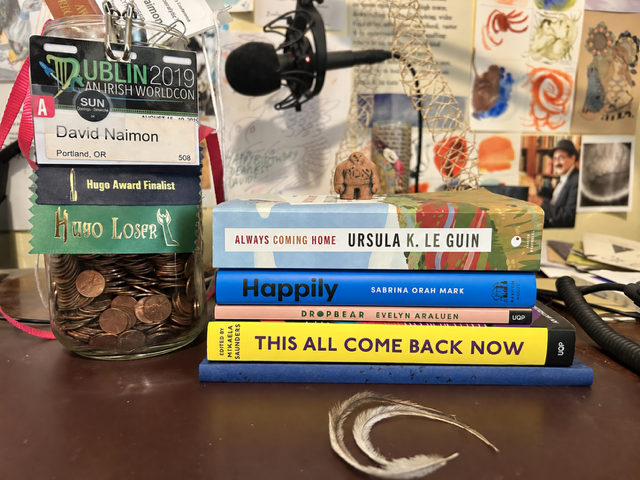
If you’re a mondo-fan of Between the Covers, you know there is a particular glee of when Naimon reveals his latest guest when an episode drops. While Naimon doesn’t let any insights slip about future interlocutors (at least that I can tell), this gives us a lovely portrait of his desk where the magic happens, the talismans that maintain it, and the books he treasures and returns to.
–Diana Arterian
*
I have been a reader of “The Annotated Nightstand” for many years, so it feels thrilling and a touch surreal to participate on the other side, Diana! You’ve graciously allowed me to tweak the format a touch, since many of my paraliterary talismans live not on a nightstand but at my podcast desk. So for my “nightstand” photo I’ve let several of these cherished items sit on my desk to summon a corresponding book from the shelves, with the hope that today’s arrangement still conjures something of the night.
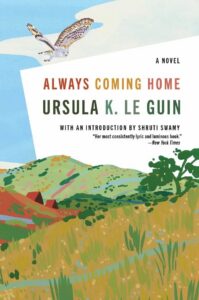
Ursula K. Le Guin, Always Coming Home
If you glance to the left side of the stack, you’ll notice a tall jar filled with pennies, a name tag peeking out, and just beneath my name a ribbon that proclaims “Hugo Loser.” The copy I share with Ursula (Ursula K. Le Guin: Conversations on Writing) led me to the Hugo Awards in Dublin, where I learned, perhaps to my surprise, that losing can be a kind of glory. At the moment the ceremony finishes and the winners pose for glamorous photos with their trophies, the losers are ushered onto a special shuttle and arrive first at the post-gala losers’ party, hosted in the Guinness warehouse lofts rented by George R.R. Martin for that purpose. A live band, a spread of catered offerings, and an open bar welcome the losing contingent as a group before the attendees arrive. The winners, last to show, proceed to the table of humorous hats, pick one that makes them look absurdly funny, and then celebrate.
This nametag nudged Le Guin’s Always Coming Home into the nightstand lineup as the perfect bed-side companion. It isn’t designed for linear reading; it upends the conventional idea of a novel. One can dip in to encounter a song, a recipe, a short story, a concise meditation on ritual, and more. I’m reminded of Le Guin’s remark about her job as keeping doors open or windows ajar, but who passes through those doors, what you glimpse through the window, how can any certainty be known? This truly is a doors-and-windows kind of book.
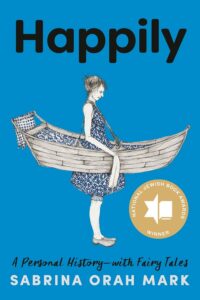
Sabrina Orah Mark, Happily
Atop the pile sits a golem figurine that usually anchors the base of my microphone boom, a guardian keeping the writerly community and these conversations safe from grim forces. Sabrina gifted me this figure, and it reliably drew her hybrid memoir-essay-fairy-tale work Happily onto the desk alongside everything else.
Evelyn Araluen, Dropbear
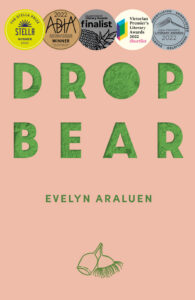
Over the years I’ve forged a connection with an extraordinary organizer, therapist, and facilitator, Leah Manaema Avene. I eventually joined her Fieldwork course, whose subtitle—“collective recovery from Colonial Fragmentation Disorder”—has gathered a vibrant international circle. At one point she sent me a kupega prototype she wove (inspired by Tuvaluan open-weave fishing nets) and which serves as one of the metaphors she employs in her teaching. It hangs just behind my mic, visible as it trajectories behind the golem and along the back of the microphone. She also introduced me to Evelyn Araluen, the Goori and Koori poet, whose first collection Dropbear is a compelling force in Australian literature, and it feels only a matter of time before North American readers catch up with her work.

Mykaela Saunders (ed.), This All Come Back Now
Perhaps my longest-standing correspondence that has grown from the podcast is with the Koori/Goori and Lebanese writer Mykaela Saunders. She is doing remarkable work, and I hope one day her recent story collection Always Will Be will reach readers in the north. Pictured is the anthology she edited—the first-ever collection of Aboriginal and Torres Strait Islander speculative fiction. In front of it rests an emu feather she sent me, which, in Mykaela’s telling, is the sole bird with this double, bifurcated plume—a creature sacred to many nations in Australia, and linked to an Aboriginal constellation The Emu in the Sky.
Mila Menendez Krause, Vasos Oscuros
This last volume, the slender blue book at the bottom of the stack, stands as perhaps my most cherished discovery. I would never have learned of Mila Menendez Krause, a Swiss-Colombian author, were it not for Mark Haber’s championing of her scarce oeuvre. Vasos Oscuros is both out of print and never translated into English. I’m not sure Mark even realizes I found this copy. Much like his own knack for surfacing almost vanished works, I stumbled upon it by pure chance—inside a derelict free book exchange just beyond the mouth of the Rouffignac cave in the Dordogne region of France. Likely left behind by a traveler who didn’t recognize its value. I dip into the pages again and again, sensing an unacknowledged or erased influence on Nabokov’s Pale Fire, even with my Spanish reading ability far from fluent. I’ll end by sharing a fragment from her writing, translated by a friend for us, Flora Abenafia:
Outside the mouth, the world is a moth, powdery, calcified—a specimen of the interior. Inside smells of leaked fuel, of a century’s domestic dust—a toxic womb. If I don’t eat the fruit immediately, the fruit will begin its occupation. It will reverse the line of sight. (What happens to a woman who is eaten by a yellow apple? Where does the meat go?)
