
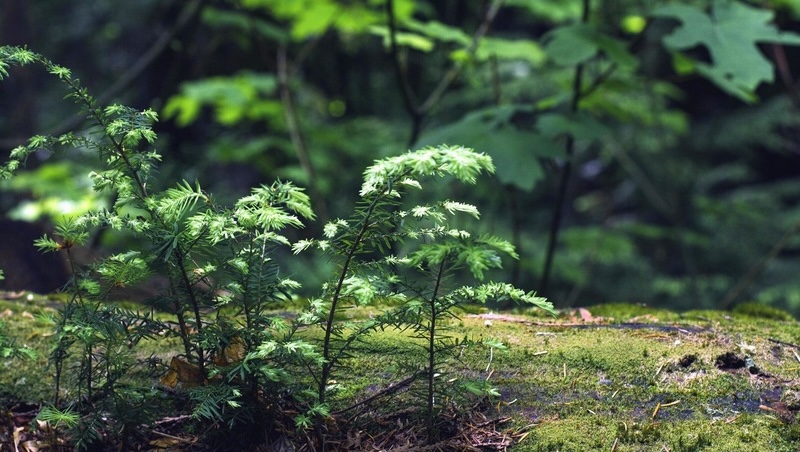
“Plants are the young of the world, vessels of health and vigor; but they grope ever upward toward consciousness…”
–Ralph Waldo Emerson
*
Over the past century, our understanding of plant intellect has grown substantially. Even before formal studies were undertaken, poets and scholars had glimpsed facets of this intelligence. Among the earliest influential voices were Goethe in The Metamorphosis of Plants (1790) and Darwin in his later works (composed between 1862 and 1880).
More recently, dedicated biologists, chemists, and researchers from various disciplines have leveraged modern technology to conduct experiments that reveal a spectrum of plant awareness. What used to be considered passive and immobile has been shown to rival, and in some cases surpass, the perceptual capacities of animals. A great deal of intelligent activity resides within plants, much of it in their root systems.
Earlier seen as static and insensible, plants reveal perceptual abilities that can match or even exceed those of animals.
Each plant lives, breathes, and communicates, and is said to possess a distinct personality and even a semblance of soul. Darwin compared the sentience of plants to the brains of simpler animals. Plants can relay signals along the length of their bodies and to nearby young shoots. These signals—and at times nutrients—are shared with neighboring plants, including those from different species. Cleve Backster proposed that plant awareness may extend beyond cellular processes to the molecular, atomic, and possibly subatomic levels.
The common view that plants are primitive due to their apparent stillness has been refuted by careful observers. Plants move at particular times, turning toward the light after darkness and reaching with tendrils toward support structures like trellises or tree trunks, sometimes wrapping around an object within just an hour. Darwin noted that such slow, purposeful motion appears when it benefits the plant. Climate studies have demonstrated another form of mobility: in some cooler-adapted trees in South American jungles, a shift toward higher elevations is underway. A similar trend is visible in the Alps, where the timberline of pines and hardwoods climbs higher as once-icy slopes recede.
The entire plant world responds to the scalar (gravitational) and vector (electromagnetic) fields that operate across our planet and its solar system. As one of the earliest life forms on Earth, green vegetation captures energy from the sun and uses it to power all biological processes, serving as a fundamental source of nourishment for all living beings. Plants act as energy conduits, communicating through vibrational signals that hint at their emotional and intellectual states. Not only does the host plant appear conscious, but individual leaves seem to possess a separate consciousness. For instance, leaves that have detached from a parent plant—especially when threatened, torn, or shredded—demonstrate heightened agitation.
Using devices like polygraphs, cardiographs, and encephalographs, scientists have identified a complex form of plant intelligence that can indicate stress levels, emotions, and even phenomena such as ESP and a fear of dying. These emotional responses are relevant not only to the plant or its leaves but also to surrounding living matter. In one famous case, Cleve Backster cut his finger and applied iodine; the plant being monitored on the polygraph reacted immediately, seemingly in response to cell damage in his finger.
In The Secret Life of Plants, Peter Tompkins and Christopher Bird recount research into several aspects of plant consciousness. Their experiments suggested that plants respond to a caring, positive environment and react strongly to loud noises and harsh sounds. They become lonely if kept apart from other plants in a greenhouse. Plants also appear capable of interpreting positive and negative thoughts and attitudes. Researchers observed that plants communicate with one another, warning of potential dangers and predators. For example, when a leaf is chewed by an insect, neighboring plants release chemicals to make themselves less appealing to the intruder.
The widely held perception that plants are primitive for being static has also been refuted by those who have patiently taken the time to observe them.
Experiments using electrodes to probe plant consciousness also yielded striking results. In one test with a cabbage, the specimen not involved in the experiment exhibited a high-pitched response when others were destroyed nearby. A similar study in Russia reported that a leaf displayed strong stress and frantic behavior after witnessing a live shrimp being dropped into boiling water.
This demonstrates that plants’ feelings are not limited to their own species alone. Some researchers speculate that plant cellular consciousness may sense cellular death that lies beyond their immediate surroundings. If confirmed, such findings would imply that sweeping destruction of a rainforest could trigger stress signals across all green life in the region. Taken together, these experiments suggest that some form of cellular awareness might be a universal feature of life.
What science has uncovered resonates with knowledge long held by Indigenous peoples. For example, the Chewong of Malaysia do not draw a hard line between human and nonhuman consciousness. They argue that the distinction between humans and other life-forms rests on our different perceptions of reality, positing that an “animal worldview” shaped by the brain and nervous system is as valid and complete as a human one. They refer to wildlife as “different conscious beings.” In the words of anthropologist Signe Howell, as cited by Knudtson and Suzuki, “for members of a given species, the world they experience is the real one.”
___________________________

From The Green Soul: Returning to Our Sacred Belonging in Nature by Lucinda M. Vardey. Copyright © 2026. Reprinted with permission from HarperOne, an imprint of HarperCollins Publishers.