I published my first novel twenty-five years ago. It wasn’t a masterwork, yet to me it felt miraculous. Unboxing was still a private ritual at that time, and I recall staring at the book with a sense of disbelief. It existed inside the box, and I realized I didn’t worry much about impending reception. The crucial thing was that I had written it and that it had found its way into the world with a genuine ISBN, which became the peak of my celebration. It simply existed!
I handed the very first copy to my mother. She had dreamed of becoming a painter. She had a teacher who encouraged her, convinced she possessed talent. But her modest rural upbringing and being a girl in the early 1950s made the path difficult. Still, she longed to provide for herself, so she pursued education in any form and ended up as a hairdresser. I’m her third child and the only daughter. The anecdote goes that I was born amid a hair-dryer and curling irons; a client, still seated with rollers, was in the chair as I entered the next room.
When I was eight, my mother returned to school to become an art teacher. The dream surfaced for her, though not in its original shape, and it felt as monumental as unboxing my debut back in 2001.
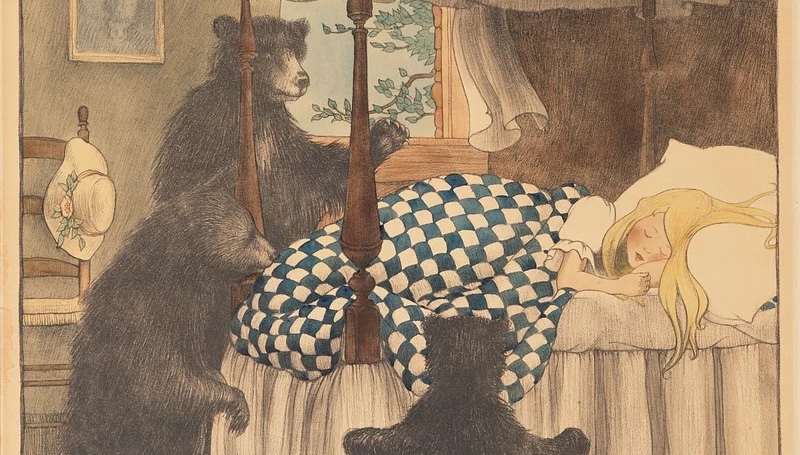
According to the original tale, Goldilocks is a mischievous girl, but I can’t help seeing a child on a quest. She’s searching for the perfect place, isn’t she?
The second copy I delivered to my schoolteacher. Let’s call her Laura. I penned a personal dedication. Then I rode my bike to her house in the rural village where I spent my childhood. I walked straight up to her door, knocked, and handed her the book. My hands trembled a little, and I was a touch embarrassed. As far as I recall, my dedication read: Dear Laura, Thank you for teaching me how to write.
From the age of six to fourteen, Laura supervised my reading and writing development. It was obvious she was moved by the dedication, yet she corrected me: I only taught you the letters, Dorthe. I didn’t teach you how to write.
I’m not sure this modest reply is entirely true. What Laura did was notice that I was a chatterbox who grew easily bored, and she supplied me with books. Over time she would covertly assign me more challenging tasks. She had me write “just a little play” and then transformed its passages into theater for my classmates and me. It felt as if she drew a door in the walls that enclosed me, offering an exit, a future with possibilities.
I’m convinced Laura was the first person to introduce me to Goldilocks. This peculiar girl who wanders alone in a barren land and then enters a house inhabited by gentle bears. The bears have just finished cooking porridge and have stepped outside to let it cool. In comes Goldilocks; she takes a spoon. The first mouthful is too hot, the second too cold, and the third is perfectly warm. She sits in chairs and rests in beds until she finally feels content. In the classic tale, Goldilocks is described as mischievous, but I can’t shake the image of a child on a journey. She’s seeking the ideal place—somewhere safe yet not confined, free yet not lost, warm yet not burned, cold yet not freezing. She’s after her zone—the Goldilocks zone.
*
What happened next was that I wanted the heroine of my tenth book, Range, to hold a role far removed from my own. I craved a true challenge, so I decided she would be an astrophysicist and named her Gunn. To anchor Gunn’s field of study, I reached out to The Niels Bohr Institute in Copenhagen. There I met a supportive professor named Johan P. U. Fynbo. He and his team are pursuing the moment when the first light pierced the darkness of the early, frigid universe.
I soon recognized that Professor Fynbo and I share not only stark differences but also remarkable similarities in our work. He uses mathematics while I rely on language, yet both of us are trying to answer questions like: How did we get here? What are we here for? What does life mean? I also learned that astrophysicists borrow tools from my field to help laypeople grasp their work. They employ metaphors, for instance. Professor Fynbo once told me his job is akin to seeking “glow worms in the dark.” That is poetry.
Like all fairy tales, the Goldilocks story aims to teach us something through a magical form that makes its emotional message hard to forget.
I wasn’t actively seeking Goldilocks when she appeared in my research. She wandered into an article about life on distant planets. No longer chasing porridge, she became an emblem of life itself. I learned that in the search for life in space, we should look for planets that lie within the Goldilocks distance from a host star like the Sun. Just like our own watery world, traveling through the blackness of space, orbiting a star, positioned neither too close nor too far, in the perfect distance to give life a chance.
Or a mother, or a father, or an aunt, or a teacher, or a bear.
Like all fairy tales, the Goldilocks story seeks to convey a truth about growth and becoming, using a magical form that makes its emotional message hard to forget. It asserts a key idea about development: one must stay within a healthy range relative to a source capable of care—a host star. If one leans too close to that source, the host’s needs and temperament can scorch one’s dreams to ashes. If one drifts too far, one becomes cold and solitary. The ideal place for a child—and for a planet—is within the Goldilocks zone. There life can thrive. Planets and people. Remember that link.
In my latest novel, I gave Goldilocks the more common name Jenny, and I let her pursue Gunn, or the Professor as the locals call her in their community, a locale of dark skies and close neighbors. Jenny is an unusual child, perhaps odd, yet she is also supported by a loving mother—the hairdresser.
It’s fiction, of course. But as with the study of Goldilocks, fiction carries the deepest truths.
_______________________________
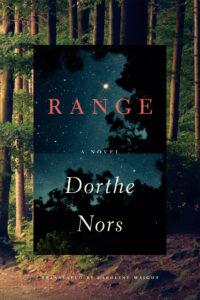
Range, a novel by Dorthe Nors, translated by Caroline Waight, is published by Graywolf Press.