
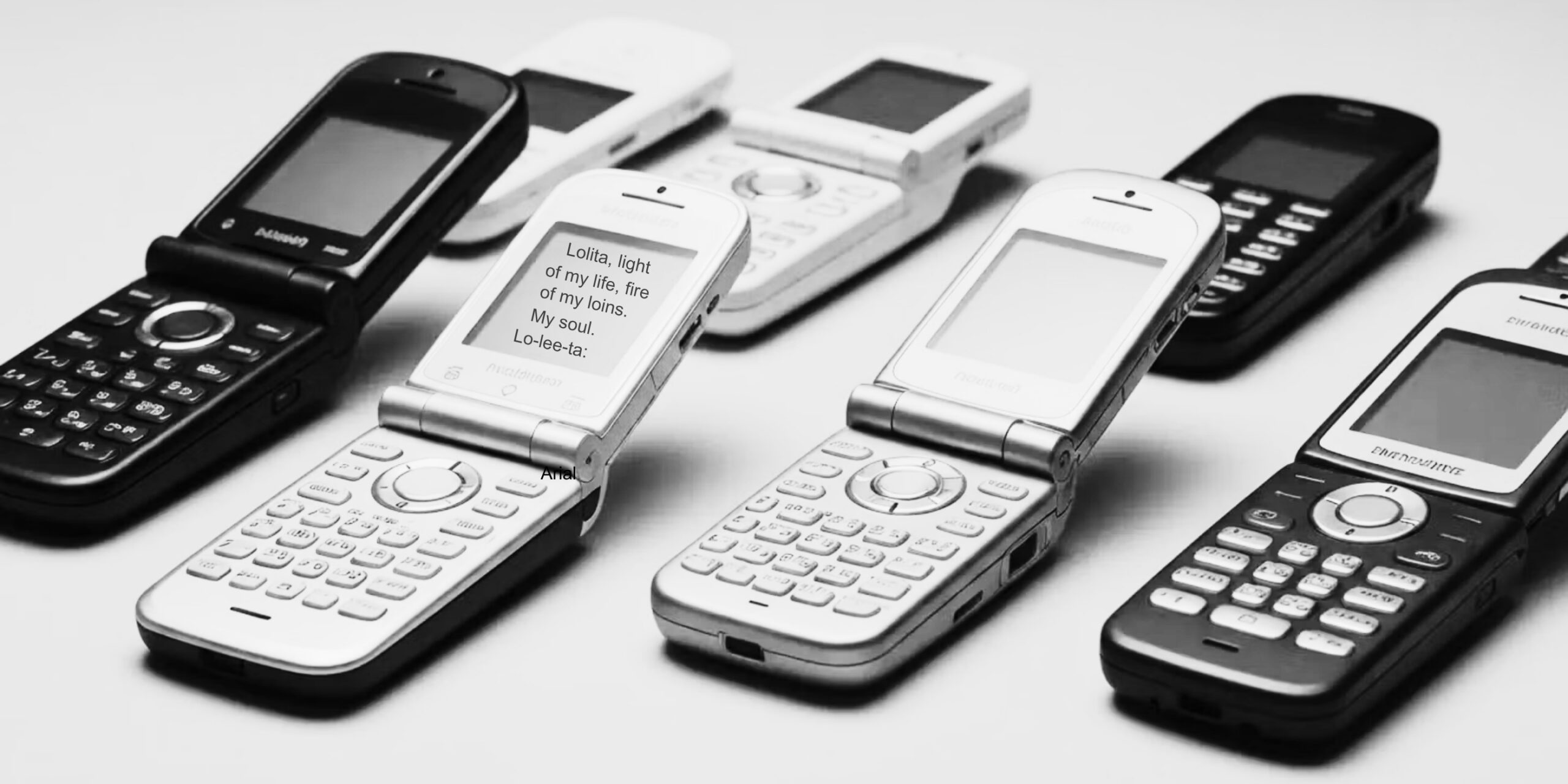
At the advent of the Y2K era, technology still carried the promise of answering a basic human need: the ache for connection, or simply the urge for external affirmation of our inner monologue. In the early 2000s, the digital revolution doubled as a personal revelation—suddenly, with chunky devices and satellite links, anyone could enter a rapidly expanding network of possible friends, admirers, pen pals, lovers, stalkers, scammers, confidants… the global web we wove with our own hands.
In a brief moment of bliss, the miracle of infinite connectivity stayed mostly within home offices; due to hefty prices and patchy coverage, Western markets saw cell phones grow slowly. In Japan, by contrast, they became nearly universal overnight. By 2004, the nation’s biggest mobile operator, NTT DoCoMo, began offering unlimited text messaging for a flat monthly rate, and before long, the feature found its way into every purse. Like a transformative firestorm, this device reshaped every layer of life—from how people spoke to how they toiled and, inevitably, what they read. This period brought with it a peculiar moral panic of the era: the cell phone novel.
Despite the appellation, these works weren’t e-books, nor were they confined to mobile screens alone. Cell phone novels, sometimes shortened to CPNs, can be understood as serialized, compact, pseudo-poetic melodramas written for a digital audience. Each installment ran to roughly 70–100 words, and crucially, writers enjoyed freedom in how they arranged the text—line breaks and ellipses carried a significant portion of the meaning. In its final shape, a single CPN segment resembled a haiku in appearance, the white space between words loaded with implication.
Even though their numbers were modest, those roughly 100 words packed considerable punch, traversing the same emotional ground as an overstuffed soap opera, yet with limited space and minimal cognitive friction. Because YA fiction hardly existed in 2000s Japan, the early adopters—proto-Twihards—made a beeline for “cell phone novel portals” that invited them to publish their own writing. In this way, teenage girls emerged as the main producers and consumers of the CPN wave, delivering nuggets of unfiltered pathos in bite-sized fragments ideally suited to the commute to school (Quibi, you’ll forgive the comparison, collapsed before it began).
If you’ve ever met a suburban teen, or have watched Degrassi, you won’t be surprised to learn that these narratives engaged familiar themes and settings. The inaugural hit, Deep Love by Yoshi (2005), chronicles a teenage girl’s descent into prostitution in a bid to save her terminally ill boyfriend—an implausibly stark premise that popularized tropes like rape, love triangles, pregnancy, and suicide as recurring motifs. At the same time, the format proved commercially viable; by 2007, print editions of cell phone novels accounted for four of the five top titles on Japan’s bestseller lists, making the cultivation of a lurid, lyrical prose suddenly financially rewarding.
Like fire and brimstone before it, this technology reshaped everything, from how people communicated to how they labored to—of course—what they read. Enter a distinctly early aughts moral panic: the cell phone novel.
Naturally, this digital frontier drew inevitable criticism, with commentators fretting that cell phone novels could erode the canon of Japanese literature. The 2008 cover of Bungakukai, a venerable literary journal, asked whether “cellphone novels will extinguish ‘the author’?” and Western media quickly echoed the concerns, as outlets like The New Yorker and The New York Times—in that same year—described the emerging phenomenon (though, once introduced to Western audiences, the genre never achieved the same traction).
Critics focused on the brief, slangy nature of the prose—laden with emoticons and dialogue—producing a conversational, hurried cadence, which the New Yorker described as a “tossed-off, spoken feel.” To illustrate, consider an approximate English rendering of the opening lines to Sky of Love, a massively popular 2005 CPN from Mika:
Since I’d arrived at school, I’d heard a chorus of rumors about Nozomu. A player. A flirt. A ladies’ man. It seemed he moved through the hallways with a different girl every day. “Watch out for Nozomu!” “If you catch his eye, you’re lost.” Didn’t someone tell me that…?
Sky of Love, like many CPNs, claimed to mirror the author’s actual life and then unfurled into territories of personal tragedy—teen pregnancy, gang rape, and bullying were common, including the caveat that you should “watch out for Nozomu.” The Japanese language’s high-context nature allows a lot to be implied with a few words; translating into English swells the word count and flattens cultural nuance. Even so, skeptics struggled to take the sentimentality of these works at face value when every twist had to be conveyed in tense, rapid bursts of gossip—an approach that sometimes used a blank space at the bottom of the screen to compel readers to hop to the next chapter.
Even with the critics’ grumbles, proponents argued that there was literary history embedded in Sky of Love and its peers. The lineage was often traced to The Tale of Genji, the classic of Japanese literature widely regarded as one of the world’s first novels. Written by Murasaki Shikibu in the 11th century, it chronicles the passionate and political escapades of Prince Genji. If you were to “translate courtly life for a school assignment,” Dana Goodyear suggested, the feverish, hormone-laden rhythms of Genji could be seen as a distant kin to the tales born on Toshibas.
This direct comparison between pixelated short-form works and their print ancestors helped legitimize the so-called “literature killer,” and it eased the anxieties of traditionalists. These stories weren’t Shakespeare, of course, but who could deny that adolescence’ raw, unguarded appetite wasn’t artful in its own right? After all, cell phone novels did offer a window into a millennial psyche that was bored and online during a couple of lost decades. The appeal was obvious: they were free, highly bingeable, and—crucially—presented as autobiographical, delivering a stream-of-consciousness narrative straight from the core of a fellow postgrad’s life. Maho no i-rando (Magic Island), Japan’s first CPN portal, openly invited users to upload diaries and blog posts, providing an unfiltered conduit for the instantaneous musings of a generation struggling to stay afloat financially.
Whether the events in Sky of Love were “true” or not mattered less than the emotional impact on readers—and the profits that flowed from that impact. CPN portals earned through advertisement revenue, and their buzzworthy content frequently translated into financial rewards. Authors could sometimes reap tangible benefits, too, as online publications could later lead to a print edition or even a movie adaptation. Although the odds were slim, portals would promote these occasional “wins” as part of their marketing and even established formal writing contests with publishers, offering cash prizes or book deals as incentives.
For a brief period, writing a cell phone novel was seen as a pathway to personal fulfillment and social mobility—even though most CPNs would never become anything more than a dead link, and many writers were secretly embarrassed by their own early work, avoiding the spotlight despite a hit that had exploded. Outside Japan, the genre was regarded more as a technical writing challenge—Takatsu, credited with the first English-language CPN in 2008, likened the medium’s constraints to a photographic macro lens. Inside Japan, privacy remained central: social networks such as Facebook were slow to spread because of the personal data involved, and on portals like Maho no i-rando, authors and readers commonly operated under pseudonyms. With anonymity as the default, the exchanges in the comments section created a dialog that would feel familiar to readers today.
No wonder the genre struck a chord with young people; these stories were free, highly bingeable, and—best of all—supposedly autobiographical, offering stream-of-consciousness storytelling straight from the bleeding heart of your fellow postgrad.
The comment section, the unmediated bridge between creator and reader, soon exposed why comparisons to The Tale of Genji fall short. A cell phone novel’s fragmented storytelling was inseparable from its tiny three-inch screen and a constantly mobile audience. The constraints dictated everything: the topic, length, language, and the mode of delivery. Yet the portals’ accessibility shaped what was on offer and who stepped up to contribute. Most CPN writers were not would-be literary stars from the start; interviews suggest they were ordinary people with side gigs, limited job prospects, and a keen sense of where opportunity lay. Writing often became a collaborative enterprise: an aspiring author would publish a chapter or two, claiming the piece came from a diary or personal blog (feeling cute, might delete later). If readers engaged, they urged completion, guiding the story chapter by chapter with the fervor of their emoticons. Remarkably, the author’s journey often mirrored that of the narrative’s protagonist, who fixated on others’ judgments to an almost obsessive degree. “She’s short,” the heroine of Sky of Love remarks about herself, “And stupid. And not that pretty… / She wears a little makeup, but it looks strange on her…”
Ultimately, the literary value of cell phone novels became a debate best left to outsiders, because those who actually read and produced within the genre seemed driven less by ambition to transform literature and more by a deep sense of cultural loneliness. In a 2013 examination of the CPN phenomenon through the lens of labor, anthropologist Gabrielle Lukács argued that Japanese CPN platforms unintentionally forged an “intimate public”—a term later borrowed by feminist scholar Lauren Berlant to describe a form of relational intimacy that emerges during economic upheaval. The idea posits that when stable, normative institutions waver, people search for a reliable framework for closeness wherever they can find it—and Lukács contends that, at the turn of the millennium, the most reliable bet was textual, tweet-length monologues. In fact, most CPNs ended by thanking their readers, whose loyalty was credited with finishing the work and often with the author’s own happiness (“I hated myself so much that I wanted to die,” confessed a pseudonymous author, Nana, about their pre-posting life). The intimate public is a one-sided kinship that emerges from such lopsided disclosure, and Berlant’s theory remains a touchstone for understanding the hollow promises of the digital age, where every minor optimization—be it social media, artificial intelligence, or surveillance capitalism—feels like a race to outpace humanity itself.
Today, teetering at the edge of a second recession and amid an AI surge, intimate publics like those born on CPN platforms proliferate in many guises: disinformation campaigns, the push to tailor ads until we dream in QR codes, and above all the surprising level of empathy we imagine from our chatbot companions. A 2025 series on the future of advertising from Publicis even proposed that AI could be the “secret to intimacy at scale”—a premise they might find echoes of in CPN history, decades earlier (though their angle leaned more toward a sensational, plot-driven arc than a sincere exploration of human connection).
Meanwhile, cell phone novels are gradually fading as links fail and servers go dark. Portals such as Maho no i-rando and Textnovel.com, which once hosted English-language CPNs, have disappeared long ago, leaving even the most famous works hard to locate in their original form. While there isn’t a movement to critically revisit what, in the end, amounts to Wattpad-style romances stitched together with line breaks, hindsight makes one thing clear: far from extinguishing literature, the cell phone novel arrived late and died early. It’s hard to imagine today’s aspiring writers embracing such strict constraints en masse without a clear technological need or financial motive, and it’s even harder to picture non-writers attempting a public, diary-like foray into this format. Isn’t that exactly what Chat dialogue is for?
Yet a few stubborn souls continue the vintage flame. The most comprehensive English guide to composing cell phone novels appeared on Wattpad in 2017, near the tail end of the genre’s Western heyday, and a handful of later comments still linger. With the precision of a grammar manual, the guide walks through every step of the CPN-writing process, emphasizing especially how to exploit stylistic choices, since the structural limits now serve more as ornament than necessity (my text messages in 2026 are far longer than they used to be). It reminds would-be writers to respect the blank spaces that separate the words, noting that those gaps can carry as much narrative weight as the characters themselves.
In a flourish of dramatic irony worthy of classical tragedy or a Titanic retelling, the guide opens with a CPN-styled illustration and proudly proclaims the genre’s endurance. “Elegant, short, and concise, the dawn of a new ERA,” it proclaims, that bold claim of progress that makes you want to knock on wood three times. In truth, it reads as a relic from another era—revisiting it feels like peering into nostalgia from two generations back, a pastime that feels almost like a grandmother’s cherished routine. That’s right, kids: in my day, you could still assume blank space was a creative choice. In my day, you could still extract meaning from what a machine would read as dead air.