There exists a straightforward method for cooking rice. My father introduced it to me when I was a child. In those days I would sit atop the kitchen counter, watching him sift the grains between his fingers—steady and swift, discarding dirt or specks, no more than tiny imperfections. He swirled his hands through the water and it grew cloudy. As he scrubbed the grains clean, the noise sounded as vast as a field of insects. Again and again, my father rinsed the rice, drained the water, then filled the pot once more.
The directions are plain. After cleansing, you gauge the amount of water this way—placing the tip of your index finger on the surface of the rice. The water should reach the bend of your first knuckle. My father never needed instructions or measuring spoons. He closed his eyes and sought the waterline by feel.
Sometimes I still dream of my father, his bare feet flat against the floor, standing in the heart of the kitchen. He wears worn button-down shirts and faded sweatpants cinched at the waist. Surrounded by the gleam of the kitchen counters, the sharp angles of the stove, the refrigerator, the gleaming sink, he seems out of place. This memory of him remains so vivid that at times it astonishes me, the way I can conjure it in such precise detail.
Every evening before supper, my father would enact this ritual—rinsing and draining, then placing the pot into the cooker. When I grew older, he entrusted this task to me, yet I never performed it with the same tenderness. I merely went through the motions, splashing water about, lowering my finger to judge the water level. Some nights the rice turned into a soft mush. I fretted that I could not execute such a simple task correctly. “Sorry,” I would murmur to the table, my voice soft and ashamed. In reply, my father would keep eating, shoveling rice into his mouth as if nothing different had occurred, as if he noticed no disparity between his flawless performance and my imperfect one. He would consume every bite, his chopsticks dancing across the plate. Then he would rise, whistling, and clear the table, every motion so clean and certain that I believed the world was perfectly alright.
*
My father stands at the center of the kitchen. In his right hand he holds a plastic bag containing water and within it a live fish.
The fish is barely breathing, its mouth opening and closing. I reach up and touch it through the plastic, tracing the gills, the soft, muscular body, my finger skimming across the eye. The fish regards me with a hard stare, flopping sluggishly from side to side.
My father fills the kitchen sink. With one swift motion he overturns the bag and the fish lunges out into the water. It arches and splashes. We watch closely, me on my tiptoes, chin resting on the counter. The fish spans the length of my arm from wrist to elbow. It remains suspended in the water, glancing against the sink’s sides.
I stay alert for the fish while my father begins preparations for supper. The creature folds its body, trying to turn or swim, while the water nudges over it. Although I create tiny ripples with my fingers, the fish stays still, bobbing from side to side in the cold liquid.
For many hours, it was just the two of us. While my mother worked and my elder brother played outside, my father and I sat on the couch, flipping through channels. He loved cooking shows. We watched Wok with Yan, my father passing judgment on Yan’s techniques. I was captivated when Yan transformed orange peels into graceful swans. My father sniffed. “I can do that,” he said. “You don’t need to be a genius to pull that off.” He placed a sprig of green onion in water and showed me how it bloomed like a flower. “I know many tricks like this,” he said. “Much more than Yan.”
Still, my father took careful notes when Yan demonstrated Peking Duck. He chuckled heartily at Yan’s wordplay. “Take a wok on the wild side!” Yan had cried, brandishing his spatula toward the camera.
“Ha ha!” my father laughed, his shoulders quivering. “Wok on the wild side!”
In the mornings, my father accompanied me to school. By three o’clock we returned home, and I would recount everything I had learned that day. “The brachiosaurus,” I told him, “eats only soft vegetables.”
My father nodded. “That’s like me. Let me examine your forehead.” We paused and faced one another on the street. “You have a high forehead,” he said, leaning in for a closer look. “All clever people do.”
I walked with pride, matching his pace with every step. I was overjoyed when my feet fell in time with his—right, left, right—and we moved as one. My father was a man of tricks, who could spend an hour hollowing a watermelon with a circular spoon or turning the rind into a tiny fortress.
My father was born in Malaysia, and he and my mother immigrated to Canada years before my birth, first settling in Montreal, then later in Vancouver. While I was born into Vancouver’s constant drizzle, my father was born under the broad skies of a monsoon country. When I was young, my parents attempted to teach me their tongue, but it never came easily to me. My father would run his thumb along my lips, his face kind, as if trying to discern what made me different.
My brother was born in Malaysia, but when he and our parents moved to Canada the language left him too. Or he forgot it, or he refused to remember—which is common—and this made my father angry. “How can a child forget a language?” he would ask my mother. “It’s because the child is lazy. Because the child chooses not to remember.” When he was twelve, my brother stayed away in the afternoons. He dribbled a soccer ball up and down the back alley, returning only for dinner. In the daytime, my mother worked as a clerk at Woodward’s downtown, in the building with the red W on top.
Our house carried ceilings yellowed with grease. Even the air felt heavy with it. I recall loving the weight of that air, the thick scent of countless meals prepared in a tiny kitchen, all those comforting aromas pressing for room.
The fish in the sink dwells with a slow, creeping death. It has a glossy sheen, as if its skin were made of polished minerals. I want to prod it with both hands, to feel its fluttering heartbeat beneath my touch. Instead, I fix my gaze on the fish. You’re growing very, very sleepy, I tell it. You’re getting very, very tired.
Beside me, my father chops green onions with speed. He wields a cleaver that he says is older than I am. The blade rocks back and forth, green onion sprigs piling up beside his wrist in a tidy pyramid. When he finishes, he rolls his sleeve back, sinks his hand into the water, and pulls the plug.
The fish in the sink floats and we watch it in silence. The water level sinks below its gills, below its belly. It drains, leaving the sink dry. The fish lies on its side, mouth open and chest heaving. It leaps sideways, strikes the sink, then rises again. It twists and jerks, writhing in the air, and it lands with a thud. It twitches violently.
My father reaches in with his bare hands. He lifts the fish by the tail and sets it carefully on the counter. While holding it steady with one hand, he taps the head with the flat of the cleaver. The fish becomes still, and he begins to gut it.
*
In my apartment, I keep the walls scrubbed clean. I open the windows and turn on the fan whenever I cook. My father gave me a rice cooker when I first moved into my own place, but I hardly use it, tucking it away in the back of a cupboard, its cord coiled neatly around its belly. I do not long for the meals themselves, yet I miss the way we gathered, our bodies leaning forward eagerly as my father, the magician, revealed plate after plate. We laughed and ate, the white steam fogging my mother’s glasses until she had to take them off and rest them on the table. With eyes closed, she would eat, crisp vegetables gripped by her chopsticks, a vivid green that stood out against the room.
*
My brother wanders in the kitchen, his body smeared with dirt. A thin trail of soil follows him as he moves. The soccer ball, muddy from the outdoors, clings to his arm. Pushing past my father, his face is tight with emotion.
Beside me, my mother sprinkles garlic onto the fish. She lets me slip one hand under the fish’s head, cradle it, then tilt it backward so she can stuff the fish’s insides with ginger. Very slowly, I flip the fish over. It lies firm and slick, its scales small and sharp.
At the stove, my father picks up an old teapot. It is full of oil, and he pours the oil into the wok. It streams out in a thin ribbon. After a moment, when the oil begins to hiss, he lifts the fish and lowers it into the wok. He adds water and the smoke climbs. The frying sound of the fish is like tires on gravel, a noise so loud it drowns out every other sound. Then my father steps from the smoke. “Spoon out the rice,” he says, lifting me down from the counter.
My brother returns, his hands muddy and his knees the color of dusty brick. His soccer shorts flick against his legs. He sits, making a sour face. My father pays him no mind.
Inside the cooker, the rice lies flat like a pie. I stir it with a spoon, turning the grains, and the steam bursts upward in a hot mist and condenses on my skin. While my father moves his arms with quiet precision over the stove, I begin serving the rice—first for my father, then my mother, then my brother, then myself. The fish continues to cook quickly in a pot, while in another pot, my father steams cauliflower, rolling it gently round and round.
My brother toys with a table leg, kicking it idly.
“What’s the matter?” my father asks softly.
He is quiet for a moment, then says, “Why must we eat fish?”
“You don’t like it?”
My brother folds his arms across his chest. I glimpse the dirt along his skin, dark and compact. I imagine chipping it away with a small spoon.
“I don’t like that eyeball. It looks sick.”
My mother tuts. Her nametag still clings to her blouse. “Enough,” she says, setting her purse on the chair. “Go wash your hands and prepare for supper.”
My brother glares for a moment, then begins to scratch the dirt from his arms. I bring the plates of rice to the table. The dirt flurries from his skin, speckling the tablecloth. “Stop it,” I say crossly.
“Stop it,” he repeats, echoing me mockingly.
“Hey!” My father taps his spoon on the counter. It sends a high-pitched ping. He jabs a finger at my brother. “No fighting in this house.”
My brother looks at the floor, mutters something, and then slides away from the table. As he retreats, he begins stamping his feet.
Shaking her head, my mother unbuttons her jacket. It slides from her shoulders. She speaks to my father in a language I cannot understand. He merely shrugs. Then he answers, and I think the words sound familiar, as if they are phrases I should recognize, as if perhaps I once knew them but forgot. The language they speak is full of soft vowels, words flowing together so that I cannot hear the spaces where breath pauses for air.
My mother told me once about guilt. Her own guilt she kept in the palm of her hands, like an offering. But your guilt, she said, is different. You do not need to hold onto it. Imagine this, she said, tracing my forehead with her fingers, then up into my hair. Imagine, she said. Picture it, and tell me what you see?
A bruise on the skin, broad and black.
A bruise, she said. Focus on it. Right now, it’s just a bruise. But if you concentrate, you can shrink it, compress it to the size of a pinpoint. And then, if you want to, if you can see it, you can blow it off your body like a stray speck of dirt.
She moved her hands along my forehead.
I tried to picture what she described. I pictured blowing it away as if it were nothing, just these tiny pieces that meant nothing, this complicity I could magically walk away from. She made me believe in the power of my thoughts, as if I could conjure what had never existed. Or turn it around. Twist it so many times that you lose sight of it, watch the tail vanish and the entire thing disappear into smoke.
My father presses at the fish with the edge of his spoon. Beneath it, the meat remains white and the juices sluice down the side. He lifts a piece and places it carefully on my plate.
Again, his spoon breaks the skin. Gingerly, my father lifts another triangle and nudges it toward my brother.
“I don’t want it,” my brother says.
My father’s hand trembles. “Try it,” he says, smiling. “Take a wok on the wild side.”
“No.”
My father sighs and lays the piece onto my mother’s plate. We eat in silence, scraping our spoons across the dishes. Our parents use chopsticks, lifting their bowls, guiding the food toward their mouths. The room fills with the scent of the meal.
My father, savoring each bite, eats slowly, attuned to the flavors in his mouth. My mother removes her glasses, the lenses fogged, and rests them on the table. She eats with her head bowed, as if in prayer.
Picking up a stem of cauliflower, my brother sighs deeply. He chews, and then his face changes. I suddenly picture him drowning, his hair waving like grass. He coughs, spitting the mouthful back onto his plate. Another cough. He reaches for his throat, choking.
My father slams his chopsticks onto the table. In one swift motion he reaches across and grabs my brother by the shoulder. “I have tried,” he says, “I don’t know what kind of son you are, to be so ungrateful.” His other hand sweeps past me and lands a bruise on my brother’s face.
My mother flinches. My brother’s face reddens, his mouth gaping, his eyes wet.
Still coughing, he grabs a fork, tines aimed at my father, and in a moment of reckless impulse, hurls it at him. It strikes my father in the chest and falls to the table.
“I hate you! You’re just an asshole, you’re just a fucking asshole chink!” My brother shouts, clutching his plate. He slams it down and his food scatters across the tabletop. He coughs and spits. “I wish you weren’t my father! I wish you were dead.”
My father’s hand drops again. This time it lands with a blunt thud. I close my eyes. I hear only a scream rising in volume. There is a loud, furious voice. I stand awkwardly, hands shielding my own eyes.
“Go to your room,” my father commands, his voice trembling.
And I think he is addressing me, so I remove my hands.
But he is looking at my brother. And my brother is looking back at him, his chest heaving with every breath.
A few moments later, my mother begins clearing the table, her face weary as she scrapes the dishes one by one into the garbage.
I move away from my chair, slip past my mother, and ascend the stairs into my room.
Outside my brother’s door, I crouch beside the wall. When I step forward and peek in, I see my father holding a bamboo rod between his hands. The stick is smooth. Its long grains, fine as hair, align in a row, spaced apart. My brother lies on the floor, as if he has been thrown down and dragged there. My father raises the rod high into the air.
I want to cry out. I want to rush into the room between them, but I cannot.
It is like watching a tree collapse, its slow arc cutting through the air.
The bamboo drops without a sound. It rips the skin on my brother’s back. I cannot hear any noise. A line of blood sweeps across his body.
The rod rises again and descends once more. I fear the bones will break.
My father raises his arms once more.
On the floor, my brother sobs into the carpet, his knees folded to his chest, the crown of his head pressed into the surface. His back caves in and I can see the bumps along his spine.
The bamboo smashes into bone and the image in my mind bursts into a thousand white fragments.
My mother lifts me from the ground, pulling me along the hall toward my bedroom, tucking me into bed. Everything is damp—the sheets, my hands, her body, my face—and she hushes me with words I cannot comprehend because all I can hear is screaming. She brushes her cool hands over my forehead. “Stop,” she says. “Please stop,” but I feel undone, unhinged, as if the entire known world is ending right here.
Morning arrives with the sizzle of oil in the pan and the scent of French toast. I hear my mother bustling about, putting dishes away in cupboards.
No one says a word when my brother does not come downstairs for breakfast. My father piles French toast and syrup onto a plate and my mother pours a glass of milk. She carries everything upstairs to my brother’s room.
As always, I follow my father around the kitchen. I learn his footsteps by heart, trailing behind him and slipping into the shade of his body. Every so often, he bends down and ruffles my hair with his hand. It feels like we are weaving a spell. The way we move in circles, how he cooks without thinking because this is the task that comes to him naturally. He smiles down at me, and in that moment the spell breaks. My father stands still, hands dropping to his sides, as if he has forgotten what he was doing mid-motion. The walls wear peeling paint and the floor remains unswept for days, leaving bits of dirt stuck to our feet.
I believe my devotion, my unguarded love, confuses him. With each day that passes, he senses I will find it harder to ignore what I cannot understand, that I will not be able to separate one part of him from another. The unconditional nature of my love for him will not endure forever, just as my brother’s did not. My father stands in the kitchen’s center, uncertain. Eventually, my mother comes downstairs again, enfolds him in her arms, and holds him, whispering something to him in words that sound unfamiliar to me, lines that seem stolen from somewhere else until he lowers his head and remembers where he is.
Later, I lean against the doorframe upstairs and listen to the sound of a metal fork scraping a plate. My mother is there already, her voice rising and falling, moving the fork across the dish, offering my brother portions of French toast.
I move toward the bed, the carpet rough beneath my feet, until I can touch the wooden frame with my hands. My mother sits there, and I go to her, coaxing the cuff of her sleeve to catch the light with my fingers.
“Are you eating?” I ask my brother.
He begins to cry. I see his face half-concealed beneath the blanket.
“Try to eat,” my mother whispers softly.
He only cries harder, but no sound emerges. The room’s light pattern slides across his blanket as his body shifts. His hair is slick with sweat, and his head nods forward and back like an old man’s.
At some point I know my father stands at the room’s doorway, but I cannot turn to look at him. I want to stay where I am, facing the wall. I fear that if I turn toward him and go to him, I will become an accomplice, sharing in guilt, however small. I do not know how to stop this from happening again, though now I understand that, eventually, it will rend us apart. This violence will turn all my love into shame and sorrow. So I stand there, not looking at him or my brother. Even the father, the magician, who can conjure beauty from nothing, simply remains there and watches.
*
Over time, a face transforms. In my father’s face I have witnessed everything: anger stripped of any recognizable feature, leaving only bone and skin; and at other moments, such deep pain that it feels almost unbearable, a face weighed down by grief to the point of dissolution. How can I reconcile all I know of him with the affection I still feel? For a long time, I did not love my father because he was complicated, because he was human, because he needed me to be someone he could lean on. A child does not yet know how to love a person in that way.
How simple it should have been. Warm water running over, the sensation of grains slipping through my fingers, the sound like stones rolling along a sidewalk. My father would rinse the rice again and again, sifting it between his fingertips, seeking the impurities, pulling them away. A speck, barely visible, perched on the tip of his finger.
If there were a remedy, I would take it. A handful of grains, balanced in my open palm, smoothing them, finding the impurities, then removing them bit by bit. And then, content with what remains.
Somewhere in memory, a fish in the sink is dying slowly. My father and I watch the water run away.
__________________________________
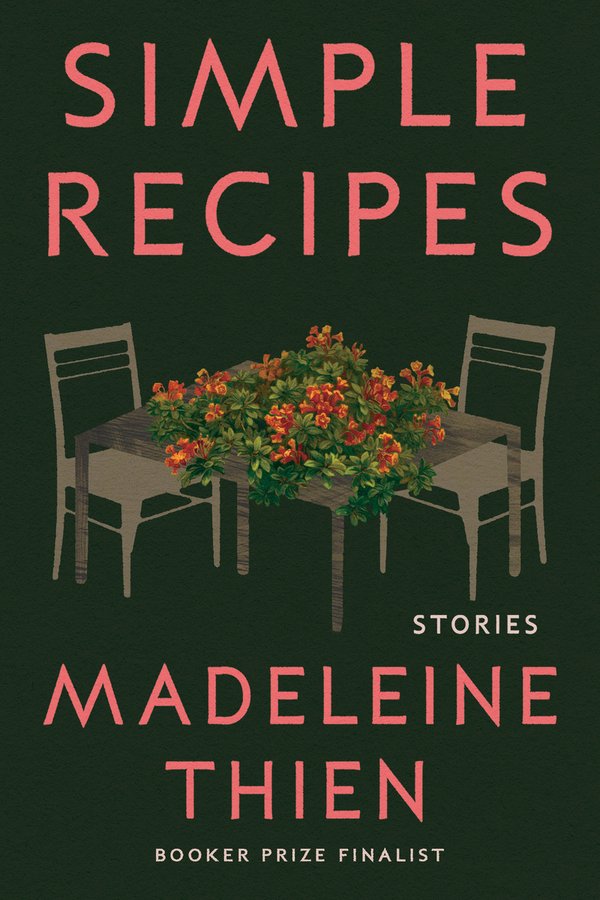
From Simple Recipes by Madeleine Thien. Copyright © 2026 by Madeleine Thien. Used with permission of the publisher, W. W. Norton & Company, Inc. All rights reserved.