
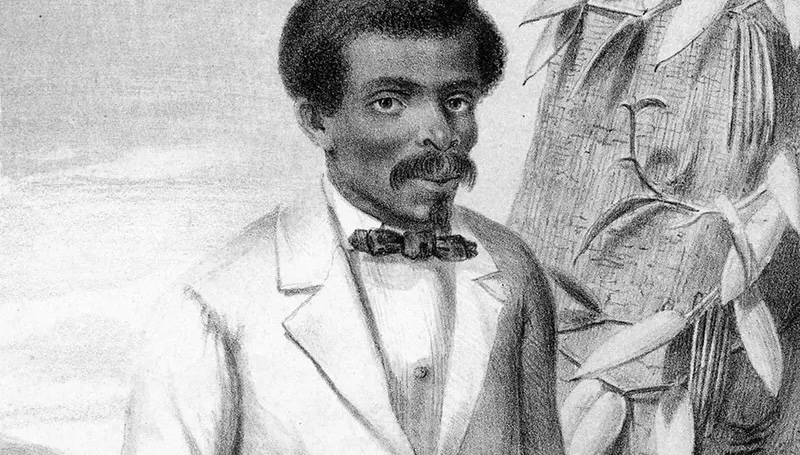
Ferréol Bellier-Beaumont recounts the 1841 eureka moment—when a vanilla plant was first manually pollinated—as follows:
One day as I walked with my faithful companion, I noticed that my only vanilla plant had produced a […] bean. I expressed surprise and brought it to his attention. He told me he had pollinated the flower. I refused to believe him and walked on. But two or three days later, I saw a second pod growing near the first. He then repeated his assertion. I asked him how he had done it. He proceeded to execute the operation that everyone now does. The intelligent child had been able to discern, in a same flower, the male and female organs, and put them properly in contact with one another.
Using a needle or a toothpick, Edmond had successfully placed the two organs in contact, in a gesture that has since become second nature to vanilla growers around the world. If the withered flower stayed attached to the extremity of the “embryo,” added Bellier-Beaumont, the operation had succeeded and ten months to a year later pods would grow. Subsequently, Edmond’s technique was rendered in simple sketches. Here was a transparent and simple method, rapidly achieved with the help of only a needle.
In a moment of revelation, the enslaved student used clear instructional tools to proudly show the technique to his master.
This relation of Edmond’s breakthrough elicits several observations. For one thing, Edmond had gone from Ferréol’s “favorite” to his “faithful companion.” What exactly did this mean? Megan Vaughan has suggested that on neighboring Isle of France, “small-scale slave ownership sometimes necessitated a degree of identification, even intimacy between master and slave.” The Beaumont estate met these conditions, with its modest number of bondage workers. However, as Vaughan goes on to show, “identification” did not necessarily foster compassion; if anything, it could be self-interested. And so, it should come as no surprise that the Bellier-Beaumont family never freed Edmond via manumission.
Next, Bellier-Beaumont’s testimony shows that Edmond’s method was in many respects the antithesis of Morren’s. Straightforward, transparent, and stage-based, it presented none of the Belgian’s elliptical, secretive language. Third, the power inversion contained in this moment was palpable: try as Ferréol Bellier-Beaumont might to suggest his pumpkins and candle bush had served as inspiration, Edmond’s discovery was not the fruit of Socratic dialogue. After all, Ferréol had initially refused to believe Edmond’s claim. In a moment of revelation, the enslaved student used clear instructional tools to proudly show the technique to his master.
Thereafter, Ferréol is said to have placed an announcement in a local newspaper explaining the method. However, his description proved too vague, and local planters came calling for greater details. Demand was such that Edmond went on tour, achieving something close to celebrity status. Bellier-Beaumont mentions that planters arranged for Edmond to visit their estates using “very comfortable” means of locomotion “to which he was not accustomed.” This was likely a horse-drawn carriage, or perhaps a sedan chair carried by fellow slaves. Edmond presented his pollination technique in person at several plantations, including those of Patu de Rosemond at Saint-Benoît, David de Floris at Saint-André, Joseph Desbassayns at Sainte-Suzanne, and Mr. Vinet at Sainte-Marie. One can imagine the reactions of audience members and especially enslaved onlookers, overhearing one of their own arriving by carriage before delivering a lecture on how to pollinate a recently introduced flower before local dignitaries and gardeners alike. They must have been transfixed. This was more than breaking a glass ceiling; it was straining the shackles of slavery, shaking its very foundations.
Although Edmond’s story is unique, for enslaved people to possess botanical knowledge was not. On Bourbon, maroons discovered the medicinal properties of many highland plants, some of which retain Malagasy names today, and shared their knowledge with those still enslaved. In the Americas, many a plant varietal was introduced by enslaved Africans, and some of them managed to continue independent production of such crops. Also in the Western Hemisphere, enslaved Africans’ proficiency at herbalism fused with Indigenous American knowledge to generate rich homeopathic cultures. The enslaved both prospected for remedies and conducted experimentation. Forms of slave knowledge, overlaid on Indigenous ones, were influential in treating dysentery and elaborating antidotes for poisonings. Such treatments, in turn, circulated between islands and continents, including between rival colonial empires. Enslaved women were often their carriers.
Some enslaved people not only made medical-botanical breakthroughs but also received recognition for their work. Such was the case with Quassie in eighteenth-century Suriname. Informed in part by dialogue with Indigenous healers, he discovered the fever-reducing properties of a local tree. By the 1740s, he was healing fellow slaves with a decoction derived from its bark. Over time, whites began adopting the remedy, and in 1753, the eminent Swedish naturalist Carl Linnaeus named the tree Quassia amara. Quassie eventually gained freedom not on the basis of his discovery but for helping the colonial authorities track down maroons.
Back in the Indian Ocean, on Isle of France in the 1770s, the king’s intendant Pierre Poivre entrusted the enslaved Bengali Charles Rama with the post of head gardener at his jardin d’acclimatation. Poivre especially appreciated Rama’s mastery of nutmeg, which he considered to be unrivaled among Europeans. According to Dorit Brixius, this reflected a growing “creolization of expertise” in the Mascarenes.
This was more than breaking a glass ceiling; it was straining the shackles of slavery, shaking its very foundations.
Even closer to home, on Bourbon, one finds other examples of specialized enslaved botanists. Thus, in 1791, planter Joseph Hubert assigned the task of protecting a clove tree to one of his enslaved gardeners, Jean-Louis. Seeing the commitment Jean-Louis showed defending the tree in the middle of a hurricane, Hubert decided to free him. The speech he delivered for Jean-Louis’s manumission on March 27, 1791, is worth quoting. He offered him a wage, adding, “I know you wish to stay in my garden. I, too, hope that you won’t abandon the care of the precious plantations that you and I have raised together, and which are our children.” He then credited Pierre Poivre and Poivre’s spouse with his decision to manumit. To Pierre Poivre he owed the cloves and other spices he cultivated, which the famed intendant had brought to Isle of France. To his widow, he owed a portrait of said Pierre Poivre, “a gift which prompted my decision to move forward the moment of your manumission.” Rarely are motivations so clearly attributed in such cases. Poivre’s philosophy, merging Enlightenment ideals with an environmental sensibility and a commitment to ending slavery, had been the main movers in this case. So, too, was a kind of botanical fraternity.
Edmond’s story does not exactly match those of Rama, Quassie, or Jean-Louis. His discovery was not strictly medical, although vanilla was used for some treatments. He did not bring knowhow to Bourbon from afar, nor did he benefit from Indigenous knowledge, nor was he freed for his achievement. The vine he pollinated was exogenous to Bourbon, as were people for that matter, as the previously uninhabited island was first visited only in 1613 and the initial French settlement attempts occurred in 1638, only two centuries before Edmond’s discovery. Yet Edmond’s invention helped transform the vanilla economy, taking it from a niche Mexican spice to a global commodity. Still, the concept of the creolization of expertise is useful for thinking about Edmond. Based on the available evidence, it would seem that he combined the botanical skills he learned from Ferréol Bellier-Beaumont with practical experiments on his estate and supplemented this with herbal and agricultural knowledge he gained through oral transmission.
Unlike Joseph Hubert with Jean-Louis, neither Ferréol Bellier-Beaumont nor his sister ever freed Edmond. One can speculate that they did not want to lose one of the small number of enslaved laborers they had or that they may have turned a profit off of Edmond’s local notoriety, perhaps charging a fee for his presentations to other planters. But this is little more than an educated guess. What we know for certain is that Edmond gained liberty through the second and final abolition of slavery pronounced in Paris by the Second Republic in 1848. The renamed isle of Réunion, definitively shedding its royal connection to the Bourbons, received a new lead official, General Commissioner to the Republic Joseph Sarda Garriga. On October 18, 1848, he published the earlier decrees of April 27, 1848, abolishing slavery once and for all in French colonies. One local newspaper that ran the proclamation still featured a suddenly obsolete ad to rent out fifteen enslaved workers.
____________________________

From Vanilla: The History of an Extraordinary Bean by Eric T. Jennings. Copyright © 2026. Available from Yale University Press. Vanilla: The History of an Extraordinary Bean has been shortlisted for the 2026 Cundill History Prize.