If I could have been a dancer, a genuine dancer, beyond those years at St. Mark’s, I probably would have chosen that path. Yet my gifts weren’t that grand, and my strong drive reached beyond mere motion. In college I danced among many other pursuits, and by the time I reached twenty-two my body—never skinny, yet sturdy, expressive, and elegant—had begun to drift away from that possible life.
Or so my memory suggests; a long-ago exchange with a college friend hinted at something different. Through my mid-twenties, as I hopped between cities for work and study, I found a dance world wherever I happened to be. I would stretch the truth about my age, presenting myself as a late teenager so I could tackle the demanding classes in professional programs. The last stint was in Philadelphia at the Philadanco school, where I was fortunate to study with renowned teachers Denise Jefferson and Milton Myers, and Jimmy Truitte. Mr. Truitte stood among the early advocates of the Horton technique, a method that felt alive and vital in the choreographies and teaching of my beloved company, Alvin Ailey, and one that matched my body’s strengths far better than ballet or Graham did.
We accumulate countless words in our minds early on, and writing becomes a deep-sea expedition to recover them.
The other classical systems were readily accessible for study. Honest self-scrutiny is essential for any artist, and dance taught me that candor—the cool, unflinching ability to evaluate my strengths and weaknesses—was indispensable. I possessed strength and suppleness, especially in my back. My feet were not remarkable, merely adequate. I demonstrated fine extension. Turnout was average, and my hips were a touch rigid. I was a high jumper and a wide leaper; I loved covering ground. My feet could be precise, but they weren’t particularly quick. There is simply no point in pretending otherwise.
The life of writing did eventually take over, and it proved to be the right path, and the years rolled on, and the dance life faded. I pondered my dance life often when I became a mother, at ages thirty-five and thirty-seven. It wasn’t easy—why should anything so mighty be effortless?—yet it proved efficient. I heard Mary Craighill’s voice: “Being a dancer makes for the best preparation for natural childbirth. You learn to ride the waves of pain, and you know how to breathe.”
I absorbed many lessons during my dance studies that carry over to the craft of poetry and to the life of a poet. I have reflected on how bending the body to music in dance relates to the way we shape words on the page to fashion music. I have counted countless beats in the studio so often that I feel I do it without thinking. The worn wooden floor of the studio is a stark, literal link to poetic form. It is an austere stage on which anything can be formed. In a rectilinear space, curves and patterns emerge. The studio is, in essence, the blank page. When it is empty of bodies or words, we begin again from scratch.
The discipline of dance is a daily commitment. Each morning, or each day, you prepare the body for what lies ahead and invite the day’s possibilities. You perform your rituals with care, and the accumulation of days becomes weeks, months, and years, all forging a technique that will be refined daily, coaxed daily, welcomed with a familiar sequence of movements. There is no substitute for today’s work. There is no workaround. Dance taught me, in short, the discipline that underpins any art. The simple routines—the five positions, the same exercises repeated so the body can move, bend, shape itself, speak, and even take flight—remain irreplaceable.
I can still feel the sharp pressure of Mary Craighill’s finger against the small of my back, guiding me to straighten and align, or Cara Gargano’s brisk pinching of my glutes, whispering in my ear, “Tighter,” as she moves around the room, eyes taking in every detail, always noticing something. Engage your center. Lengthen your spine. Relax the pelvis but don’t collapse it. Lengthen. That is how you align your back and achieve a beautiful line. That is also how I smooth the kinks out of a poem’s line. My body remembers doing so many things. We accumulate countless words in our brains early on, and writing becomes a deep-sea expedition to recover them.
And a teacher’s touch is essential to teach you.
In this second spring, you can do anything, she said.
From dance, I learned to be ruthlessly self-critical. The sharp, correcting gaze in dance class—lingering, precise—tells you exactly what to fix. Left foot must not be angled; hips must shift to the right; soften your hands, unclench your jaw. Tilt the head slightly; straighten the knee completely. And then there are the exhortations to reach, to pull, to turn, to twist, to tuck, to scoop. Even though we may share lessons in poetry workshops, the scrutiny for a poem must come from one’s own inner eye. Any guidance must originate from within.
There is technique, and there is movement. Once the body has learned its function, it must travel through space, not merely stringing steps together. The essential question remains: what distinguishes steps from dancing? Dance teaches how to shift direction suddenly while preserving integrity and poise, how to alter pace, how to build speed, and how to stop with precision. There is a careful estimation and calibration involved in moving along a circle that is truly a circle, following a strict boundary, how to sense that line and design. Once the poet has practiced these craft elements, then she must sing.
Every motion originates from a solid core. Even if the center isn’t visible, it must exist. Even if the poem veers off-center or remains unconventional, there must be a center, because “eccentric” describes leaning away from the axis or deviating from the center.
No shortcuts. There was no room for bending the rules in dance class. No shortcuts. The same holds for poems. For me, dancers stand as noble exemplars of an artist’s life. What does it mean to do the work without expecting compensation that matches the effort? The most demanding, the most exquisite, the toughest, the luckiest, the most gritty, the most glamorous. The prima ballerina receives bouquets and bows, yet offstage her feet bleed inside pointe shoes that are often discarded after a single performance because they’ve worn through. Not just the feet: everything sacrificed to make art. It isn’t easy to pursue this path. And it remains a privilege.
It is the stern, unvarnished honesty of studying dance that has given me the most. It is a value I carry into my life and my work: the truth of the poem in its form—that is, does it cleanly reach its fullest possibility? How can that be measured? And then, the inner honesty of what is spoken within, not necessarily every tiny detail mirroring the life that inspired it, but the profound truth of art that seeks the unpaved road.
Soon after visiting my friend, I returned to a ballet class for the first time in twenty-five years. The Chinese acupuncturist I saw regularly (for the hip worry, that old dance injury, as I like to phrase it, even though I don’t love the injury) was delighted by my return. She told me I was entering my second spring, a stage in a woman’s mid to late forties when one can feel almost like a younger version of herself, but with wisdom and restraint. In second spring, she claimed, you can accomplish anything.
The work waits for you every morning.
My college friend, who battled cancer, had been a nationally ranked fencer at forty-seven; now in her sixties, she remains a nationally ranked fencer. She never relinquished the dream of her body, never turned away from what it knew and excelled at. She fences with a handful of antique Chinese gold bracelets on her wrists, and with each movement she creates a musical phrase.
Middle age sits as a doorway you did not choose, an unforced crossing of an invisible midpoint, waiting for something to drop. Yet it also offers a chance to remember, fruitfully, who you were and who you are becoming, the selves threading into one another, like beads on a string, one after another.
When my children were roughly seven and eight, we climbed a mountain in Maine—not a colossal peak, but monumental to me. Just below the summit, I turned to look back at the approach we had left, and I saw a drop as if a sheer cliff lay ahead. A shudder went through me; fear rose. I fought to go forward, to hold myself together in front of my young sons, but I could not. I turned away and descended instead. I was terribly disappointed in myself. I asked where my courage had gone, where it resided, and why I could not summon it. I was not afraid that my body would fail me; I was simply afraid.
No words came. No words at all.
And then I considered that the courage we possess does not reveal itself in every act we undertake. Perhaps the physical bravery I once carried—when I danced daily, stepping into the unknown, beyond pain, beyond shame, beyond certainty, beyond even my own limits—exists somewhere else as well. It may not appear in mountain climbing, yet it lives in other aspects of my life where I am strong and surprised by what I can do.
Part of that courage lives in my writing, both in the act of creating art and in the work that results from it. A courage that does not seek the limelight but grows from hard, truthful labor.
Even the most modest gesture can be beautiful, a moment to express, a moment to stand tall.
The work waits for you every morning.
The body harbors far more knowledge than it can articulate.
In middle age, you begin to discern the patterns formed before the midpoint, and ahead lies not only the sum but something else as well.
__________________________________
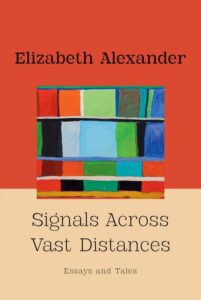
Excerpted from Signals Across Vast Distances: Essays and Tales. Copyright (c) 2026 by Elizabeth Alexander. With permission of the publisher, W. W. Norton & Company, Inc. All rights reserved.