

The fires began with a gentle Midwestern boy who loved animals. Kevin Tubbs grew up in a comfortable suburb outside Omaha, Nebraska, in a canary-yellow ranch house filled with dogs. Tubbs’s mother, a tender-hearted woman given to long spells of depression, had a soft spot for strays. Within the home, the dogs were indulged to an unusual degree, holding status as nearly full members of the family. Once, when Tubbs was thirteen, he became alarmed at how a neighbor was treating his own dog, a Siberian husky. The animal, fizzing with the inexhaustible energy of a creature bred for hauling chockablock toboggans, was confined to a tiny pen, a mere twenty feet square, behind the neighbor’s trailer. For hours every day, the husky, howling piteously, would try in vain to leap the walls of his prison.
One night, overwhelmed by the animal’s cries, Tubbs slipped from his home, crept into the neighbor’s yard, and opened the pen’s gate for the suffering creature. Under a dull moon, he led the dog across town, entrusted it to a trusted friend, then returned to his bed. As with much of what would later be labeled domestic terrorism by the federal government, Tubbs did not see his act as political so much as a straightforward moral duty: a living being was hurting, and it was within his power to intervene, so he did.
Before the family settled in Omaha in the 1960s, Tubbs’s parents had endured their own trials. His father, a professional soldier, had completed combat tours in Korea and Vietnam. In Korea, near the Chosin Reservoir, his marine division found itself hemmed in by a surprise assault mounted by a hundred thousand Chinese infantry. For more than two brutal weeks, as Siberian winds drove temperatures down to thirty degrees below zero Fahrenheit—so cold that the weapons froze—the battle claimed the lives of thirty thousand soldiers through bullets, artillery, or the merciless cold. Tubbs’s mother was German, born mere months after Germany’s defeat in World War II.
As a girl, she had walked the railroad tracks outside Frankfurt, gathering discarded coal to heat her family’s home. She met Tubbs’s father when he was stationed in Germany after his tour in Vietnam. In the feverish glow of love, she followed him back to Nebraska, where he was assigned to a local air force base. The base housed a crucial defense nerve center, a command bunker set deep into the loess, built to withstand a nuclear blast. Tubbs’s upbringing was quintessentially middle-class—meat on the table every night; prime rib on Sundays—but even as a child he sensed a looming, unspoken catastrophe on the horizon. He carried the sense of a ruined world perched on the edge of his consciousness.
Tubbs’s father stressed the value of obedience, while his mother warned that following rules could produce monsters. No wonder, then, that he grew up wanting to be both a soldier and a punk. He discovered that he relished discipline and order yet despised conformity, the cowardice of outsourcing one’s thinking to others. He distrusted the government, loathed Reagan and the suburbs, yet after college planned to enlist in the Marines. Tubbs was the kind of stubborn teenager who would head home from ROTC, where he served as cadet first sergeant, at exactly the speed limit while blasting Minor Threat. The contradictions didn’t trouble him. To him, both paths represented a fidelity to principles, a commitment to something larger than oneself, a defense of the vulnerable—two righteous armies marching under different banners.
Tubbs was haunted by a fear that nothing he did was making any real difference, that he was pantomiming elaborate gestures of futility—engaging in just theatrical resistance.
When Tubbs was seventeen, a turn in his life arrived via a page in the Utne Reader. An advertisement from the National Anti-Vivisection Society caught his eye, and he wrote for a pamphlet to learn more about vivisection. The material was stark: animals routinely subjected to brutal procedures in the name of science. He soon subscribed to the society’s quarterly journal, then The Animals Voice, a glossy periodical dedicated to animal rights. Its graphic images—rats cut open, dogs with their faces sliced, monkeys howling under electrodes—seemed like windows into a nightmare.
Tubbs reached a conclusion: animals experienced happiness, sorrow, fear, excitement, perhaps even affection. If that was true, why was it permissible to harm them? Why harm any creature? The revelation that brutality occurred in laboratories, circuses, and on farms struck him as tearing back a curtain he hadn’t known existed. He lived in a city that was a major center for beef production. The scent of cattle—their dung, the lush mix of grass and hay—drifted in on the prairie winds, and at times he imagined he could even hear a distant bovine chorus. He learned that cows mourned when separated from their calves, and he realized the surrounding economy was built on an infrastructure of atrocity.
Tubbs did not welcome these revelations. He hated the slaughter, but even more the complacent indifference of neighbors who turned away from the carnage occurring right under their noses. No one around him seemed to share his concerns. He felt isolated, a sense of dissonant pity, and he faced a grim choice: retreat into a comforting illusion, collapse in despair, or take action.
Tubbs’s plan to imitate his father’s military dream faded as a new sense of purpose—saving animals—took hold. Yet as he started college in a rural area, a newly minted vegan among big-game hunters, there seemed little chance to translate his beliefs into action beyond scouring the local supermarkets for tofu. During his junior year, he swapped cornfields for redwoods, transferring through an exchange program to Humboldt State in California, a campus he knew mainly because it was near San Francisco—famed as a home for the Dead Kennedys—and presumably offered better vegetarian fare than Nebraska. At Humboldt, he encountered political organizing and the pleasures of potent marijuana. He joined the campus animal-rights group and began attending protests at fur shops, slaughterhouses, and McDonald’s. Some evenings, he and new friends watched grainy videotapes of animal “liberations”—sneak-into-labs operations where masked activists freed dogs used in beauty-product testing—fed around as samizdat by fellow activists. Tubbs felt prompted by these stories: that was the path he wanted to walk. Yet the idea of breaking the law outright unsettled him.
As he absorbed more books, magazines, and bulletins, Tubbs came to see that the cruelty toward animals did not exist in isolation; it was entangled with broader ecological destruction. The hamburgers people ate came at the expense of rainforest biodiversity, cleared to make room for pasture. Those forests, in turn, played a pivotal role in absorbing human-made carbon emissions, a factor in climate change that scientists described as global warming. Everything was interconnected. In his spare moments, Tubbs wandered the coastal redwoods surrounding the county, marveling at the ancient trees—some older than two millennia—standing as monuments to humanity’s own insignificance in the grand scheme of life on Earth.
Back in Omaha, Tubbs devoted himself fully to activism. He sued his college town to block local crows from being shot, and in Des Moines he was arrested for running through the Iowa Cattlemen’s Association in a cow costume, while a friend chased him with a cleaver. (Theater, he admitted, was one of his guilty pleasures: the week his father died, 1990, he played Giles Corey, crushed for resisting the Salem witch trials, in a college production of The Crucible.)
After graduating, Tubbs took a starvation-wwage internship with PETA in Washington, DC—his dream employer—where he hosted a public-information booth on the National Mall with his girlfriend, another intern, handing out brochures to visitors that condemned GM for using live pigs in crash tests. Weekends found him jailed for acts of civil disobedience against cosmetic companies who tested products on animals. While illegal, Tubbs saw such episodes as technical infractions rather than crimes against humanity. But PETA lacked deep pockets, and many people seemed to dismiss him as a minor irritant rather than a force for change. The fear that his work might be futile persisted.
As the internship came to a close, Tubbs applied for a position as assistant editor at Earth First! Journal, a radical environmental newsletter produced in Eugene, Oregon. Earth First! was a scrappy, grassroots outfit formed in the early 1980s to advocate more confrontational tactics than those used by mainstream groups. The Journal blended sharp editorials with field reports on environmental clashes around the world. Its contributors appeared to be fighting a frontline war for the planet, far from the reach of Washington, DC. His application—a cover letter accompanied by a criminal record—was accepted immediately. Tubbs and his girlfriend packed the essentials, along with Pujo, their beagle-pitt bull mix, into a station wagon and headed west to seek a more ethical home.
*
Long before Eugene became synonymous with radical politics, it was a timber town. Nestled at the southern edge of the Willamette River valley, the region’s natural wealth drew settlers in the mid-1800s. Many, like Tubbs, were Midwestern refugees, weary of droughts and heavy locust swarms. After displacing many Kalapuya people—pushing them to coastal reservations—and carving rail lines through the Cascades, white settlers opened the forests to heavy logging. The logs were moved to Eugene for processing or floated on the Willamette to Portland, chained as massive rafts.
After World War II, demand for wood-framed houses surged, and roughly half of the county’s workforce was tied to the timber industry—the Oregonian described it as “the wheel which sets all other wheels in motion.” This prosperity would become fuel for critique in later decades. The 1960s brought a boom of youthful dissent, with antiwar protesters splashing blood on recruiters and firebombing the local armory. By the early 1990s, Eugene had earned a reputation for its progressive irreverence, drawing a diverse group of misfits, oddballs, and independent thinkers.
The Earth First! Journal had moved to Eugene in 1993, placing Tubbs in a cement-heavy trailer on the edge of the Whiteaker neighborhood, just outside downtown, where he found himself in the core of a radical fringe. The Whiteaker was a melting pot of hardcore activists, rebellious students, aging hippies, utopian technophiles, guerrilla gardeners, avant-garde artisans, drifting musicians, militant social workers, hard-partying addicts, crust-punk rebels, and a broad spectrum of left-wing opinion, all huddled in an informal network of shabby houses and cluttered bungalows.
Yet, beneath a broad array of misfits, the social world could still be divided into two camps: us and them. The rest of the United States appeared content with rising stock prices, the country’s post–Cold War aura as the world’s sole superpower, and the influx of inexpensive goods from Mexico under new free-trade deals. But among Eugene’s radicals, success carried a sting, born of the belief that every American victory came at someone else’s expense—often someone who didn’t get to celebrate it.
To resist established authority, the Whiteaker produced its own eclectic counterculture. Tubbs could tune into Radio Free Cascadia, a pirate station that spanned from acid jazz to whispered erotic chatter, from Cuba-aligned dispatches to readings by philosopher John Zerzan—who famously lived without wage work and survived by selling his own blood plasma. Much of the social fabric revolved around demonstrations, with friends gathering on weekends to march, blockade, or climb trees in defense of any urgent cause. In the streets, camouflaged anarchists would clash with police on a regular basis. A tongue-in-cheek sign at a local cafe tracked the mood of the police presence from “ominously quiet” to “omnipresent (carry rocks)” to “fully stirred (fight back),” while on Wednesdays a nearby bar hosted rambunctious screenings of Cascadia Alive!, a public-access show replaying footage of the day’s clashes.
Economically, Eugene wore a perpetual gray cloak: damp air, overcast skies, and a roiling sense of rebellious possibility—a romantic, lawless glow that felt like a rite of passage for young people convinced they could topple the system. Tubbs happily embraced vegan cuisine, which, to his delight, tasted good, and there thrived a thriving ecosystem of left-wing, small-press zines with titles such as Live Wild or Die! and The Black-Clad Messenger. From the moment he arrived, Eugene felt more like home than any place he had known in Nebraska.
The Earth First! Journal paidTubbs a modest stipend, and he filled gaps by scavenging from dumpsters. One day, after salvaging a trunkful of bananas on the verge of spoiling, he drove them to Food Not Bombs, an anti-capitalist soup kitchen built on mutual-aid principles. There he encountered a striking volunteer, Jacob Ferguson. Even in this bohemian enclave, Ferguson stood out: a man who looked like a postapocalyptic pirate, his ropey frame clad in ragged black attire, long dark hair bound in a nest of dreadlocks, tattoos everywhere, including a crown tattoo that bore a bizarre birth defect—a calcium deposit shaped like a devilish horn on the top of his skull. Yet his face was gentle and attractive.
Curious about this odd, formidable figure, Tubbs struck up a conversation. Ferguson was new to the city as well, having spent the past year rebounding from a heroin habit by embracing activism with his pregnant partner. When not volunteering or attending demonstrations, Ferguson cooled down by playing guitar in his speed-metal band, Eat Shit Fuckface.
Tubbs saw in Ferguson the exact opposite of himself in almost every way: Tubbs grew up in comfort under a stern father, while Ferguson had spent much of his childhood in poverty, watching his father—a petty thief and drug user—rotate in and out of prison with tattoed forearms boasting “crystals” and “pistols.” Tubbs was cautious and deliberate; Ferguson, daring and spontaneous. Tubbs still considered himself a rule follower, instinctively giving police their space, while Ferguson treated the entire system as rigged and accorded no respect to authority, hating cops with a passion. Yet Ferguson was also sharp, funny, and incredibly magnetic, and behind his rugged surface lay a shared commitment to hard work and unconventional thinking. More importantly, Tubbs could sense in Ferguson a counterpart who could help him become part of something larger than himself. Ferguson admired Tubbs’s steady, serious demeanor, like a professional in his prime.
The two unlikely comrades soon became inseparable, forging a bond akin to long-lost brothers. They began coordinating dumpster dives and making forays into the surrounding forests. East of Eugene, the land untwists into a near-primal expanse, with millions of acres of ancient forest spreading across the Cascades—primarily cedar, red hemlock, and Douglas fir, towering so high they could brush the sky. Jacob Ferguson, in particular, heard the forest’s call. He relished stepping outside civilization, shedding all ties to the synthetic world, and feeling humanity’s footprint slip away. Fueled by a desire to protect this Arcadia, Tubbs and Ferguson would soon team up for a major political demonstration that would set them on a perilous new path.
*
In 1991, an unknown arsonist damaged a portion of the Willamette National Forest. The fire burned for two weeks, laying waste to nearly nine thousand acres of firs near Eugene. No suspects were named, but activists pointed a guilty finger at the timber industry. Most old-growth forest remained protected from logging, yet federal law allowed salvage rights on partially burned patches. After the fire, logging companies petitioned the U.S. Forest Service to clear the salvageable timber. Activists pressured a court to block the sale. Then in 1995, President Bill Clinton signed legislation that lifted protections on the Willamette and hundreds of other forests, opening them to new logging.
Everywhere Tubbs looked, the Earth was being turned into a landfill and God’s little creatures were having their skulls split.
The Willamette forest stood at a crossroads where the natural world collided with capitalism. Logging and wood products remained Oregon’s largest manufactured exports. Of the United States’ 156 national forests, the Willamette had long been its most productive, delivering nearly a billion board feet of timber each year. For activists, the term old growth denoted more than a forest’s age; it described a vast, intricate network of plant, animal, and fungal communities that had evolved in a finely tuned balance over ten thousand years. By the early 1990s, about 90 percent of the Willamette’s old-growth had already been harvested, leaving behind a stark question: was old growth sustainable, or was it sacred? The Clinton administration’s policy shift felt like an ultimate insult to the Willamette’s champions.
Dozens of determined activists, including Kevin Tubbs and Jacob Ferguson, took to the mountains to defend the wilderness against the combined might of the timber industry and federal authorities. Whenever a logging truck or a road grader approached the ancient trees, the protesters would block the path, chaining themselves to barrels filled with concrete and reinforced by rebar—stolen by Ferguson from nearby construction sites. As the campaign intensified, the protesters established a small settlement near Warner Creek, digging trenches, building a wooden fort with a moat, a palisade made from discarded log ends, a watchtower, a functioning drawbridge, and even a stream-fed bathtub and shower. They named their encampment the Cascadia Free State, a sovereign enclave that pledged obedience to the laws of nature above all else.
Video footage from the occupation shows Tubbs and his steadfast dog Pujo perched atop a twenty-foot platform, a delicate balance maintained by two long poles and a couple of hefty cables. The bipod was a clever act of rebellion: a single nudge could topple the entire contraption, sending Tubbs and his canine companion plummeting to the ground. The platform had been designed by a fellow protester with engineering know-how, a full-time worker who, on weekends, would drive six hours from Seattle to deliver groceries to the encampment—Joseph Dibee.
Living on donations and braving a brutal winter that blanketed their tents in snow, the Warner Creek holdouts drew closer, sharing joints and tall tales around fires. A pair of activists even exchanged vows in a pagan ceremony and welcomed their first child. At one point, Ferguson—who had been a high school varsity basketball player—arranged a five-on-five street-ball game against the teenage children of local loggers, the activists narrowly losing by a margin of four points.
Finally, in August 1996, after nearly a year of occupation, the Clinton administration relented, tightening restrictions on logging in national forests. The Willamette was spared. The activists, wary of a trap, remained put. Forest Service officers arrived in force, detaining the protesters in handcuffs, and the camp was bulldozed.
For many involved, Warner Creek marked a turning point—a hard-won victory that proved it was possible to confront both a powerful industry and the federal government and win, even momentarily. Yet for Tubbs, the sense of triumph felt hollow. Dozens of people had lived in the woods for months, endured hunger and cold, and what had been achieved? A few thousand acres of forest saved, only to be adjudged again by the next administration. He hoped the ideas would spread, but the movement’s numbers were small. The broader catastrophe—ecological decay and the slaughter of countless animals—loomed larger than any single victory. Everywhere Tubbs looked, the Earth was being turned into a landfill and God’s little creatures were having their skulls split.
The campaign’s win did little to reshape the larger war. Tubbs, now twenty-six, had devoted nearly a decade to political action—letter-writing, leafleting, canvassing, tabling, teach-ins, lawsuits, occupations, boycotts, vigils, pickets, rallies, and even guerrilla street theater. Yet, when he stepped back to survey the impact of his life, the effect felt frustratingly minimal. What other choices did he have?
*
A few months after Warner Creek’s so-called emancipation, the Earth First! Journal received a cryptic letter from abroad. Stamped from the United Kingdom and unsigned, it carried the signature of a shadowy movement that had begun to circulate in activist circles—the Earth Liberation Front. For years, ELF rumors had circulated in whispers: a loose network of autonomous “cells” wedded to aggressive environmental vandalism. ELF lore claimed inspiration from Europe’s mythical “little people”—the fairies, gnomes, and goblins that supposedly carried out mischief under the cover of night. The first ELF cell appeared in Brighton in 1992, where they attacked equipment belonging to a firm accused of harming peat bogs. Soon after, other cells sprouted across Europe and Canada. Now, for the first time, the ELF signaled its intention to expand into the United States.
The letter—reprinted in full by the Journal—urged readers to rise and physically destroy any infrastructure that damaged the Earth, from lumberyards to whaling fleets to waste dumps. Those who polluted the planet should “bear witness to some of the most destructive eco-sabotage and criminal damage ever seen”—though the authors stressed that the violence should be directed at property, not people. But the central message was unmistakable: the environmental movement could no longer be content with lawsuits and sit-ins. The Earth’s aggressors would now face a stark ultimatum: abandon their harmful practices or face the consequences at the hands of the Elves. Kevin Tubbs, a man whose soul brimmed with love for animals and the world that nurtured them, reread the letter, again and again, until it carved itself into his memory.
____________________________
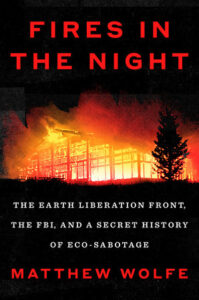
From Fires in the Night: The Earth Liberation Front, the FBI, and a Secret History of Eco-Sabotage by Matthew Wolfe. Published by Viking, an imprint of Penguin Publishing Group, a division of Penguin Random House, LLC. Copyright © 2026 by Matthew Wolfe.