
This first appeared in Lit Hub’s Craft of Writing newsletter—sign up here.
My grandmother lives with dementia. I could claim that her grasp on reality wobbles, but that would misrepresent things. Rather, her sense of reality seems liberated from conventional notions of time and place. When she looks at me, she recognizes me, and she recognizes my mother. She recalls that I am married and then wonders when I will wed. She reaches for my hand, and upon contact, she cries out that my skin feels “so cold.” A moment later, she reaches for my hand again.
From early on, my life has been shaped by people who seem to hold the world loosely in their hands. At my other grandmother’s funeral, my uncle filled the room with memories so vivid they bordered on the fantastical—stories of his birth, told with a gleam in his eye. The principal at my Christian high school regularly traced world events—terrorist attacks, the rise or fall of presidents, the price of gas—to covert spiritual warfare. When I was thirteen, I worried about being stalked by a demon, and when I told the woman who ran my Bible study about it, she didn’t reassure me; she began to pray.
Whether or not my background is typical, I suspect a common thread: a fragile relationship to what lies beyond the self. In fact, it may be almost inevitable. A host of forces—religious fervor, drug trips, the aging process—can dislodge a person’s mind and spirit. So what do we mean when we, partisans of the literary world, talk about realism? What qualifies as real?
What do we mean when we, the citizens of the literary world, use the term realism? What counts as real?
The question hit me most directly while I was crafting a story called “New Mercies,” which appears in my debut collection Please Don’t Touch the Body and was first published by the Kenyon Review. Through this piece, I aimed to explore dementia from inward and outward viewpoints. With that aim, I wrote a story in close third person, weaving together three overlapping perspectives and concluding with the perspective of the person experiencing dementia.
I modeled the first vantage point on a teen named Kori. In the narrative, she volunteers at a retirement home, hoping to atone for her perceived sins by teaching residents about poetry:
Kori has never seen a fully exposed penis. Not in its entirety. Not without clothing and a tangle of hair. She has felt one, though. On one occasion. She sensed its tight energy beneath constricting underwear, pressing and strained. She explored its length with her fingers until a dark, damp mark appeared through the fabric, and she pulled her hand away, nauseated yet staring into a face she trusts. While she struggles with specifics, rights and wrongs, consent and refusal, a sense of conviction still pierces her. She faltered and caused another to stumble, too.
In this passage, Kori is uncertain and self-blaming, insisting that her own missteps somehow contributed to someone else’s harm. Her chapter adheres to the parameters of realism, even as her inner life is touched by religious guilt and confusion.
The second and third perspectives belong to the two people who attend Kori’s poetry session: Martha and Anne, lifelong partners. Martha’s portion confirms what we might have already sensed—that Anne is living with dementia and that her condition becomes most visible when she indulges in a fantasy about cloning Martha and Anne to extend their lives. We also learn that Martha is determined to shield Anne from any sign of decline. She bargains with the cosmos, convinced that if she can carry the lesson without Kori detecting Anne’s failing mind, then Anne will be well. When this fails, Martha is crushed:
There is no making sense of Anne’s speech, which reveals, in mere moments, how far Anne’s sense of reality has drifted. Yet Martha feels as though she herself must be the one losing it. She wants to push Anne from the room and close the door. She wants to cradle Anne’s head in her hands and press her curls to her lips. She wants to twist Anne’s neck, listen at her ears, and pull out the roots of her dementia. She wants Anne to stay as Anne.
Although Martha’s thoughts are clouded by her longing to undo the illness, her section remains grounded in the ordinary—the rhythms of daily life and the pressures of sustaining a relationship.
But in the third section, from Anne’s point of view, the boundaries between genres blur. Anne possesses an interior world that, while painful for Martha to witness, is nonetheless vivid. Through Anne, we shuttle in and out of the present alongside Martha and Kori, tracing their shared past and Anne’s fantasy of cloning. A glimpse reads:
Anne and Martha receive what’s theirs with a knock at the door and newborns left on their doormat, delivered as if by room service. Although Martha finally consents to the babies, Anne watches closely for her reaction. At first, Martha lowers her gaze, her hands covering her mouth. But once the babies cry, she reaches for them.
What appears as a hallucination when seen through Martha’s eyes becomes a veritable truth in Anne’s. The idea of cloning is real; the babies exist; and so does Anne’s longing for a future in which she and Martha are united.
Across Anne’s chapters, the veneer of realism doesn’t vanish because the narrative strategy shifts; rather, the commitment to the original approach remains steadfast. Ending with Anne’s dementia-distorted vantage, I hoped to resist elevating any single perspective above another and to invite readers to confront the friction between perspectives, accepting that reality isn’t a single, fixed thing.
I wonder what we gain by separating works of realism and surrealism, and what we lose.
While I wouldn’t call Anne’s portion strictly realism, I wonder what about her experience might not be real. Is realism tied only to minds untouched by illness or distortion, or at least not so altered that the mind becomes, as my grandmother’s is, unbound? It occurs to me that a novel drawn from my own childhood—with its demons, angels, and visions—would take on a surreal edge even while remaining faithful to the texture of daily life.
In composing this piece, I kept Franz Kafka’s The Metamorphosis in mind. Part allegory about a man transforming into a giant insect, part intimate portrayal of a person misunderstood by his family, the work pushes realism to its limits and asks us what we mean by truth. Consider, toward the end of the tale, Gregor’s attempt to reconnect with his family on a night when his sister plays the violin:
No one noticed him. The family was absorbed by the music. Gregor’s sister played with a pure, mournful beauty, her face angled as she followed the melody. He inched forward, keeping close to the floor so he might meet her gaze if the chance arose. Was he an animal if music could move him so profoundly? It seemed he was shown the path to nourishment he had longed for. He resolved to reach his sister, to tug at her skirt so she might enter his room with the violin, to be by her side as long as he lived; his startling appearance would have to serve some purpose—and he wanted to be at every door of his room to hiss and spit at any would-be attackers.
This passage straddles the line between realism and the surreal, beginning with the ambiguity of “no one noticed him,” an expression that could apply to a tiny insect or to a man who believes himself to be one, lurking unseen in the shadows. The line “Was he an animal if music could move him so?” further signals this double vision, and the final line—“he wanted to hiss and spit at the attackers”—presses the reader to oscillate between two images simultaneously: a distressed insect and a man who snarls and crawls in fear.
We are invited to dwell in the unease of uncertainty, or in holding two opposing truths at once. Without accepting Gregor’s skewed experience, The Metamorphosis would not be what it is: a story that is simultaneously about seeing mental illness from the outside and being trapped inside it—and, in another light, about the inevitable divide between one mind and another.
I’m not arguing that the notions of realism and surrealism have no use. They do, especially in discussions about our craft and, yes, in the marketplace. There are, of course, science-fiction and fantasy works that deliberately abandon our world—for example, N.K. Jemisin’s Broken Earth trilogy, Susanna Clarke’s Jonathan Strange & Mr Norrell, and Octavia E. Butler’s Kindred. Yet the line where realism ends is not fixed. Alarmingly, once we label one experience as “real” and another as “surreal,” we diminish the value of the latter experience.
I wonder what we gain by drawing strict boundaries between realism and surrealism, and what we lose in the process. Perhaps realism offers more reassurance than truth—a way for some readers to assert that their minds are stable, that reality can be spoken of in shared terms.
_______________________________________
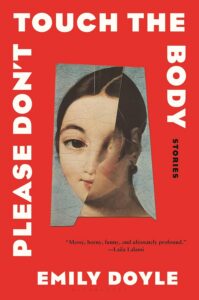
Please Don’t Touch the Body by Emily Doyle is available via Bloomsbury Publishing.