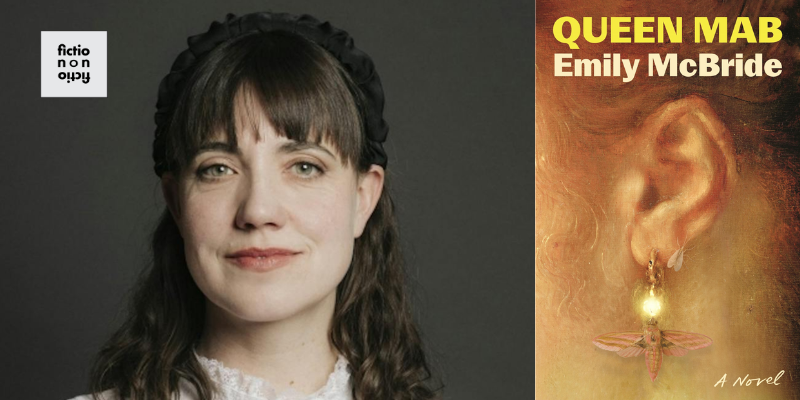
Fiction writer Emily McBride joins co-hosts V.V. Ganeshananthan and Whitney Terrell to discuss her debut novel, Queen Mab, and maternal mental health. McBride talks about the media frenzy around the trial of Lindsay Clancy, a Massachusetts woman charged with killing her three children, and considers how Clancy’s insanity defense has seized the public imagination, prompting new conversation about postpartum psychosis. McBride reflects on Queen Mab’s protagonist, a 23-year-old graduate student of Victorian and modernist literature, who struggles to bond with her baby and begins to fear that her child is a changeling. McBride explains the narrative shifts she uses to portray the character’s fluctuating reality and why literary allusions to changelings and fairies make sense in the context of the pressures of new motherhood. She also discusses how the most infamous “bad mothers” in folklore have skewed society’s perception of postnatal depression. She reads from Queen Mab.
To hear the full episode, subscribe through iTunes, Google Play, Stitcher, Spotify, or your favorite podcast app (include the forward slashes when searching). You can also listen by streaming from the player below. Check out video versions of our interviews on the Fiction/Non/Fiction Instagram account, the Fiction/Non/Fiction YouTube Channel, and our show website: https://www.fnfpodcast.net/ This podcast is produced by Whitney Terrell, V.V. Ganeshananthan, Emily Farris, Sydney Perkins, and Emma Ware.
Emily McBride
Queen Mab by Emily McBride
Others
Inferno by Catherine Cho • Lucky Jim by Kingsley Amis • Romeo and Juliet by Shakespeare • The Yellow Wallpaper by Charlotte Perkins Gilman • Madame Bovary by Gustave Flaubert • Medea by Euripides • Labyrinth (1986) dir. by Jim Henson • Cottingley Fairies: How Sherlock Holmes’s creator was fooled by hoax | BBC (2020)
EXCERPT FROM A CONVERSATION WITH EMILY MCBRIDE
V.V. Ganeshananthan: Madeleine’s backstory holds another layer in that she is adopted. She makes a fruitless effort to identify her birth parents, and that pursuit reshapes her bond with her mother Carol, a moment she voices aloud to her infant daughter. Could you speak a little about the function Carol serves within the novel?
Emily McBride: When I began writing this book, I was already a mother of two, and I noticed a broad discussion among people of my generation about motherhood—whether it’s something one chooses or something one feels compelled to do. I wanted to widen the lens to include other experiences and not just the choice to have children. So the book features characters who want children and don’t, those who don’t want children but do, those who don’t want children and don’t have them, and all the combinations in between.
And so Carol becomes the second face of the coin that is Madeleine. Carol, who cannot have children biologically, yearns for it and therefore idealizes the baby as something almost sacred, which puts her in conflict with Madeleine, who has naturally become a mother but discovers she cannot summon the maternal affection. Carol thus serves as a counterpoint to Madeleine and also offers another perspective on the world of different kinds of families and parenting.
Whitney Terrell: But doesn’t Carol tell Madeleine that, “It would have been okay, you could have had [a child] later, it wasn’t that big of a deal to me”? And that really makes Madeleine quite fierce. I think Madeleine says, “I had this baby for you.” At least in her head. Am I remembering that correctly?
EM: Yes, by the time the book begins, their communication has deteriorated, and Madeleine has read Carol’s longing for a continuing family as something more urgent. And later, Carol concedes that, “you know, maybe I said that after I’d had too much to drink at that funeral.” So the whole thing is a misunderstanding, and Madeleine takes it very hard.
WT: We’ve already touched on the medical and psychological underpinnings of postpartum depression and psychosis, but fairy tales and folklore went there long before psychology existed. The book’s title and Madeleine’s nickname, Queen Mab, reference a fairy named by Mercutio in Shakespeare’s Romeo and Juliet. Since this program explores literature and politics, could you talk about the role literature plays in this book and in Madeleine’s consciousness, and how the mind uses or crafts these fairy figures in the possible visions she has throughout the story?
EM: I was deeply drawn to how people of earlier eras understood the processes we continue to experience today. Changeling legends—inspired by fairy tales I encountered when I became a mother—felt like a partial explanation for some of the sensations I experienced: a trace of darkness, not fully recognizing either my new role or the child as something that belongs to me. Those feelings were temporary for me, but I’ve always been curious about how people interpret their own upheavals. In the past, there was folklore and faith; in modern times, science, and perhaps in some corners, superstition returns. Literature provides an intimate view into the minds of those who lived long ago. So the changeling motifs offer a kind of interpretive route for Madeleine, even if it isn’t a modern medical explanation; it supplies a narrative that helps her make sense of what she’s going through. She’s basically searching for a storyline that can explain her experience.
WT: Why does she feel detached from the child? Why doesn’t she experience the expected emotions?
EM: Exactly. Why is there an expectation that she should feel a certain way when her own experience doesn’t align with that?
WT: Did you yourself feel a similar, though milder, sense after giving birth?
EM: Yes. I tended to feel a carefully calibrated neutrality, almost like I didn’t feel anything, which is also a sign of postpartum depression. I only learned years later that this was what had happened to me. Madeleine’s experience is far more intense, and I wanted to push it to the edge to probe those kinds of emotions and the darker corners of this topic, including aspects that aren’t commonly discussed. I also shaped Madeleine as a literature scholar so she would gravitate toward explanations like changeling stories. In the end, that approach became a powerful way to examine how others have spoken about crises in life, especially given how little of classical literature focuses on motherhood specifically.
Of course, people have long written about other kinds of catastrophes, and Madeleine’s field is modernist studies. I found the modernists especially compelling because of their formal experimentation, which arose in reaction to the certainties fractured by the generation before them. They confronted the loss of religious authority following Darwin, the erosion of nature due to industrialization and mechanization, and the immense human cost of World War I. They produced literature in response to a world where meaning no longer fits the old framework. And while I’m not claiming that having a baby equals a war, I wanted to explore how you write about experiences when nothing makes sense anymore, when former certainties vanish and you no longer recognize what once existed.
Transcribed by Otter.ai. Condensed and edited by Sydney Perkins and Emily Farris. Photograph of Emily McBride by Silvia Poch.