
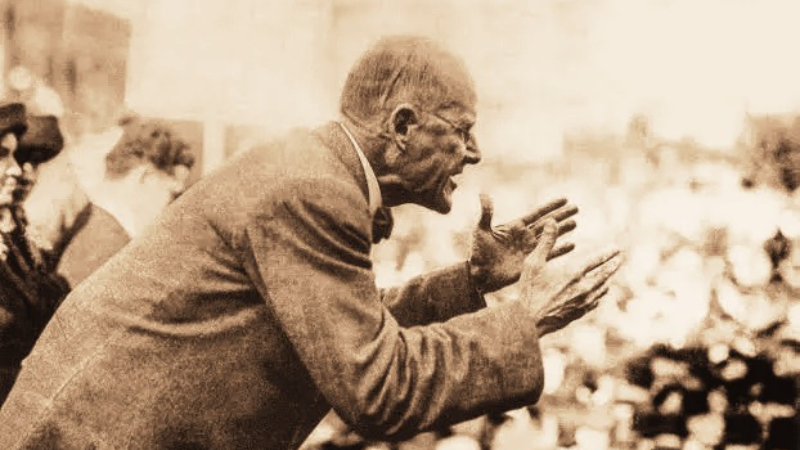
On a misty September morning in 1877, Eugene Victor Debs adjusted his collar and headed toward the Indiana State House. He was nearly twenty-two, a member of the Brotherhood of Locomotive Firemen for just over two and a half years. Yet that day he would deliver the opening address to the union’s national convention.
Horse-drawn wagons and carriages rolled through the downtown streets of Indianapolis, clacking on the cobblestones and scattering gravel as the smooth pavement gave way to rougher patches. Buildings ranged from richly ornate cast-iron façades to plain brick blocks; steam whistles blew from the rail lines toward Union Depot, the first in the country to funnel all train traffic into a single hub. Local leaders were thinking long-term here. Meatpacking was another major industry in the city, Kingan and Company’s enormous plant one of the world’s largest, its cutting-edge chilling system enabling year-round production in the era before refrigeration.
Their work was dirty and dangerous.
Indy wasn’t Chicago or St. Louis, not the sprawling Midwestern metropolises that boasted hundreds of thousands of people, but its 75,000 residents offered a smaller-scale picture of a nation rapidly industrializing. With all the opportunities and cruelties that entailed. The boom-and-bust cycle of capitalism had collapsed four years earlier in the Panic of 1873, an economic crash nearly as severe as the later Great Depression—and unemployment lingered in Indianapolis as elsewhere. Workers faced the threat of layoff and grudging wage cuts. Politicians answered calls for a public jobs program with novel punishments: fines for begging and a proposed workhouse where “all persons incapable of paying fines” would be compelled to smash stones to pave more city streets.
Soon, Debs would glimpse the Indiana State House come into view. A white wooden fence framed the tree-lined lawn— trunks slender as matchsticks, branches heavy with green leaves clinging to the season’s edge. The capitol’s dome rose above, a grand if crumbling structure of blue limestone and gray stuccoed columns modeled after the Greek Parthenon. Debs—affable and outgoing, a little over six feet tall, with a lean but sturdy frame—stepped into the capitol and climbed the stairs to the House of Representatives’ chamber on the upper floor, which the Brotherhood of Locomotive Firemen had borrowed for the gathering. He greeted his fellow delegates, who had shed their soot-caked overalls for suits and ties.
Their work remained grimy and perilous. Firemen shoveled coal into the locomotive’s firebox, a chamber prone to explosions. Each month, the firemen’s magazine carried somber notices of wedded wives, orphaned children, maimed railroaders. Derailments and crashes were everywhere. Railroad workers formed by far the largest group of industrial injuries in Gilded Age America: one count lists 56 percent of broken ribs, 50 percent of broken arms, 41 percent of broken legs, 71 percent of severed arms, and every case of amputated legs among the afflicted.
Nearly one in four railroad workers could expect to die on the job if they remained in the trade for thirty years; only coal mining rivaled it in danger. The work paid relatively well by contemporary standards, with veteran engineers often able to own their homes, but the shifts were long and irregular, stretching from twelve to twenty-four hours or more. “It is not uncommon,” one railroad worker observed, “for an engineer to go for nearly a week without sleep, except in fits on the road or while waiting at a branch or engine house.” Workers lived near the yards, knowing they could be summoned away for days or weeks. The priorities of their employers, not personal desires or collective needs, governed their lives.
Debs did not begrudge the railroad companies. If the job proved too perilous or exhausting, the hours too long, or the bosses too harsh, it fell to the workers to prove themselves worthy of greater respect. If they could do it—if they could renounce strikes and heavy drinking and defiant behavior, if they could live out the Brotherhood’s motto of “benevolence, sobriety, industry”—then the companies would treat them with the dignity they deserved and pay them fairly. He believed it could be so.
The story of Eugene V. Debs’s life is the story of one man’s radicalization—and of the country he helped radicalize in turn.
That summer, as far as Debs was concerned, the rail workers had done the opposite.
Exhausted by four long years of economic decline, railroad workers had walked off the job by the tens of thousands, from the East Coast to the Corn Belt, sparking hundreds of thousands more to join them in a nationwide strike. It was the first strike of its magnitude in American history. The government treated it as insurrection. President Rutherford B. Hayes dispatched federal troops and militias, who opened fire on protesters, triggering violence and widespread devastation of railway property—burned locomotives, smoldering roundhouses, tracks twisted into mangled heaps of metal. The central question of the Great Upheaval was whether the nation’s industrial growth would serve the workers who powered the engines and operated the looms, or whether it would crown a fresh generation of industrial barons who would monopolize wealth and power. “It is wrong to call this a strike,” one newspaper declared. “It is a labor revolution.”
And that was precisely what Debs—a fresh-faced twenty-one-year-old, earnest and respectable—did not want. After all, the very railroad companies that workers had struck against had granted the Brotherhood’s delegates complimentary transportation to their national convention. What clearer sign of the rail lines’ goodwill? What stronger proof of the merits of winning favor with employers?
So when Debs rose to address his fellow delegates that September morning—nervous perhaps, since he had been asked to fill in—he spoke with the voice of a young man playing the role of an elder statesman. “I would impress upon the minds of this assembly of firemen,” he said, “the duty we must perform with careful deliberation.”
He turned toward the philosophical. “A railroad,” he mused, “is the architect of progress, and through its magical power the uncultivated among us is lifted from ignorance and idleness.” Could protest also be an architect of progress? On that, Debs—future labor organizer, future democratic socialist—was unequivocal:
The question has often been asked: Does the Brotherhood encourage strikers? To this question we most emphatically answer: No, Brotherhood. To disregard the laws that govern our land? To destroy the last vestige of order? To stain our hands with the crimson blood of our fellow beings? We again say, No, a thousand times No.
The story of Eugene V. Debs’s life is the story of one man’s radicalization—and of the country he helped radicalize in turn.
Thirty-five years after that speech in Indianapolis, the socialist movement Debs led would claim footholds from Wisconsin to Washington and publish newspapers from Kansas to New York whose readership eclipsed many mainstream outlets. Perpetually on the road, he spoke in crowded labor halls and gatherings filled with men and women still bearing the odor of a twelve-hour day. He had become a labor activist whom workers treated as one of their own. Oklahoma tenant farmers would haul their wagons hundreds of miles to hear his near-religious orations; immigrant garment workers in Chicago cheered as this native son waved the red banner with fierce zeal. He convinced untold numbers of ordinary Americans that unity could topple the corporate tycoons who filled elections to create a freer, more democratic society. At one point, about 1,200 Socialists held elected office nationwide, including 80 mayors in 36 states, and led several major unions as well. When Debs’s agitation landed him behind bars, he received a million votes for president while imprisoned.
Yet Debs’s stature cannot be measured by a tally alone. His lasting contribution lay in making it feel natural that being American and a Socialist could go hand in hand: that socialism could ride the same democratic currents that defined the nation’s early struggle against colonial rule and its later abolitionist crusade. Yet his prophetic vision extended even further. He declared himself “for socialism because I am for humanity.” His democratic socialism dismissed all forms of unaccountable power—rich over poor, men over women, white over Black, colonizer over colonized—as poisons to human freedom. By the end of his life, he urged a popular effort against Jim Crow and urged young men to resist being sent to wars that would enrich profiteers. Here stood a man—arguably even to his detractors—a figure who seemed almost Christlike, his heart beating with humanity’s pulse.
How did a man who once urged deference to authority transform into such a righteous crusader? The answer lies in Gilded Age America: in the graveyard of overnight shifts and overpriced company stores, among workers in shoddy camps and politicians who schmoozed in Washington, D.C., in gleaming corporate boardrooms and boisterous strike meetings. In short, the answer lies in a country not so very different from our own.
Playful yet self-aware, endlessly compassionate and given to grand romance, more a Christian reformer than a cautious politician, Debs would choose a life of principled action over the comforts of polite society. He would advance his revolutionary cause with courage and vigor, fueling workers’ struggle for freedom even as it split some of his closest allies. He would neglect his health, strain his marriage, and alienate would-be supporters.
He was not a flawless man. But that is not why we should revisit Eugene V. Debs’s life and legacy today, in our era of renewed oligarchy. It is not why democratic socialism enjoys more mainstream appeal now than at any moment since his death. It is because Debs stood as one of America’s foremost critics of plutocracy: a man who climbed into capitalism’s boiler room, surveyed its machinery, and declared it inherently tyrannical. He proposed an alternative—the co-operative commonwealth. A democratic socialist society free from tyrants, large and small, where everyone could “enjoy healthily all the good things of the earth.” A society that would not flourish on status-seeking and wealth-making, and thus would not be shaped by the greatness of a single individual but rather by the solidarity of ordinary people.
But all of that lay in the future.
__________________________________
From American Socialist: The Life and Legacy of Eugene V. Debs. Used with the permission of the publisher, Simon & Schuster. Copyright © 2026 by Shawn Gude