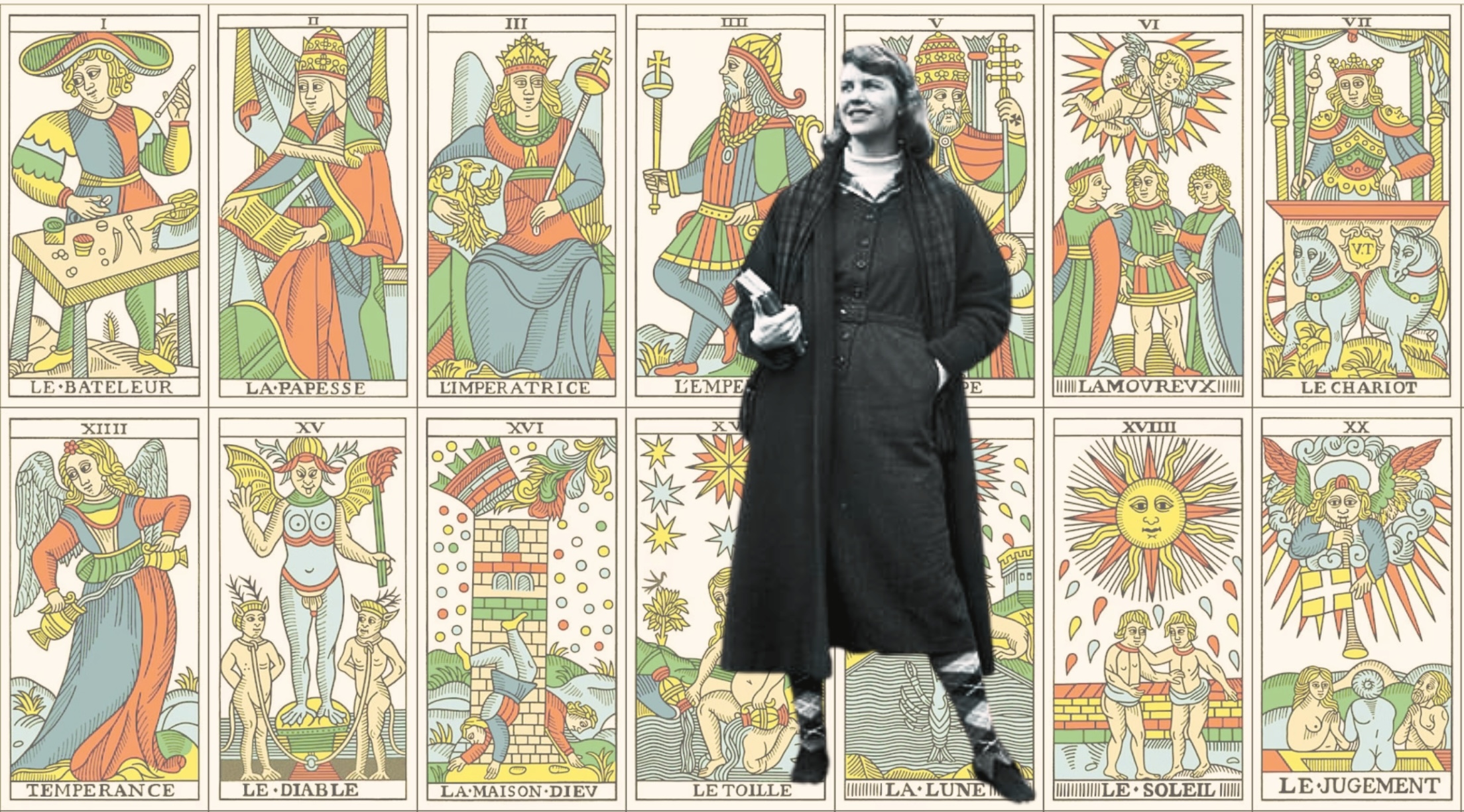
According to Smithsonian Magazine, Sylvia Plath relied on the Tarot de Marseille as part of her card work, a deck her husband, Ted Hughes, gifted to her on her twenty-fourth birthday in 1956. It is also thought that she consulted the Rider-Waite deck as well. The original Tarot de Marseille cards later surfaced at auction via Sotheby’s and found their way into Courtney Love’s possession, after which Love shared a post featuring her own tarot draws from Plath’s cards. Upon encountering that famous social-media post, I began to shape my own modest understanding of Plath’s oeuvre, approached through my training in literature and my practice as a tarot reader.
First, it’s essential to recognize that tarot operates as a system of imagery that invites personal interpretation. While there are baseline meanings for the cards, the reader’s engagement with the illustrations essentially paints the picture in real time.
In Plath’s case, she makes explicit reference to The Hanged Man within her poem “The Hanging Man,” depicting a figure suspended above the earth and a world that feels inverted. Many scholars contend that the poem speaks to a hostile world and to her struggle to conform to the era’s expectations of womanhood in the 1960s, given her resistance and ambivalence toward accepting the role of wife and homemaker.
I view these lines as evidence of Plath using tarot to probe the rift between tradition and the erosion of her heritage through an existential lens.
The Hanged Man in the Rider-Waite deck appears as a person suspended in an upside-down pose, signaling a sense of being stuck and uncertain of the self—an echo of the imagery in her verses. “The nights snapped out of sight like a lizard’s eyelid: / A world of bald white days in a shadeless socket. A vulturous boredom pinned me in this tree. If I were I, I would do what I did” mirrors that sentiment, reimagined in poetic language.
The Moon card invites us to admit our deeper fears and to engage with the subconscious in intricate, nuanced ways. The Moon’s guidance is often summarized as facing fear rather than fleeing from it. Plath alludes to this idea in “The Moon and the Yew Tree,” writing of “green vapors” awakening a déjà vu-like scent—akin to a recurring nightmare—and describing how it haunts and threatens as if a past trauma lingers, signaling her anxiety around the moon and its symbolic significance. In this sense, she would have understood that The Moon—and the moon itself—can symbolize family dynamics.
From an astrological standpoint, the Moon embodies maternal influence, while the yew tree stands in for her father, with associations to death and rebirth. The poem probes the rift between established religion and occult ties through the mention of blue saints in the church, a topic linked to the Hierophant tarot trumps that signify devotion to faith. In this reading, I interpret Plath’s work as her use of tarot to examine the split between tradition and the sense of losing one’s heritage through an existential lens.
The lines in “Morning Song” and the poem “The Fool” carry great weight, though some scholars also see resonances with The Magician and The Star. I personally hold that more than one interpretation can be valid, and I entertain several possibilities. The argument for The Magician arises from the opening line—“Love set you going like a fat gold watch”—which can be read as a reference to the sorcerer-like power to transform words into material things and to fashion realism into something else entirely.
The Star embodies hope and a brighter outlook, matching the optimism the poem projects as it begins a journey into motherhood, a path Plath regards with ambivalence: “I’m no more your mother / Than the cloud that distills a mirror to reflect its own slow / Effacement at the wind’s hand.” She recognizes that a child will serve as a mirror to herself as a mother, yet she hesitates about motherhood because of its potential impact on her career. The poem ends with stars being erased by the dawn, suggesting a closing of one’s capacity to produce writing: “Whitens and swallows its dull stars. And now you try / Your handful of notes; / The clear vowels rise like balloons.” We know that Plath continued composing poetry after giving birth in 1960, and in fact her creative life flourished, yet her ambivalence about starting a family amid a burgeoning career remains understandable.
Even though The Fool moves forward with momentum, that forward motion can, for Plath, also bring hesitancy—take one wrong step, and The Fool might tumble from its perch.
Thalidomide can be read in dialogue with The Lovers. Both the card and the poem contemplate the tension that arises when one must choose between competing paths. The Lovers emblematic tension centers on making decisions grounded in opposing forces, while “Thalidomide” underscores the delicate balance between love and cruelty. Plath writes about a harsh absence, carving out space for what is given, describing a love of two wet eyes and a screech, the white spittle of indifference, and the turning and falling of “the dark fruits.” Just as foliage on a fig tree yields fruit uncertainly, the poem suggests a tension between wanting to safeguard and wanting to let go due to the Mercurial