

My edition of Élisabeth was printed under the name Gilbert Cordier and appeared from Gallimard in 1946. The novel never gained momentum and gradually faded from circulation. Six decades on, Gallimard brought it back with the altered title La maison d’Élisabeth. Now, almost eight decades after its French debut, it has been rendered into English by Aaron Kerner for McNally Editions, preserving the original designation Élisabeth.
Its author, however, was never Gilbert Cordier. Cordier does not exist. Cordier serves as the pen name for Éric Rohmer (1920–2010), the renowned French filmmaker responsible for My Night at Maud’s, Claire’s Knee, The Green Ray, A Summer’s Tale, Pauline at the Beach, A Good Marriage, Chloé in the Afternoon, and a long line of other Nouvelle Vague milestones. Indeed, Éric Rohmer, who once ran as the editor of the Cahiers du cinéma, has since emerged as perhaps the most recognizable figure among his peers—often shown in standalone releases or in curated rosters alongside other Rohmer titles. Many of his works stand together in collections such as Six Moral Tales, Comedies and Proverbs, and Tales of the Four Seasons, and he authored them all.
What is striking is that Éric Rohmer never used his given name as written on his birth certificates. The occasionally meticulous Wikipedia entry cannot decide whether his birth name was Jean-Marie Maurice Schérer or Maurice Henri Joseph Schérer, with the surname likely tracing back to the German Schärer or Scherrer, meaning a worker who shears cloth or sheep. His chosen pen name materializes as a fusion of two other names: the actor-director Erich von Stroheim of Grand Illusion and Sunset Boulevard fame, together with the writer Sax Rohmer, creator of Dr. Fu Manchu.
Ironically, Stroheim was born Erich Oswald Stroheim (the “von” was a fictional flourish); and as for Sax Rohmer, his real name was Arthur Ward. Éric Rohmer’s name is therefore a pseudonym forged from two other pseudonyms. If that were not enough, Rohmer sometimes offered different birth dates, and even today it remains uncertain whether he was born in Tulle or in Nancy. In short, we lack certainty about his birthplace, his date of birth, and his complete legal name. What is indisputable is that he possessed a keen Catholic sensibility.
That the Second World War is merely a month away is the furthest thing from their thoughts. This is their summer idyll; they’re on time off and they mean to enjoy it.
For full disclosure, Rohmer’s daughter-in-law is the writer’s second cousin. Éric Rohmer lived a life marked by intense privacy, so much so that even his own parents were unaware that their son had become a renowned filmmaker. He also deliberately kept a distance from the world surrounding him. In the staged interview he gives within the pages of this volume, as he discusses Élisabeth, he recalls Paris in 1944—“bullets still flying… right past my window”—when the city was a battleground, yet he was busy drafting his novel Élisabeth. A few lines later he asks: “Is it even possible to write about what’s unfolding at present?” His answer remains constant: “No, it’s not—you need to take a step back.” And he insists that his stance endures to this day.
Indeed, his stance endures. If one can single out a characteristic that later defined Élisabeth and, in varied form, many Rohmer films, it is the impression that everyone has been put on time-out. The characters aren’t depicted as villains who have stepped over a line; they have not crossed into wrongdoing, but the impulse to misbehave lingers in their minds, unquenched. We watch them grapple, not with others, but with themselves. They pursue someone, yet it remains unclear whether what they seek is the body of another or merely the mischief within their own minds. They do not know. And we do not either.
Rohmer’s world feels authentic, yet those who populate it remain detached, almost distant from everyday concerns. Most of them do not appear to balance bank accounts or hold demanding occupations. They are comfortably established, and ordinary worries tend to fade into the background, save for their peculiar drives. We sense the overall mood of their lives, but we rarely witness their lived-in homes. The places they inhabit act as a backdrop rather than a central setting.
In Paris, people ride trains, collide with others, stroll through parks, ride buses, enter or exit buildings, linger in cafés, buy things, and lead lives that seem uneventful on the surface, and external events rarely intrude. In Élisabeth, cars are driven, bicycles are rode, and the threat of mishaps—perhaps even a near-accident—lurks. The heat can even drive someone to collapse for a moment. Yet, as in many Rohmer films, the characters are young and on holiday, free to savor the seaside or the countryside. As Huguette, a heroine in the novel, notes, the world appears to dissolve into flirtation. The fearsome war looming just a heart-beat away remains far from their thoughts. They are in a summer paradise, on leave, determined to enjoy it. The final image of the book shows Claire reclined in a garden chair beneath a linden tree, wholly absorbed in a book while trying to shield herself from the sun. World War II never happened, or at least it will never interrupt their present, and Rohmer’s own claim notwithstanding, bullets do not whip past their windows.
*
Élisabeth centers on two principal figures. One is Michel, who is weighing the possibility of ending his relationship with the older, widowed Irène. The situation is fraught, and Irène often breaks down in tears. She grants Michel the freedom to decide for himself, adopting an attitude of surrender and release. She does not contest him. Meanwhile, Michel begins to suspect that he harbors a deep-seated hatred for her. She does not realize that he would prefer to part ways, though her tears hint that she senses their relationship is at a crossroads.
He may despise her, yet he also loves her. “I know her too well to merely see her—I love her too much…,” and “Love is a habit you stumble into, never something you choose.” Irène, conversely, “hates him, too, and cannot bring herself to admit it, because deep down she still longs to love him, even if she no longer truly believes in it.”
These sharp insights into the contradictory workings of the human psyche might sound austere or breezy, but they are precisely Rohmer’s signature. Rohmer was still young, perhaps a touch naïve, yet these perceptive observations about conflicted feelings and human psychology would reappear in virtually all of his films.
In another moment, Michel pretends to be his cousin Bernard. He even declares himself to be Bernard in such a sly and insistent way that the reader immediately suspects he cannot be Bernard. Michel is physically restraining Jacqueline in his car, and Jacqueline struggles and manages to slip free. Right after Bernard’s unsuccessful attempt, she remarks that he might prefer an older woman—hinting that he is not Bernard after all, but Michel, still wavering about ending his relationship with Irène.
This switch of identities between the two men—who are cousins—remains murky; Rohmer alludes to it so obliquely that readers are reminded that his novel was written during a period when the celebrated nouveau roman began to emerge through writers like Nathalie Sarraute and Alain Robbe-Grillet. Rohmer’s text is frequently elliptical and often enigmatic, especially when he withholds the identities of several characters. Consequently, some readers may feel puzzled. Yet who cannot recall the final scene of My Night at Maud’s, when Jean-Louis Trintignant’s character intuitively—without proof—discerns that the woman he married triggered Maud’s separation from her husband?
Despite their embarrassment, they retain a touch of eloquence in their speech… In that sense, formality does not corrupt desire; it compels it to state itself clearly.
Then another figure, Bernard, a youthful man, encounters a girl named Huguette while swimming one day. He might still harbour a soft spot for his cousin Claire, but Huguette is keenly aware of his aims and exits his car just in time, unlike Michel, who is flirting with misbehavior. When rain begins, a conversation unfolds as both Bernard and Huguette take shelter beneath trees. The scene evokes Rohmer’s 1970 film Claire’s Knee, where Claire and Jérôme also seek shelter from a sudden downpour. In the moment of proximity, Jérôme confesses to Claire that her boyfriend may be unfaithful. When Claire ceases crying upon hearing this, Jérôme comforts her by touching her knee—once, twice—and, in his own words, that is all he has ever really desired from her: her knee. The knee acts as a metaphor for sexuality. Claire may sense what he is doing as his hand glides along her knee, or she may be completely oblivious. The moment has a theatrical quality, almost farcical, but it remains tense and loaded. Rohmer makes sleeping with someone seem far simpler than voicing one’s desire aloud. That is why the moment when a clear, articulate confession of desire lands before the person whom one desires becomes unbearably powerful. No scene in Rohmer fails to reveal the poetry of two people exchanging glances.
What they know, or think they know, about the other’s thoughts is captured in the rapid, almost imperceptible smile that flits across their features, reminding the reader and viewer alike that silence is rarely a vacuous moment between two people.
Rohmer’s dialogue never runs short; it is often richly literary and meticulously crafted, yet it allows his characters to lay bare their souls to the very person with whom they have every reason to guard themselves. It is this candor that unsettles and also continually draws us to Rohmer. His figures are forever analyzing themselves, and they do so with one another so deftly that many critics have labeled Rohmer’s cinema overly analytical, either unrealistic or too languid. But is realism—especially when expressed in everyday speech—any more accurate? I doubt it. And I am not alone in this view.
Rohmer’s people can be startlingly intimate. Yet even in their awkwardness they carry a certain grace in their speech, leaving them both formally distant and profoundly exposed. In that sense, reserve does not diminish desire; it compels it to declare itself. This is also how intimacy becomes art.
Rohmer’s characters may be on holiday, and they may talk in learned, literary terms, and their values may feel wholly alien and artificial; they could all be living in a realm where there is no war and where bullets never cross windows. But do not be fooled; this is still our world, albeit viewed through a slightly skewed lens and a veil of opacity.
____________________________
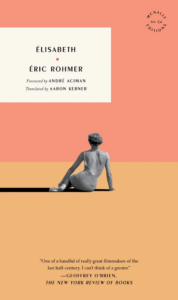
From Élisabeth by Eric Rohmer, translated from the French by Aaron Kerner. Introduction copyright © 2026 by André Aciman. Available from McNally Editions.
