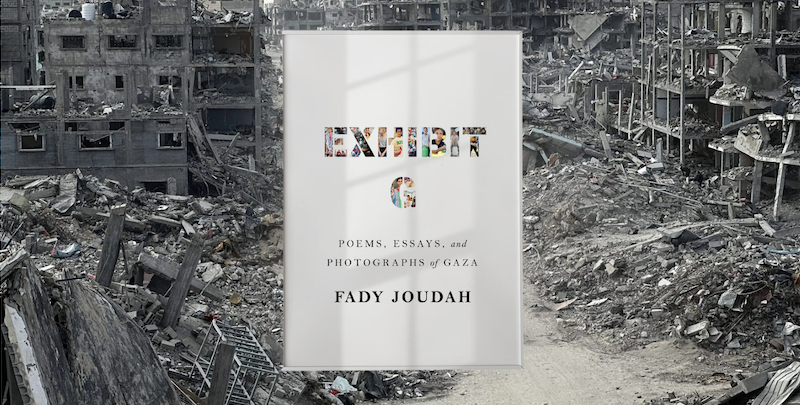
Fady Joudah’s Exhibit G stands as a rare specimen in its category. This multimedia poetry collection—born in diaspora, yet everywhere in form, content, and voice tied to Gaza—maps Palestinian life under the shadow of genocide.
Exhibit G extends Joudah’s ongoing contemplation of language and time, the fundamental rhythms that shape existence when genocide erodes stability. Where his earlier […] (2024) lingered in muteness and its echoes, Exhibit G in fact embodies the utterance born of a refusal to permit certain speech. Confronted with the impossibility of guaranteeing tomorrow’s survival for his people, the “Exhibit” adopts a polyphonic register in the language of Gaza.
A collaboration among Joudah—a Palestinian physician and poet from Gaza, now based in Houston, Texas—Palestinian poets writing from and about Gaza, and the Gaza Soup Kitchen alongside Gazan photographers documenting its efforts, the volume answers the call for a renewed poetics as Palestine endures in both English and Arabic alike. Moving across poems, essays, photographs, and drawings, Exhibit G gathers the many hands, faces, and odes of a people feeding, burying, and naming themselves as the US-Israeli genocide persists, unrelenting, from the 1948 Nakba to its ongoing terrors.
Joudah sits with a single letter—“G”—which lingers on the tongue just before articulation. The “G” of genocide, the “G” of Gaza in English, becomes a disinterred horizon, a grammar of ghurbah (Arabic for exile or estrangement) and ghurūb (Arabic for setting or decline). The sun rises and sinks without end in the West; its light refuses Palestinian shores, forcing the visual landscape and its clocks into a reality of perpetual dusk. Not a museum display, nor a mere exhibit, nor a documentary of crime, Exhibit G foregrounds Gaza’s tireless endurance, resisting the transient “exhibit” through which Palestinian suffering has often been framed under a Western sun. The result is a demanding journey through committed verse with no obvious exit for the reader.
Within the harsh frame of genocide, Joudah and his interlocutors construct a Palestinian poetics under the ceaseless pressure of time, lineage, and language that time itself has ruptured. Labīd—early in our Arabic poetic heritage—reminds us that time, still, remains at hand. For the imperial wars and the clash of pre- and post-era, the struggle has always been ours since before we recognized it:
دِمَنٌ تَجَرَّمَ بَعدَ عَهدِ أَنيسِها حِجَجٌ خَلَونَ حَلالُها وَحَرَامُها
Dark and dirt-trodden now lie their grounds, their people, gone with
years past, months both sacred and profane.
Joudah’s journey follows a timeline likewise disfigured by its own passage. Between the Arabic of Palestine and his English voice in the United States, he tells us that he cannot “turn off time” as it courses through Exhibit G. The dirt of Labīd’s ode, through the years, fights to speak through the West’s enforced silence:
Because no oxygen for the dead.
Then they came for the dirt, and the dirt had no lips, so they tossed our corpses in the street
–“Truth is Never Finished,” (10).
The “never” embedded in Joudah’s title keeps its rifts within this Exhibit, through which the people and the months, sacred and shared, enter. And yet, his opening words still speak:
And a world we want to begin begins:
I turned my love for you into art,
that I may triumph over death (1).
Gaza emerges as a language of Palestine in its own right—a new beginning, the ultimate and sole utterance of the single “G.” Engaged in a poetic tradition whose words now travel between Israeli bombardments and smiles resigned to living under rubble, Joudah and his Gaza partners “triumph” against the global impulse to confine Palestine to the erasure Labīd described as “their people, gone.” Here, those writing from abroad—like Joudah—must confront their remoteness from the accumulating ruins; and those under bombardment must endure the endless checkpoints—material and linguistic—separating them from the Gaza they once knew. The “Exhibit” thus speaks in the Nakba’s language—genocide as it unfolds, everywhere, again and again.
As the volume shifts between voices and moments in Gaza, Joudah wrestles with the finality of genocide through the ongoing question “What yet?” in his eponymous poem, “Exhibit G: Surviving Image”:
Good love will be bread. Water before love.
“Who smiles when marked for extermination?”
Who asks this? The image
of the unforgettable to you. Who wants proof
of what went too far but did not go far enough?
What yet?” (24).
The collection seeks all that remains of Gaza through a rich blend of sound and silence, survival voiced in the glottal “G” lodged in our throats. Images from Gaza watch back across the book’s spine, uncertain and not necessarily mirrors of the poems they accompany. Across from Joudah’s poem “Salaam, Ya Salaam,” a photograph shows a woman flashing a smile that is incomplete. This version of “Salaam” appears beside her name split by Israel’s genocide:
Israel killed his younger brother, sister-in-law, and three of their four
children: The daughter who survived: Salaam.
Their corpses could not be retrieved. Rubble and snipers. In lieu of grief,
my friend decided to start a soup kitchen during the annihilation.
Family and friends will run it, he said, my youngest brother and
my sister. Israel would later assassinate his youngest brother. He would be
Buried. Salaam would go on to have a baby girl.
–“Exhibit G: Surviving Image” (14).
What survives for Salaam is not herself alone, but first, what “Israel killed.” Joudah’s colons refuse a clean closure and further entwine the form of linear time and space. The in-between grammar of that “G” persists in the “decided” act of choosing to “start a soup kitchen” for life. It also endures in the faces and smiles captured in photographs, yet they are not the images “you reposted.” “G,” Gaza, where “could not” becomes the devastation of bodies never retrieved. The future’s unmade ruins arrive in the phrases “would be / Buried,” once the simplest dignity, now a distant wish itself. “Salaam” continues, carried by winds, the bygone and the young, breathing anew against an end that is only known through extermination.
“… [D]uring the annihilation years,” Gaza appears as “A fascicle: in parallel, in sphincters, convergent, or pennate” (19). The fascicle marks the core of structural organization, of poetry’s lines; of hunger, its lines; of tradition, its lines; of bombs, the imperial reordering of the world into lineages under murderous dictates; and medically, of nerves—the interior made exterior, pressed together. In Exhibit G, the physician-poet mobilizes the concept of the fascicle to map the temporal and spatial dimensions of Palestinian togetherness—a collectivity formed under, and repeatedly fractured by, a world determined to erase Palestine. It is at once the living hub of a homeland that Joudah hails from, now accessible only through his surname among the lists of martyrs. It is Palestine condensed into the letter “G,” a people pressed into the singular, coherent sound of Gaza as Genocide and Grammar and Ghurūb and Ghurbah:
To stand in line and shout, beg, howl, grin from ear to ear, feel, feel, feel.
The time before and after food is merriment within internment. Kids
dressed up in their best remaining clothes and shoes. Their favorite
pajamas. Or the only one left (19).
“To feel” the “Time before and after food,” another measure of life, compromised. “Before and after food” no longer aligns with the pre-dawn and post-dusk horizons, the visible landscape and its clock forced into a different darkness. Language is felt through the fall and rise that persists even when it should not:
What free fall and what ascension.
What accrues in the kids’ memories is stored in their bodies. What’s stored
in their bodies is a beginning of love stored in time.
Too many Palestinians are a beginning of love stored in time (19).
Joudah’s poetics demand a continuous return. Beginnings are multiple, and as he explains, they are inevitably Palestinian.
The poem makes a valiant effort to materialize what cannot be. A fresh beginning arrives: an isolated, hanging “the,” seldom separated from its Arabic companion, left at the surviving edge of imperial English. This tongue spits a sound audible only to those drawn into the world’s most brutal practices:
The
drones overhead, the white noise of genocide (19).
Genocide in Gaza becomes the soundscape of the unforgiving sky above. The people of Gaza inhabit the hanging edge of Joudah’s “The,” as the definite article tilts toward a sky made whole not by commercial flights or idle ceiling fans, but by drones that drum death:
Another marker: to become the emblem of humanity’s call to all peoples (20).
The light of a negated Palestinian horizon here fades, and with it,
The aleph of dimming souls, may the good Lord shield you from it, sees
resistance to injustice as the cause of ruin, and not the injustice (24).
Joudah marks the moment of genocide, and the genocide of time itself, through language in which ruin comes first. The invocation of the Hebrew “aleph” marks the displacement of the poet’s Arabic tongue. The Arabic “alif,” if rendered in English, cannot—will not—engage with the wanton destruction. The rubble is not a thing in itself. The Arabic “alif” first recalls and stretches outward: it opens the alphabet and seeks to meet the letters that together can articulate Joudah’s “I,” rarely welcome throughout the collection. The Hebrew “aleph” thus signals the poem’s ultimate unraveling in form and practice, a skeletal language counter to Gaza’s Arabic poetic heritage. The Palestinian “I” may only enter the linear space of poetic life once it is already dead, marshaled by the Hebrew that prepared the continuous Nakba. “And you reposted it,” says Joudah. The Arabic “alif” cannot be the breath,
The incinerated
air the people breathe (24).
And we hear the cries of Shaban al-Dalou. Israel’s genocide twists Gaza into the incinerators of the Holocaust, turning our airways into conduits for language crafted against Palestinian life. Israel’s bombs consume the nineteen-year-old Shaban, burning him as he lies in his bed. A social-media post carries his gruesome death before he receives his engineering degree.
Exhibit G seeks to recover an alternate chronology not constrained by the West’s dark ghurūb over Gaza, a lexical order that honors Palestine before its unjust erasure. The Exhibit opens onto the wounds of language—an English that has made decisive claims yet refuses to acknowledge the material truth it has become (144). Joudah negotiates the rubble and its terrifying implications in a poetry that resists being bound by any single form; he treats the English he writes as a tool of politics that prevents Palestine from being read as “all” and “humanity.”
Rawan Hussein, a Gazan Palestinian poet, consolidates the Exhibit within this fiercely idiomatic framework: her poems yield another voice, numbered one through five. The layout of Hussein’s name—first name under the title, then surname, with Gaza tethered by a comma—and then Rawan Hussein, Gaza—people and place—breaks in time, tied to another comma that leads to 2021. Joudah presses us to heed the signs that carry the ongoing destruction. We recall 2021, the year of the Unity Intifada met with Israel’s unyielding efforts to erase Gaza, Palestine. We glimpse page twelve at the end of Poem #1 of 5. We count the years. Stop counting, she instructs, and arrive at time. We look back through twelve more cruel years before today, 2014. 2014 marks a year named not by the calendar alone. We read Israel’s brutal designation of that year in the blunt “Battle of Withered Grain,” a public pronouncement of forced famine, a slow genocide that predates the Gaza Soup Kitchen. The horizon from which the sun should rise withers as it reaches Hussein and Joudah from Gaza—2014, 2021, 2026.
Hussein’s signature appears in italics before the poem’s first line, an inverted and deterritorialized takhallus carved from the Arabic poetic tradition’s customary sign-off, after which one would depart from verse. We do not depart from Rawan’s poetry. “Dawn broke on our heads,” writes Rawan Hussein:
Time set itself aside
and places shut their eyes,
like a girl with words
that gray behind her lids.
Ceilings tumbled
waterfalls of stone,
and under the rubble
the last perceived image
hangs: a final painting
sculpted on our faces.
Alone we grow old tonight
weave hours and wear them,
gobble the terror that runs
down our kids’ mouths.
Someone will devour
our rusted lips.
Hussein’s lines struggle against the fatalist insistence that sustains the Exhibit’s disorienting march through a ruined Palestine. They return to the quiet “lips” that guide Joudah’s “Truth is Never Finished,” here “rusted” as rubble rather than left as mere dirt. Hussein’s verse engages the arrangement of time and material reality against Palestinian life, now tinted with a painfully modern hue. Across the page we encounter another figure, sixty-seven; it carries us into the resonance of a broken clock, our entry into Palestinian time. Sixty-seven evokes a man in motion: first he moves away, then toward us, again. We recall 1967, the Naksa, the “setback” of liberation already shadowed by English’s ticking clock.
“The Palestinian body creates the overlap zone between Arabic and English. In that zone, the body renders the alphabet illiterate,” writes Joudah, as we exit Exhibit G (164). Gaza, as a language, produces the only path through manufactured borders, built from letters and walls and calendars and clocks and narratives that attempt to fix it once and for all. Yet Palestine remains the route back: toward home, toward return, toward the Arabic poetic heritage that rises anew from Gaza’s ruins.