
Years ago, amid the downturn of the Great Recession, I attended a gathering sponsored by an environmental organization that had formed in protest to a proposed dam on the Cache La Poudre River in northern Colorado. At the time, my husband and I held water rights drawing from that watershed, rights we used to irrigate our modest vegetable farm. Most of the farmers in our rural community supported the dam, but we, as environmentalists, stood against it. I respected the group’s efforts and was considering joining them.
That was, however, until one of the group’s members, upon learning I was a farmer, pinned me with a condescending lecture about how agriculture should manage water. I still had water spots on my glasses from installing our drip irrigation system, and I wasn’t about to be “farm-splained” by a fellow who wouldn’t know a ball valve from an intake line. I’ve come to believe that the most effective activism often involves enduring long, tedious meetings with people you find vaguely annoying even when you share the same cause, but I never returned to any of that group’s events.
I wanted to write a novel in which the water crisis of the American West was “redeemed by the imagination.”
Years later, while drafting my novel, Appraisals, I spent time unpacking this moment. In real life it felt obnoxious, but not especially meaningful. In fiction, however, I could see the narrative potential clearly. I became enthralled by the power of our immediate disdain for one another and by the assumptions each of us carried into the exchange. I had been absolutely sure of my own moral high ground, and it was obvious he felt the same. I began to wonder: what if my husband and I spoke about the dam project with the same mutual scorn? Or one of my teenage children? A neighbor or a friend I cared deeply about?
Appraisals is about water rights and marriage and local farms and parenting and zoning laws and grandmothers, which is to say it examines the emotional toll of climate anxiety in rural places, and how these tensions either separate us from or, ideally, bring us closer to the people we love. The novel unfolds during the Great Recession on a farm remarkably similar to the one my husband and I purchased in 2008, which we sold at a loss in 2013, narrowly escaping bankruptcy and foreclosure. I initially assumed that such lived experience would simplify the writing process, but the opposite proved true. Through several failed drafts, I struggled to separate my opinions about the book’s political background—the worth of local foodsheds, regenerative practices, water law and the water crisis, and the influence of oil and gas development on rural communities—from what good fiction does best, which is to center character and relationship.
In the author’s note to the 1995 paperback edition of In the Time of the Butterflies, Julia Alvarez writes:
What you’ll find here are the Mirabals of my creation, made up but, I hope, true to the spirit of the real Mirabals…I wanted to immerse my readers in an epoch in the life of the Dominican Republic that I believe can only finally be understood by fiction, only finally be redeemed by the imagination. A novel is not, after all, a historical document, but a way to travel through the human heart.
I did not want to write a memoir, and I did not want to write essays. I wanted to craft a novel in which the water crisis of the American West could be redeemed by imagination. To learn how to prevent polemics from eclipsing the personal, I turned to other writers who work within the climate-fiction subset I call contemporary agrarian.
*
In Ruth Ozeki’s My Year of Meats, the protagonist Jane Takagi-Little creates a TV program called My American Wife! that is, in truth, a string of advertisements designed to sell American meat to Japanese housewives. When the assignment takes her to an eastern Colorado cattle ranch, Jane notices that the family’s young daughter shows precocious breast development as a result of the hormones used in the operation. Here is Jane deciding to address her suspicions with the child’s mother, Bunny:
I know what denial looks like, and what it feels like too. It’s a volatile flicker of recognition in the eyes, quickly shaded by a vagueness that saturates the body like sluggish blood. It is opaque. Murky…I know this because I make television and try to navigate it on a daily basis. It feeds on convention, hides behind etiquette, and the only way to deal with it is a blunt frontal strike.
In fiction, we connect with characters we don’t have to continue living with, and in that fleeting state of love we may be more willing to entertain ideas and viewpoints we would otherwise resist.
Beyond the broader metaphor of the climate crisis embedded in those opening lines, the large-scale politics of farming become mere backdrop for a more gripping personal narrative. Jane understands that calling Bunny out is both a social misstep and a professional one, yet her choice to do so nonetheless becomes an invitation to redemption, which Bunny accepts. The subtlety of the interpersonal dynamics and the dialogic exchanges grounds the conflict in emotion, and two people who were once adversaries eventually discover common ground.
But what happens when no common ground can be found? In Diane Wilson’s The Seed Keeper, Rosalie Iron Wing, the central figure, cultivates an organic garden on her husband John’s conventional farm. When they are younger, their son Tommy helps Rosalie in the garden, and she teaches him about their Dakhóta history and beliefs. As Tommy grows and begins working in the larger fields with John, a white man, he grows distant from Rosalie.
Surrounded by approving adults, [Tommy] learned that his father’s beliefs were blessed by God and church and community. Eager to please him, Tommy began spending less time with me, until I finally stopped asking if he wanted to help in the garden or gather plants in the woods. Because this is what he remembers, Thomas grew up believing that I had given up on him. And that is what he can’t forgive.
This rift runs deeper than disagreements about crops and methods, reaching into the brutal history of genocide and displacement that is woven through America’s agricultural past. Wilson threads these relational fractures throughout the novel but does not resolve them. Instead, she allows them to echo and intensify the still-unhealed wounds in the nation’s story.
Returning to these writers helped me gain the distance needed to inhabit my characters, and in doing so I grew even more convinced of the value of fiction set in the present climate moment. Today, media often veers away from real-life climate narratives, perhaps assuming—incorrectly—that readers do not want to engage with them, much the same way I recoiled from joining that same farm-splainer. It takes real energy to confront discomfort, whether with strangers or loved ones or even our own complicity in this disaster. In fiction, we connect with characters we do not have to continue living with, and in that temporary space of affection we may become more willing to entertain ideas and viewpoints we would typically resist.
_______________________________
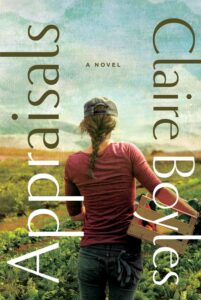
Appraisals by Claire Boyles is available from W.W. Norton & Company.