
In college, I enrolled in a handful of creative writing courses, and as I wrestled with the kind of stories I wanted to tell and the angles I wanted to pursue, the body kept returning as the central concern. While reading and crafting, I kept asking myself how the body appears inside every narrative—what it does, how it moves, where and when it excretes and vomits and lounges and bleeds, moving in minute, almost imperceptible ways or remaining immovably still. So I embraced the project of narrating the body’s story. I placed myself inside the bodies I created. The body became everything to me. It became the core of my work. And even after those classes ended, that fixation refused to fade. There was no switch-off and no return to a previous self. Today, whenever I encounter novels whose primary subject is corporeality, I feel drawn in. Bodies in torment, bodies altered, bodies possessed, bodies emptied, bodies manufactured—every conceivable form of the body finds a place here. This quiet obsession is mine. Below are several books that foreground the body in a compelling way.
*

Justin Torres, Blackouts
One of the delights of Justin Torres’s Blackouts is the palpable presence of bodies on the page. The volume is peppered with images, and because Blackouts includes a book within its pages—the images carry layered significance. The inner text is titled Sex Variants: A Study of Homosexual Patterns, a real work by George W. Henry who, along with other heterosexual scientists, effectively appropriated the trailblazing contributions of queer journalist and researcher Jan Gay. That title is handed to the main character by a mentor-like figure on the brink of death. The manuscript itself has been heavily redacted. So we encounter photographs of researched queer bodies that were seized by straight researchers, juxtaposed with a body of work that has been altered and manipulated. I’m intrigued by the extent to which copies of ourselves can feel like parts of ourselves, and what it means for those copies to be borrowed, misrepresented, or reimagined.

Jesmyn Ward, Sing, Unburied, Sing
Characters are haunted throughout Sing, Unburied, Sing. Set in Mississippi, Ward follows a family navigating a loss shaped by racism and its brutal fallout. The specters—those unbodied presences—are what give the novel its resonant voice. They embody a history that cannot be denied, lingering because the wrongs inflicted upon them demand acknowledgment. A world that tolerates such acts deserves its ghosts and the anguished psyche they awaken: “I washed my hands every day, Jojo. But that damn blood ain’t never come out. Hold my hands up to my face, I can smell it under my skin.”
Naben Ruthnum, Helpmeet
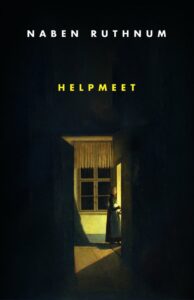
I do not typically gravitate toward horror—I’m a shade cautious and prone to nightmares—but I read this with a friend and found myself living for the vivid descriptions of a body in decay. The terror here is understated, almost observational. Emotions are largely stripped away, and the narrative unfolds as if it were a Cronenberg-inspired nature documentary. Beyond the beauty and precision of the language when describing a deteriorating form, the text also offers quiet reflections on the people affected. There’s the deteriorating husband, who makes you wonder what you would do if your own form violently rebelled against you. And there’s the wife, tending to her partner. How does one bear witness to a living decomposition? What must one endure to survive it?
Sarah Gailey, The Echo Wife
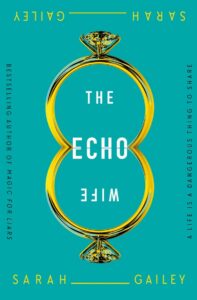
What defines a person—the sum of experiences, memories, or the body that carries them? What if all of that could be replicated, as closely as science allows? If the scars on your skin could be duplicated along with the memories they hold, would the resulting being still be you? The Echo Wife probes these questions as it follows Evelyn Caldwell, a renowned researcher whose work unintentionally yields a clone named Martine. Martine was created by Evelyn’s ex-husband to secure a family he could not obtain through Evelyn. When Martine becomes pregnant—an act that should be impossible and certainly unlawful—new debates about personhood arise. Works that investigate the autonomy of clones naturally prompt intense philosophical discussions about self-determination, bodily sovereignty, consent, state interference, and gendered power. What captivates me here is the burden of responsibility: would you feel accountable for something that originated inside you, even if it was created without your knowledge or consent? Does a creature built from a part of you ever truly belong to you, and if so, for how long? Could it ever cease to be yours?
Ahmed Saadawi, Frankenstein in Baghdad
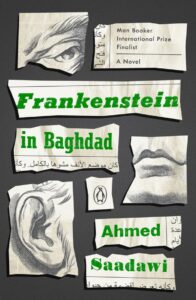
Frankenstein in Baghdad translates Mary Shelley’s classic into the terrain of an American-occupied Baghdad, introducing Hadi—a scavenger, a liar, and the creator of the Whatitsname, a stitched-together body formed from victims of bombardment. Hadi’s motive for assembling the Whatitsname is to give its victims a proper burial. By mending the scattered parts into a single figure, he argues that the authorities must recognize the pieces as people. Perhaps, more than Shelley’s Frankenstein, this novel pushes us to ask what constitutes a person. If one limb remains detached from the rest of the body, does the person still exist? Does a core essence remain lodged somewhere within the detached part? Each fragment of the Whatitsname seems to retain a trace of the person it once belonged to. The creation becomes a vigilante that seeks vengeance on those who harmed its parts. Yet the Whatitsname develops goals of its own, needing more flesh to endure. All of this is wrapped in a narrative that feels expansive—epithets for a broad cast, with a fluid, spiraling movement through time and shifting perspectives.
__________________________________
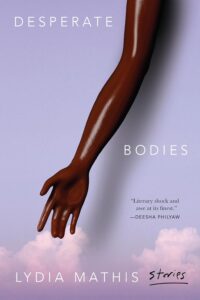
Desperate Bodies by Lydia Mathis is available from Roxane Gay Books.