
Our mixum-gatherum of magnificent reviews this week includes Emma Alpern on Emma Cline’s Switzy, T.M. Brown on Danny McBride’s Thrilling Tales of Modern Men, Sara Collins on Sebastian Barry’s The Newer World, Joy Williams on Lance Richardson’s True Nature, and Tembe Denton-Hurst on Marlon James’s The Disappearers.
Brought to you by Book Marks, Lit Hub’s home for book reviews.
*
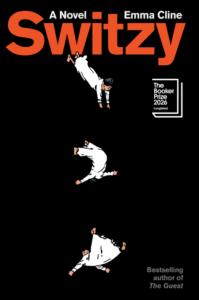
“Switzy is Cline’s bold swing, already among the Booker Prize longlist contenders. At moments it tilts toward sentimentality, wearing its own sense of gravitas, yet it also comes across as quirky and buoyant, guided by a narrator’s dementia-distorted voice crafted from David’s thoughts. When he tires, the thoughts become muddy and repetitive. Song lyrics, phrases, and stray words drift in and out like visitors dropping by for a final laugh or fright.
As with this year’s other striking dementia-centered work, Ben Lerner’s Transcription, the unraveling of David’s memory reads less like a medical diagnosis and more like a language glitch. There are puns, misreadings, nicknames for people whose names elude him or feel uneasy to utter (the liaison, Anna Gould, becomes Ghoul; a black-car driver is labeled Meatball). Snippets from Moby-Dick and The Sound of Music, plus a grim recollection of the Stanley Steemer man who drenched David’s carpets with a toxic solvent that chilled his bare feet (‘Suck, suck, suck’). The result can resemble a puzzle, though it’s rarely clever or coy. Instead, Cline—through this, she implies what a mind does when isolated: a soothing, looping wordplay using the scraps it can cling to, the entire person’s vocabulary scrambled and rearranged one final time.
…
“In Switzy, Cline’s habit of letting her narratives spread across a flat plane rather than climbing toward a peak ultimately serves her well. ‘I find myself resisting a tidy, conventional arc,’ she explained in a Paris Review chat from 2020. ‘What you can hope for is resonance, or a slow circling of a moment or emotion. It’s far more ambient and diffuse, and less concrete.’ Her other novels present sensational focal scenes—The Girls and The Guest—centered on a fictionalized take on the Manson family and a con artist hovering in the Hamptons—but in Switzy she often lets the momentum drift, producing a strangely restrained, even sombre, literary-thriller. Here, the inward realization of how little genuine human contact he has experienced finally comes into focus. On the sentence level, she’s stronger here, and more crucially, she has found a figure who rewards her looped writing impulse.
From time to time, the text widens to contemplate larger stakes. David isn’t the only one slipping away in the digital age: ‘Now there were a million mental jaunts accessible in every instant, consciousness fractured at every turn.’ Perhaps that’s why nobody noticed as he drifted away. Yet unlike Transcription or George Saunders’s Vigil, this year’s other novel about a prosperous elder heading toward oblivion, the book doesn’t attempt a societal diagnosis. What remains is something smaller, tighter, and more intimate: a faded tune, Cody’s vigilant presence, a final arching of an eyebrow.”
–Emma Alpern on Emma Cline’s Switzy (Vulture)
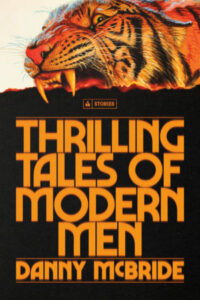
“McBride’s stories aren’t aimed at bashing men so much as poking fun at male insecurities in a way that isn’t flippant or overly earnest. ‘The Institute of Men,’ a fable-like stand-out in the collection, is told by Mitchie, a receding-hairline forty-two-year-old who undergoes a trial to regain his hair and swagger. The procedure triggers a string of humiliations, yet Mitchie keeps pushing forward, savoring the praise from coworkers and the attention of a love interest, until things deteriorate badly. Much of the book follows this familiar blueprint of a flaw—if only I were braver (‘The Book Burner’), if only I were younger (‘Dad’s Way’), if only I could keep my hair… (‘Institute’). It evokes, for a moment, Hemingway’s Men Without Women, a collection built on the premise: if only there were no women.
…
“A thread of envy threads through Thrilling Tales. In a June interview with the Times’ David Marchese, McBride described jealousy as a flaw that reveals what people prize about themselves and what still makes them feel incomplete. The murky corners of the internet offer a ready-made gallery of excuses for men who feel unfulfilled, a chorus of voices that mirror their discontent. Like any sharp satirist, McBride amplifies those resentments, inviting readers to see the world anew through them.”
…
“McBride’s origins lie in south Georgia, with childhood years in Virginia shaping many of his stories’ settings along those Gulf and Atlantic fringes. His voice works like a stage whisper from a theater troupe, mixing locker-room bravado with baroque diction that recalls a Faulknerian vibe in a frat-house. When Greg explains his dream of becoming a master illusionist to friends while they drift through a marsh, a nudge about performing for kids irks him: ‘No, I won’t be doing children’s birthday parties. Jesus. I’m aiming for real magic—things of spectacle and scope,’ he insists.
…
“McBride’s dual career as a writer and actor injects a refreshing energy into the conversation. Rather than reinforcing a crude, male-pity narrative—where misfortune is someone else’s fault—he encourages men to lighten up and even laugh at themselves. He doesn’t see that stance as at odds with a contemporary sense of masculinity; nor does it imply indifference to those who feel adrift. Books like Thrilling Tales propose a different way to think about male frustration—perhaps a more plausible route than endless hand-wringing over the male experience in today’s discourse.”
–T.M. Brown on Danny McBride’s Thrilling Tales of Modern Men (The New Yorker)
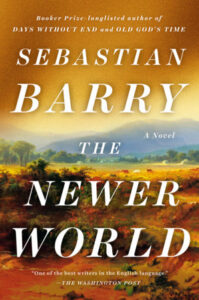
““But isn’t the story as compelling as the truth?” asks Tennyson Bouguereau, the narrator of Sebastian Barry’s The Newer World. Tennyson, a former enslaved man in the aftermath of the Civil War, narrates his life in a way that evokes the enduring debate about whether history should be handed to us through fiction or scholarship. While many historians might insist there’s no contest, the question slyly prefigures the novelist’s retort. It sent me back to a line from Barry’s Costa Prize-winning 2008 novel The Secret Scripture, where the narrator calls history “a splendid array of guesses held up against the assault of unyielding truth.”
In her Reith Lectures, Hilary Mantel suggested that history is “what survives the sieve when centuries have passed through it,” yet I think of it more like a butterfly net. Historians chase the meaningful moments, leaving out others on purpose. Barry’s entire œuvre embodies fiction’s power to fill in those gaps, weaving personal tragedies into national catastrophes in ways that, dare I say, illustrate the supremacy of the form—especially for those of us descended from people whom history has long ignored.
…
“This handing off of storytelling—from an Irish refugee to a Native American woman, who then yields to a formerly enslaved man—feels as timely as the finest historical fiction always does, relevant to the writer’s present, to borrow a phrase from John Fowles. It is also vivid in its depiction of a postwar Tennessee where Confederate sentiment may have faded but its ideas remain stubbornly alive: “All their intent was to shove us back into the hog pen and secure the latch as tightly as possible, resisting any further wandering.”
…
“What I adore most about a Barry novel is how he voices the ‘nothing people’ of history. It’s like lowering a rocking chair onto a shaded porch and listening as the narrator, often reflecting, tries to reckon with what they did and what was done to them. It’s a startling effect, especially given the extraordinary control he wields over language. In his hands it reaches a register that feels almost celestial, a dangerous, vertiginous thread of prose.”
–Sara Collins on Sebastian Barry’s The Newer World (The Guardian)