
Each term, I begin by asking my college students a straightforward question: what do you know about Asian American history, and what have you been taught about it? The typical reply, often with a hint of embarrassment, is that they don’t know much at all. When pushed, they usually recall a pair of iconic facts—Chinese laborers who laid the railroad tracks and the internment of Japanese Americans—that they learned from a few paragraphs in a high school textbook.
There is nothing inevitable about this gap in knowledge. Asians constitute the fastest-growing racial group in the United States today, yet their history in this country spans centuries. Beginning in the 1850s, Chinese migrants drained California’s marshlands to make way for farming, blasted tunnels through the Sierra Nevada to complete the transcontinental railroad, and felled timber to construct towns and cities across the American West. In tandem with their labor, their presence—and their acts of resistance—helped reshape the nation’s legal framework.
My recent book, John Doe Chinaman, examines how American law circumscribed the lives of Chinese immigrants, focusing on the years from 1850 to 1920. I uncovered thousands of local and state statutes that controlled Chinese people’s economic, political, cultural, and spatial existence. These laws imposed special taxes, limited job opportunities for Chinese workers, segregated Chinese schoolchildren, and barred interracial marriage. Chinese residents endured and resisted these discriminatory measures. They fought for civil rights, for a sense of belonging, and for recognition of their humanity—striving to be seen as more than merely “John Doe Chinaman.”
If you’re seeking a deeper sense of the history of Chinese Americans, Asian Americans, and the discriminatory laws their presence helped spur, the following books offer essential perspectives:
*
Erika Lee, The Making of Asian America: A History
For a solid primer on Asian American history, Erika Lee’s The Making of Asian America offers a sweeping, cohesive narrative. The book traces the arc of a diverse set of communities—Filipino sailors, Chinese laborers, Japanese farmers, Vietnamese refugees—and the prejudice they encountered on American soil. For younger readers, Lee has also published Made in Asian America, an introduction suited to middle-grade readers. Those pages offer stories of endurance and resistance alongside frank examinations of America’s long history of discrimination.
Gordon Chang, Ghosts of Gold Mountain: The Epic Story of the Chinese Who Built the Transcontinental Railroad
Chinese workers were indispensable to America’s westward expansion in the 1800s. Chang emphasizes not only the scale of this achievement but also the sacrifices that made it possible. By digging into the scant surviving records, he brings forward the voices of the Chinese railroad laborers who laid rails through the Sierra Nevada and across the Utah desert.
Him Mark Lai, Genny Lim, Judy Yung, Island: Poetry and History of Chinese Immigrants on Angel Island, 1910-1940
Beginning in 1882, a suite of exclusion laws barred most Chinese entrants. A few decades later, in 1910, authorities opened Angel Island in San Francisco Bay as an immigration station to process and detain newcomers. Confined for days or weeks, detainees left behind carved verses on the walls of their barracks. In Island, Lai, Lim, and Yung gathered, translated, and presented the detainees’ poems—expressions of sorrow, protest, and resilience—that ring with contemporary relevance.
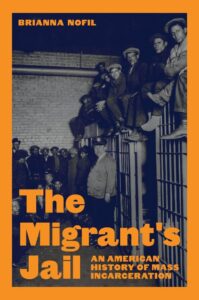
Brianna Nofil, The Migrant’s Jail: An American History of Mass Incarceration
Chinese exclusion laws laid the groundwork for today’s immigration controls. In this significant study, Brianna Nofil reveals that exclusion also established a blueprint for detaining migrants. At the turn of the twentieth century, federal officials started outsourcing the confinement of Chinese immigrants to local jails, forging a collaboration between immigration administration and the criminal-justice system that fostered the era of mass detention we see today.
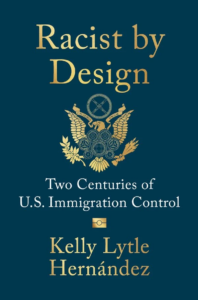
Kelly Lytle Hernández, Racist by Design: Two Centuries of U.S. Immigration Control
The book’s central claim is also its title: U.S. immigration control has long been, and remains, “racist by design.” This argument has appeared before, but Hernández renders it in a way that is both comprehensive and accessible. Racist by Design opens with the Haitian Revolution of 1791, tracing Americans’ fears of Black abolitionists from the Caribbean and the efforts to bar them through state and federal law. Hernández then ties these anti-Black immigration policies to the broader history of Chinese exclusion, to the border with Mexico, to the visa regime, and beyond. The work makes explicit how the arc of Chinese American history intersects with the wider trajectory of U.S. immigration control.
______________________________
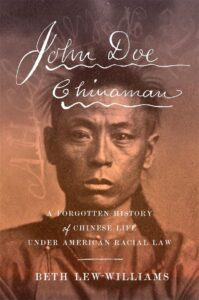
John Doe Chinaman: A Forgotten History of Chinese Life Under American Racial Law by Beth Lew-Williams is a finalist for the 2026 Cundill History Prize.
