
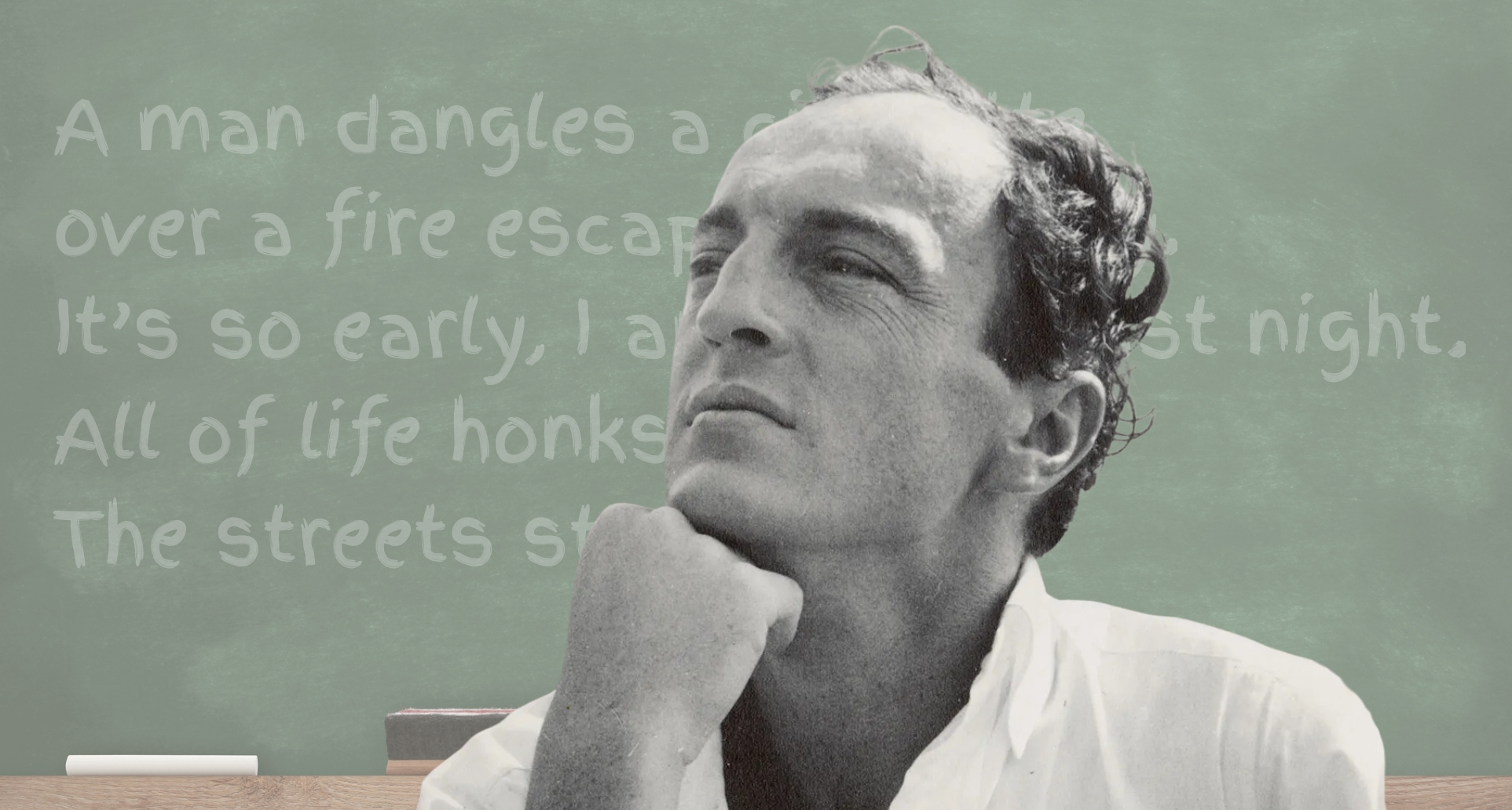
When I taught poetry, I always showed up with pencils, scraps of paper, and a printed copy of a Frank O’Hara poem. For my students—eager middle-schoolers crammed into crowded libraries and overstuffed classrooms—O’Hara wasn’t a familiar name. His brisk, exuberant lines and quick quips stood in stark contrast to the measured craft of Robert Frost, Shel Silverstein, or any other poet the curriculum had long pressed upon them.
At last here was a poet who lacked the formal polish that can make poetry seem stuffy, as if it spoke in a language adults pretended to master. I watched their faces crinkle into small smiles as they read about Lana Turner’s fainting spell—a roomful of twelve-year-olds giggling about 1950s movie gossip and a star they’d never heard of. It felt like an inside joke they shared together.
Anyone who knows O’Hara’s work will recognize that sense of camaraderie—an immediacy, a casual wit that almost instantly makes you feel complicit. In his artistic manifesto (crafted, true to O’Hara’s style, in about an hour while Donald Allen was on his way to pick it up), he described writing a poem for a single person: as if he could have picked up a phone instead of a pen. It was unlike anything my students had encountered.
How could such spontaneity, tucked within loose forms and plans they were accustomed to, shift their notion of what poetry could be? They weren’t alone. In the century since his birth and the six decades since his death, generations of writers have drawn inspiration from his casual profundity. In many ways, he remained, as ever, the monarch of the New York art scene.
I asked them to be like Frank O’Hara, noticing colors and sounds and people we encountered.
O’Hara is best known for his collection Lunch Poems, written during his lunch break as a receptionist at the Museum of Modern Art—proof that even future curators and critics must begin at the front desk. He’s often been described as a painter’s poet, and, rejected by the conventional literary world, found quicker companionship with the Abstract Expressionists than with the literary establishment. Lunch Poems—praised by Ted Berrigan as “a great book!” and hailed as one of the “most important documents in contemporary poetry”—includes some of his most famous pieces, among them “The Day Lady Died,” “Ave Maria,” and “A Step Away From Them.” The last of these became my standard classroom pick. I would call on a keen student to read it aloud, while a whole class of seventh-graders followed along on their printouts, as they began:
It’s my lunch hour, so I go
for a walk among the hum-colored
cabs. First, down the sidewalk
where laborers feed their dirty
glistening torsos sandwiches
and Coca-Cola, with yellow helmets
They protect them from falling
bricks, I guess.
O’Hara described this mode as “I do this, I do that” poems. He gave it a broader label too: Personism (“a movement which I recently founded and which nobody knows about”), defined not by a lack of ideas but by a surplus of spontaneity. “You just go on your nerve,” he wrote. “If someone’s chasing you down the street with a knife you just run, you don’t turn around and shout, ‘Give it up! I was a track star for Mineola Prep.’” You can imagine him strolling along W 53rd Street, the lunch hour slipping away, composing with a nerve so forceful it poured out without effort.
Even when I hadn’t sought permission from the school administration, the next part of the lesson would turn collaborative. Departing in a cluster rather than in single-file, I would herd seventh graders into the hallway, pens in hand, for a Poetry Walk. I urged them to be like Frank O’Hara, noticing colors, sounds, and the people we crossed paths with. Upon returning, they shared details they had walked past for years without noticing—a crack in the wall, a spiderweb in the corner by the door. Eight years later, I still remember the exact examples they offered.
I had learned what O’Hara had first shown me: poetry isn’t, as some might think, a grueling exercise in diction and simile. Rather, it is a way of seeing — of noticing details we might otherwise overlook. It’s all too easy to become accustomed to the sight of hard hats and stop asking what they’re guarding. The glistening torsos of the construction workers can be dismissed as merely sweaty. You need fresh eyes to truly look. His poems sometimes formed quickly, perhaps because he wrote them as soon as something caught his attention. As he put it in Autobiographia Literaria:
And here I am, the
center of all beauty!
writing these poems!
Imagine!
The finest O’Hara followers are the ones who remind us to find beauty in the world—whether in a torso on a New York street or in the everyday act of cooking eggs for someone you love. The So-Called Second New York School (which trailed behind O’Hara, John Ashbery, James Schuyler, and Kenneth Koch) began by studying this approach as if attempting a cheat sheet. Bill Berkson and O’Hara’s joint chapbook, Hymns of St Bridget, opens with Berkson trying to imitate O’Hara’s way of seeing in a poem about a church steeple, an attempt he calls a “cheap imitation” of his style. “It is to you, bending limp and ridiculous, on Ninth Street, that I turn,” he writes, finding the personality and humor to reframe a familiar landmark. It’s easy to treat a church with solemn gravity; it’s far harder to see it for all its bent absurdity. (A posthumous Berkson notebook—the work A Frank O’Hara Notebook—was published in 2019.)
O’Hara’s literary influence has been, in a word, immense.
Ron Padgett: “reading poems like [A Step Away From Them] by Frank let me realize I could relax… and say anything I wanted.”
Alice Notley: “I was often working out in what I conceived to be O’Hara’s forms…I wanted to make work like that.”
Poets in his circle each drew something different from O’Hara, weaving elements of his voice into the bedrock of contemporary poetry. You can hear him in the humor that flavors literary magazines, and in the constant pop-culture references. The short, conversational turns he proved could be poetic.
The simplicity of O’Hara’s work means it’s just as exciting as it is accessible.
Nothing, however, endures like his appreciation for the mundane. While O’Hara wasn’t the first to champion daily life, the years after his sudden death (he was fatally struck by a jeep on a Fire Island beach at age 40) have made his work a blueprint for capturing modern existence. This past summer, sixty years after his death, I encountered a piece by Pip McGough in The Brooklyn Rail that crackled with a matter-of-fact, I-do-this, I-do-that quality, noticing the thick bus glass I had never contemplated before. I see O’Hara’s influence repeatedly as I turn the pages of publications. In 2024, for example, I recall reading Alex Dimitrov’s “Everything Always” in The New Yorker, where he writes
A man dangles a cigarette
over a fire escape on Crosby.
It’s so early, I am still in last night.
All of life honks.
The streets steam.
O’Hara is present in this, as if he’s the unspoken other end of Dimitrov’s telephone call. In car horns and steaming concrete, he sees in a way that would make O’Hara proud. He is a touch sadder, less exuberant, yet he selects details—unglamorous, unremarkable, seemingly insignificant—that convey the immediacy of being alive. In a Poetry Foundation lesson plan, Dimitrov describes how O’Hara can teach students to notice the beauty in the everyday. “A poem has already happened to you today,” he begins. A poem is happening to students, poets, teachers, everyone, every hour, every minute.
It’s easy to like Frank O’Hara. There’s a reason I begin my students with him: unlike his friend and fellow New York School member, the famously opaque John Ashbery, the simplicity of his work makes poetry both thrilling and approachable. A friend recently shared that her MFA professor, a notable documentary poet, turned to O’Hara when she needed a reminder of the “pleasure of poetry.”
This may help explain why he has enjoyed such a surge of popularity in popular culture—his rhapsodic observations are understood and enjoyed by anyone who can share in the experience of being alive. Don Draper, in Mad Men, reads a copy of Meditations in an Emergency, and “Mayakovsky” (perhaps my favorite O’Hara poem) is read aloud in an episode. Ada Calhoun’s widely discussed memoir Also a Poet uses O’Hara as the hinge on which an exploration of her father/daughter relationship turns. As Sophia Stewart notes in The LA Review of Books: Frank O’Hara is everywhere—in television, in books, in articles, and in epigraphs.
To anyone who has spent time with O’Hara, finding a favorite Lunch Poem or tracing his references to 1950s culture makes sense. I maintain there are two kinds of enjoyment in poetry: one rooted in deep analysis, cataloguing the vastness of allusions, opening a poem wider and wider until the bottom is out of sight. The Waste Land by T.S. Eliot or The Faerie Queene by Edmund Spenser exemplify that approach. O’Hara’s is the second kind. He is felt rather than fully understood.
When O’Hara died, he left behind hundreds of unpublished poems hidden in every corner of his apartment. I like to imagine the ones tucked in the back of his desk, written as if possessed, freed only when the stray thought landed on the page. His work carries no pretension: just a poet, observing the world and telling you about it. A hundred years after his birth, we still hunger for authenticity. Frank O’Hara, with each glistening torso, never fails to reveal something true.
