
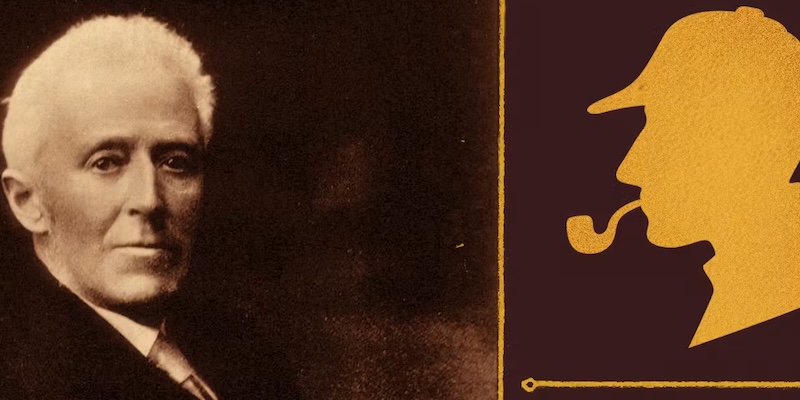
Joe Bell was a physician who kept himself perpetually occupied. Beyond his responsibilities at the hospital and his policing duties, he gradually built one of Edinburgh’s largest private practices, a feat he sustained throughout his career. Every day he would undertake as many as twenty home visits, shuttling from appointment to appointment in his refined barouche.
During a visit to Hugh Black—a minister at St. George’s United Free Church where Bell served as an elder—Bell’s wife, who had summoned him, worried that her husband might be developing a cold. Black’s wife’s concern was dismissed by the minister, who insisted that he would be fit enough to preach the following morning.
When Bell arrived at the house, he stepped into Black’s study, seated himself opposite the minister, and began delivering a joke. As the minister roared with laughter at the punchline, Bell rose abruptly and pointed a stern finger at his patient, as if he had caught him in a fib. “Ye’ll no preach the morrow,” Bell asserted. He judged from the hearty sound of the minister’s laugh that the cold was deep-rooted, and that rest was the only effective remedy.
For a period, Bell also supplemented his income by serving as a medical examiner for an insurance company. The nineteenth century saw a surge in people purchasing life insurance, spurred in part by fears surrounding diseases such as smallpox, tuberculosis, and cholera.
Yet the system proved susceptible to abuse. The worst offenders among those who profited from it were doctors paid by patients to omit unfavorable findings in the examination reports sent to insurers. By mid-century, insurance firms began employing their own medical referees to provide thorough and unbiased reports for review.
Bell’s abilities made him especially well suited to this line of work. He once correctly identified a man submitted by insurers as a former soldier. After palpating the man’s bare ribs, Bell declared, “You have belonged to the volunteers.” The man confirmed past service, though his military career had ended years earlier. Bell’s keen understanding of anatomy allowed him to uncover the man’s previous vocation. His clients—the insurers—must have relished having such penetrating eyes on their side.
That Bell was the inspiration for Sherlock Holmes was a fact known to only a few, including Robert Louis Stevenson, who had already sensed the truth.
While Bell divided his time between this auxiliary line of work, his private practice, his collaborations with Henry Duncan Littlejohn, and his duties on the wards of the Royal Hospital for Sick Children, he kept a watchful eye on Conan Doyle’s ascent. The interview in The Bookman had sparked a flurry of correspondence with his old clerk in the spring of 1892.
In one missive, Conan Doyle thanked Bell for further ideas. “Your letters are truly of great value to me and I am exceedingly obliged to you for the details which you so kindly furnished. The deserter-cobbler is admirable, and I wish I had a dozen more such cases.” In the same note, Doyle admitted he was “insatiable for material,” having committed to writing twelve more stories for The Strand.
“Your sketch too of the crime is capital,” he continued. “It needs a second plot to run parallel with the first, and to draw another red herring across the trail besides the ex-soldier. But there is the nucleus—and indeed much more than the nucleus, of something very good. I shall certainly—with your kind permission—avail myself of the idea.’” He closed by saying that he had asked the bookseller to send Bell a “complete edition of my little yarns,” and thanked him “once more very heartily for the ’tips.’”
That Bell was the inspiration for Sherlock Holmes was still known to only a handful of people, including Robert Louis Stevenson, who had by then guessed the truth. Since the publication of the interview in The Bookman, however, interest in the identity of the unnamed “professor of medicine at Edinburgh University” had been growing.
Harry How, who had been working as a features writer for The Strand Magazine since its inception, resolved to secure the scoop. After all, what better venue to unveil the mysterious professor’s identity than the very magazine that had elevated the fictional detective to international fame? And so, How appeared on Conan Doyle’s doorstep one afternoon in the summer of 1892, seeking an audience with the renowned author.
“I found him utterly different from the man I expected to see; but that is always the case,” How wrote in the piece he soon published. “There was nothing lynx-eyed, nothing ‘detective’ about him—not even the customary walk of our modern solver of mysteries.” Instead, he was greeted by a cheerful, genial, unpretentious man who clasped his hand warmly and invited him inside.
After a tour of Conan Doyle’s “prettily-built and modest-looking red-brick residence” at 12 Tennison Road in South Norwood, the two men settled in the author’s richly wallpapered study. They lit cigars and settled into their chairs to discuss Conan Doyle’s childhood and early adulthood. Before long, the conversation wandered to his days as a medical student at the University of Edinburgh.
What better place to reveal the mysterious professor’s identity than in the very magazine responsible for making the fictional detective an international sensation?
“There I met the man who suggested Sherlock Holmes to me—here is a portrait of him as he was in those days, and he is strong and hearty, and still in Edinburgh now,” Conan Doyle told the journalist, handing him a photograph. “I was a clerk in Mr. Bell’s ward,” he continued. “A clerk’s duties were to note down all the patients to be seen, and muster them together. Often I would have seventy or eighty. When everything was ready, I would show them in to Mr. Bell, who would have the students gathered round him. His intuitive powers were simply marvelous.”
Then Doyle shared several tales of Bell’s observational sorcery: the man whose alcoholism was betrayed by a flask tucked into his breast pocket; the cobbler whose trade showed itself by wear on the inside of his trousers where the lapstone rested.
“He was continually before me—his sharp, piercing grey eyes, eagle nose, and striking features,” he said, puffing on his cigar. “He was exceedingly kind and painstaking with the students—a real good friend—and when I took my degree and went to Africa the marked individuality and discerning tact of my old master left a deep and lasting impression on me, though I had no idea that it would one day lead me to abandon medicine for story writing.”
Conan Doyle realized he had given How enough material to pique his curiosity about the Edinburgh professor. Soon after the interview, he drafted a somewhat anxious letter to Bell.
I fear that my little sketches have caused a newspaper man to pursue you with as much persistence as Holmes pursued his criminals. Mr. Harry How… was here yesterday, and on my mentioning, in the course of the interview, the influence your teaching had on my powers of observation and deduction, he departed with every intention of writing to you and extracting as much as he could to embellish his article. I thought I should write to you independently to say that I have nothing to do with the matter, and I hope you won’t think I would influence your decision one way or the other. I should be very sorry if you felt bothered in any way by my having drawn you into this.
Bell replied, in his usual jovial fashion, agreeing to permit publication of his photograph in the forthcoming article. He also told his former student that he would be happy to answer any further questions the journalist might have. “Your permission will rejoice the cockles of Mr Harry How’s heart,” Conan Doyle replied.
Not long after, Bell penned a lengthy letter to How in which he downplayed any influence he might have had on the creation of Sherlock Holmes.
“Dr. Conan Doyle has, by his imaginative genius, made much of very little, and his warm remembrance of one of his old teachers has colored the picture,” he wrote, with his characteristic modesty. “In teaching the treatment of disease and accident, all careful teachers first have to show the student how to recognize the case. The recognition depends in large part on the accurate and rapid appreciation of small points where the diseased state differs from the healthy state.”
Bell, sharing some of Holmes’s own puzzlement at those who overlooked a world of detail in seemingly trivial things, went on to explain his method to the journalist:
The differences between a soldier and a sailor appear in their manner of moving, though I once had to tell a man who claimed to be a sailor that he had, in his boyhood, been a mariner. The subject is endless: tattoo marks on a hand or arm will reveal voyages; the adornments on the watch chain of a successful settler will show where his money came from. A New Zealand squatter will not wear a gold mohur, nor will an engineer on an Indian railway don a Maori ornament. If you apply the same principle—using one’s senses with precision and consistency—you will see that many medical cases carry their past histories with them, histories that are national, social, and medical, as a person walks into the consulting room. Conan Doyle’s genius and vivid imagination gave his stories a new direction, but he owes far less to you, Joseph Bell, than you suppose.
A few weeks later, How requested permission to reproduce Bell’s letter verbatim in Strand’s August issue. Bell granted consent.
Not long after, Conan Doyle wrote to Bell with another warning. Holmes’s growing popularity had brought many inconveniences, and he feared How’s interview could unleash further complications. “I fear that one consequence of your identity being revealed to the readers of the Strand will be that you have ample opportunity to endure lunatic letters, and that at least part of the stream that pours upon me will be diverted toward you,” he wrote.
By then, Conan Doyle was receiving dozens of inquiries addressed to Sherlock Holmes each month—autographs, advice, even requests for locks of hair.
You will hear, alas, from youths in the south of Portugal, from the American woman with the curved spine, from the Liverpool merchant who longs to know who Jack the Ripper is, from many people who believe their neighbors are starving maiden aunts to death in sealed attics, and in short you will bless me and my stories when you glance at your mailbox.
Meanwhile, Bell could not yet imagine the scale of what would follow. The next month, The Strand published a feature titled “A Day with Dr. Conan Doyle,” profiling the author and, for the first time in print, naming Joseph Bell as the real Sherlock Holmes. What Conan Doyle had most dreaded was about to be unleashed upon his former mentor.
______________________________________________
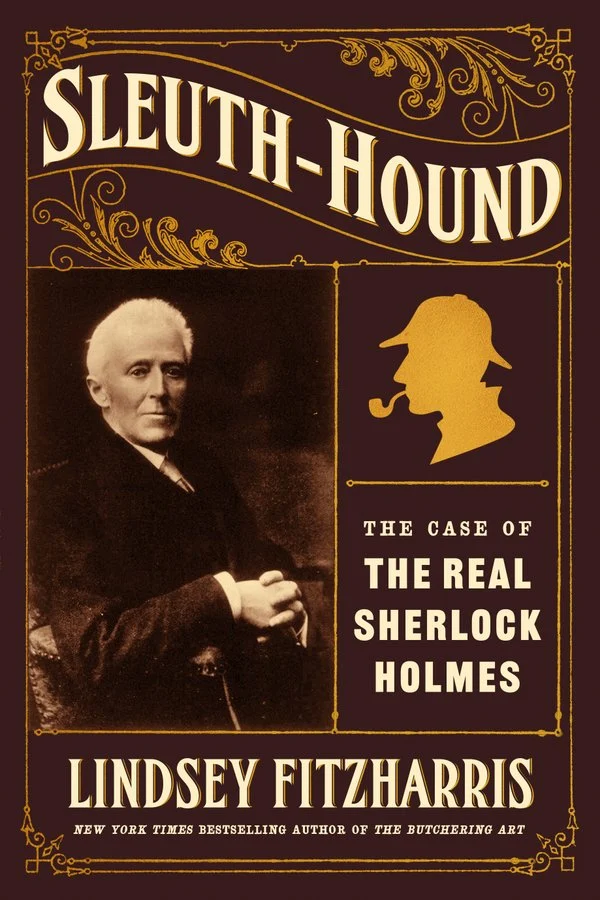 Excerpted from Sleuth-Hound: The Case of the Real Sherlock Holmes by Lindsey Fitzharris. Published by Farrar, Straus and Giroux. Copyright © 2026 by Lindsey Fitzharris. All rights reserved.
