
In December 22, 2015, after years marked by mysterious, fluctuating symptoms that would come and go, I awoke with a fever, joints afire, and skin that felt as if it were pierced by shards. In the months that followed, my world narrowed dramatically, bending me into a version of myself I barely recognized. I had to leave my dream role teaching fiction writing to inmates and largely shelve my own creative pursuits. I wrestled with brain fog and headaches that made sustained reading nearly impossible, and I reoriented toward a life filled with constant visits to doctors, acupuncturists, lymphatic masseuses, practitioners of Chinese medicine, and even a bookstore psychic whose prediction—that I would make a full recovery after about four months—proved unfounded.
Within a few months, steroid and opioid use for pain triggered high-dose steroids and sugar cravings that changed my body in ways strangers barely recognized. While I grew larger in one sense, I became more acutely aware of every sensation my body sent me, yet I seemed to lose my place in the world at the same time.
Initially I was diagnosed with Lyme disease and a second tick-borne illness called babesiosis. After a year of treatment some symptoms eased, including a distressing sense that I couldn’t seem to catch my breath—air hunger, as if my lungs were failing me. But overall I was worse off than at the start. Part of that deterioration came from contracting a potentially life-threatening intestinal infection called c. difficile, which I likely caught in a hospital, where I also contracted hepatitis B from an accidental needle-stick by a nurse in distress. Hospitals, it turns out, are perilous places for anyone with a compromised immune system.
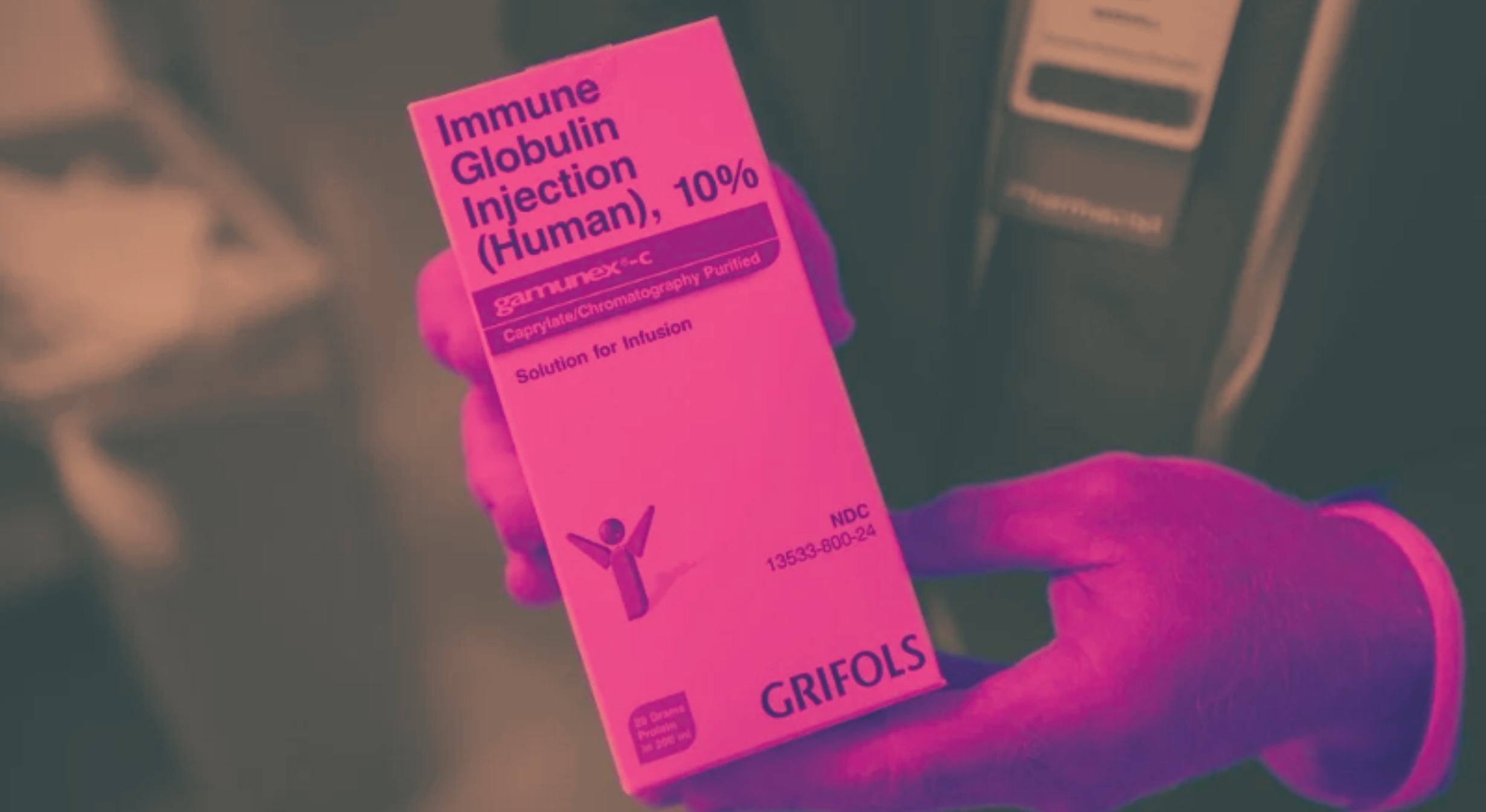
From New York’s Hudson Valley, where I had long dreamed of settling, my husband and I moved to New York City, where I’d grown up and where my family lives, and began seeing physicians at major teaching hospitals. The quality of care improved markedly. I was diagnosed with autonomic small fiber neuropathy, a condition that disrupts the regulation of blood pressure and heart rate, digestion, temperature, and other bodily functions beyond our conscious control. I was told I needed IVIG, intravenous infusions of immune proteins derived from donor blood to temper my body’s autoimmune assault on my nerves; in later years, I also required IVIG to sustain my immunity while large portions of my immune system were suppressed by medications used largely for cancer, so my own defenses wouldn’t turn against me. IVIG wasn’t a universal cure for every aspect of my illness as my doctors imagined, but it undeniably saved my life.
The majority of patients refer to immune globulin as “liquid gold,” because it is so precious to us—and so costly. Each infusion costs about $9,000–$10,000, which translates to an average monthly bill around $35,000 for regular recipients like me. The neurologist who initially prescribed mine ended up fighting my insurer for nearly a year, through every round of appeals, including several “peer-to-peer” discussions—an odd back-and-forth where your doctor, an expert in your disease, contends with a doctor employed by the insurer, who can come from any specialty—over a highly specialized treatment.
Even after years of illness-related atrophy, my writing, literacy, and education—and the privileges that accompany them, such as whiteness, a cisgender identity, and a family able to support me financially during this ongoing crisis—have retained immense influence throughout my illness. They have served as channels to access treatment, to obtain information, to learn, and to communicate in ways that doctors can hear, inspiring a willingness on their part to listen, to be challenged, and to see in me not only my disease but my potential.
Disagreeing with a doctor is frightening.
Above all, I am alive largely because I can write, because I still have something to say, and because my competence seems to prompt doctors to recognize my reality, my personhood, my hopes, the woman I lost, and the one I am desperate to reclaim. I can convey urgency, render my pain tangible, evoke empathy and compassion, and when I am articulate and fortunate enough to have my truths acknowledged, I am met with a level of engagement that many patients never experience.
This truth is most evident in messages I send through patient portals or emails to my doctors, and in the pages I assemble before appointments to be concise and precise, sometimes simply handing them the sheet with diagnoses, medications, symptoms, how long they’ve lasted, and a pain scale. I studied and learned their language, partly through a prior job in which I wrote scripts for virtual patients designed to teach nursing students how to conduct health history interviews with care. It seems I possess a wide repertoire of skills.
My rheumatologist frequently remarks on the strength of my writing; he always asks how it’s going, adding, “As long as you’re writing, that’s all I need to know.” He has joined me in valuing one of my highest priorities and core facets of myself, and in turn it makes me feel seen, because I am not merely a case or a disease but a person.
Of course there are remarkable physicians whose compassion extends to patients regardless of their abilities or ease with communication, but the persistent question remains: how can even the most empathetic doctors provide optimal care to patients who, because of illness, gaps in education, or limited familial and social support, are unable to articulate the nature of their suffering and symptoms from the outset?
Moreover, understandably, many patients do not feel entitled to or comfortable with challenging a medical professional—correcting a misunderstanding, an incorrect memory, or an omission—and as a result do not receive adequate or appropriate treatment. The patriarchal, academic, and hierarchical setting of hospitals, especially university hospitals, can be daunting. Disagreeing with a doctor is frightening. What if they stop liking me enough to help? What if they see my history of bipolar disorder and PTSD, the complexity of my illness, and only label me with a diagnosis akin to “hysteria”?
I struggled through school because of poorly managed bipolar disorder, but English class and college essay writing were among my strongest talents. I was supported by an English teacher who encouraged my potential as a writer—a voice worth sharing. She also delivered the most memorable Thanksgiving sandwich I’ve ever had while I was in a mental hospital on Thanksgiving: fresh white bread, turkey, stuffing, cranberry sauce, and gravy. It remains one of the kindest gestures I’ve ever received.
Those deaths, those tragedies, unimaginable losses, became my win.
My voice as a writer was not confined to academic spaces. The last story I wrote as an undergraduate became my first published piece and helped me gain acceptance to several MFA programs, including my top choice. There, I thrived. The dynamics of status, money, and race, along with my largely cis-heteronormative identity and gender presentation, and my conventional attractiveness and slenderness, affected how I was heard as well.
Even today, overweight and more than a decade into my illness, doctors do not struggle much with how to see or approach me; I am readily perceived as a highly educated and literate person who consistently advocates for herself, even as I have learned to push back against doctors for more without harming their egos. I have learned to inject humor, to restrain tears that might lead to dismissal, and to speak to doctors as peers, mindful of the power of suggestion—if I frame us as a team solving a case—me as the patient, the case—we often receive something most patients do not: genuine collaboration, an attentive ear, and a willingness to go the extra mile.
I am a woman with a severe mental illness. My relationship with medical professionals is not perfect. I have been told that “a psychiatrist is the best person to oversee your care” even though I have autoimmune encephalitis, inflammatory arthritis, and other conditions, and even though labs clearly show elevated inflammation and autoimmune antibodies. I have not always been taken seriously. More often than not, though, I have been. My confidence in communicating with my medical team comes not only from the effort I put into how I speak and write to them, but also from the life circumstances of my birth and upbringing that empower me now—even when I feel utterly powerless. Yes, I am fortunate. And yet this is profoundly wrong. The gap between my care and that of most others should not exist.
As a final, desperate attempt to secure insurance approval for IVIG, the infusion pharmacy assisting my neurologist reached out to my insurer and claimed something that could compel them to pause and reconsider, giving me a chance to keep seeking answers and to obtain “liquid gold.” Specifically, a man at the infusion pharmacy told an insurance doctor, during a peer-to-peer, that I was an author—“Google her! You’ll see”—set to write an exposé for the New York Times. The piece would illuminate my insurer’s denial of life-saving treatment—an accusation that several California families had recently leveled in court against the same insurer, on behalf of relatives denied coverage for IVIG.
The plaintiffs prevailed. Those deaths, those tragedies, unimaginable losses, became my win. I live with the understanding that what saved me, and continues to sustain me, is something I did not earn through merit or virtue but which was purchased by the lives of people just like me—people who likely could not advocate for themselves as I have learned to do. The kind of luck I have feels earned by others’ sacrifices; its price is the value of a single breath—one that no one can claim as their own achievement, no matter how wealthy—and it represents not only the cost of health but the cost of life itself.
__________________________________

Greyhounds by Emma Smith-Stevens is available from Dzanc.
