
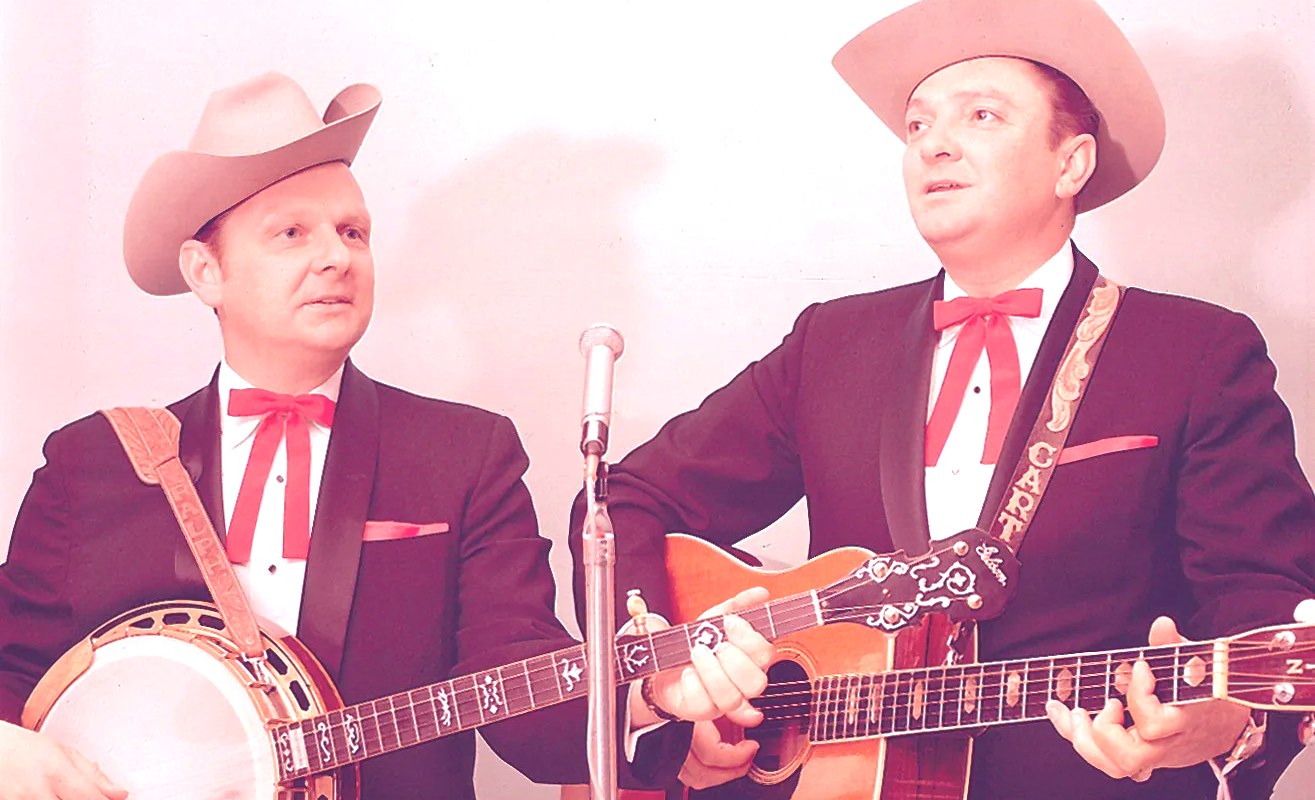
If I could choose only a single Stanley Brothers record, The Legendary Stanley Brothers (Recorded Live), Volume One—the edition with the yellow band on top indicating it’s the first volume—I would pick that one without hesitation. In truth, if I were restricted to a lone bluegrass album, this would likely be the pick. Because it feels flawless. You know that feeling when you glimpse a moment captured in a photo years later and you realize how much it conveys—the smallest details, the essential truth of something? This disc functions as that impeccable moment. It preserves something the studio versions could never convey, the apex of the Stanley Brothers’ craft. I can scarcely imagine what life would be like without this record.
In some respects, this record carries an air of mystery. It vanished from shelves for many years, yet at times it seems to have resurfaced again. The credits are practically nonexistent. James Shelton, Ralph Stanley’s longtime guitarist, suggested it might have been recorded by Peter Kuykendall—the man behind Bluegrass Unlimited—and perhaps it was a Culpeper, Virginia, performance. He must have had a Nagra and an audience microphone pointed at him, because the applause is astonishingly loud and distorted. David Rawlings, my musical partner, and I joke that it sounds as if the crowd is clanging plates between tunes, but that is part of the charm and contributes to the record’s undeniable perfection.
This record is like that perfect snapshot. It captures what could never have been captured in a studio album.
I first encountered this record at age twenty, in Santa Cruz, in a group house on Highland Avenue at the base of the campus. I lived with a bluegrass mandolin player named Mike McKinley, who owned an outstanding record collection. One day I was in the bathroom scrubbing the tub—as one does in a crowded house where a bath is a rare luxury. I’m crouched on the floor, and Mike drops on side A of The Legendary Stanley Brothers, “Dream of a Miner’s Child.” It hit me like a tractor beam: I had to walk over to the turntable to see what this was. Not only was it the first time I’d heard this record, but it was also the first time I’d heard the Stanley Brothers. It struck me with the force of lightning. I’d grown up playing acoustic music, strummed the guitar since I was nine, but I’d never heard anything so immediate. It felt like a missing piece of the puzzle about how music ought to be. Suddenly everything clicked. I’d wanted to play music, but I lacked clear directions. Hearing this album, it would not be an exaggeration to say it redirected the whole course of my life.
The recording itself is spare, the sound unadorned and a bit rugged, almost tough in places. The harmonies are exquisite, yet there’s a crisp edge to them that I find irresistible. And the songs—the material is timeless. “Rovin’ Gambler,” “Banks of the Ohio,” “He Will Set Your Fields on Fire,” “Roll in My Sweet Baby’s Arms.” And “Knoxville Girl,” probably my favorite: the storytelling is so vivid—like a movie in my head, only better than that: it’s a book. Except it’s a song!
Beyond the craft of the songs, the themes carry a universal, enduring resonance: heartbreak, gambling, addiction, murder, judgment, sin, the supernatural, love, loss, the afterlife, redemption. There’s nothing dated about any of this. In hindsight, it feels more pertinent now than it did when I was twenty. I’ve likely performed every track on this record; at some point each one became part of my own repertoire.
This album pointed me toward the direction I wanted to head in—or at least toward a path I knew I had to follow. Frankly, I wasn’t hearing acoustic music that was as forceful, as sincere, or as capable of grappling with the depth of human experience and emotion as I perceived it. I’m one of those people who mostly responds to hard times; good times pass without leaving a mark. The tougher moments life throws at you are what I feel compelled to respond to, and I hear that push and pull reflected in this music.
It’s like a magic window on a world. You feel the audience, you hear Carter talking, and then you hear them playing.
This cover photograph embodies the idea I mean when I call the whole thing flawless. I’ve studied this striking image, especially Carter Stanley’s expression, again and again. He didn’t live long after this photograph. And because it’s a live album, you get those brief spoken interludes between some tracks, little pieces that have stayed with me to the core. I can almost recite Carter’s onstage voice, including his cadence. I know this influence has shaped the way David and I banter onstage. It feels like a portal to another world. You sense the audience, you hear Carter speak, and then you hear them perform.
The last time I revisited it, I reached for it to sing along again. I hadn’t been listening to much old-time and bluegrass in the preceding six months to a year. Radio availability was limited. I’d just returned from a tour and wanted to reconnect, to recalibrate, because that sense of grounding is crucial to how I approach my own music. When I was younger, I basically aimed to sing like Ralph Stanley—or perhaps a blend of Ralph Stanley and James Taylor, if such a blend were possible. So I played the record and joined in, three-part harmony, adding a tenor above Ralph. It’s a fundamental touchstone for me. And when I revisited it, I realized that this had to be the record I was talking about.
I recall the first time I played The Legendary Stanley Brothers for David, and it blew his mind. He erupted, yelling and pounding the table, because he’d never heard the Stanley Brothers before. So I introduced him to it, and it completely captivated him. We dubbed a cassette of it, and for the first couple of years on the road, driving across the country, we sang three- and four-part harmonies alongside this record. That’s how we learned to sing together. It has profoundly influenced our work. As I said, I can’t imagine doing what I do without this album.
______________________________
From On the Records: 80 Musicians on Beloved and Overlooked Albums by Brian Beck with Piotr Orlov. Copyright © 2026. Available from Clarkson Potter, an imprint of Crown Publishing Group, a division of Penguin Random House, LLC.
