
Among all the far-off places, and all the deserted and unknown cities, among all the lawless, godless regions, the Guayrá was an oasis. A small, lush country under a torn and tattered sunset, out in the middle of the most uncertain immensity of harsh and barren lands. It was an oasis of untamed vines spilling over walls. Of rivers that resembled living creatures and of golden statues of the Virgin, sent for by Father Antonio Ruiz from far-off lands.
It was an oasis of fields of corn and beans, of cassava trees that grew neatly trained in small orchards. But also of orange and lemon groves, of rosy-leaved peach trees, of carrots and cabbages. It was an oasis of streets and the children who swept them. Of women spinning cotton in their hammocks and men lost deep in the cotton fields.
Of all the happy, hermitic lands, the Guayrá was the jewel. The tacurú stone, together with the vegetation, was both the oil and the dust. Antonio Ruiz was the fire. There in the place where he sat, one of the Guaraní would go up to him and recount a dream. They called him Antonio Rey (Antonio King) or Antonio Luz (Antonio Light). The padre sat, forever in the midst of an inner vision or offering teachings. At his side, Father Jesús Maceta would listen to the talks he gave and commit them to memory. When Ruiz told of a vision, Maceta would sit thinking for a long while afterward, looking for a way to interpret his images.
Administrative matters also fell to the two Jesuits.
“Write this down, Maceta,” Ruiz said. “We have received a letter requesting that we send certain birds to the king from Asunción. Now, write the following: We greatly regret that we are unable to send them to You, because said birds live in the jungles where God placed them, and they fly away anytime we go near. We now ask that God send the most beautiful of birds, which is the Holy Spirit, to You. We regret having no bird to send to Your person.”
Father Ruiz signed the letter, Maceta sealed it with the insignia of the Company of Jesus, and went to find the tapererepurá, a quick, skinny man who acted as messenger between various of the missions. The Guayrá was still covered in a thick mist at that early hour, but the man was out in the middle of the square, looking down into the well and thinking sleepily about something.
“Good morning, Maceta.”
“Good morning, the tapererepurá. I want you to take this message to Villa Rica for me.”
The man turned his gaze northeast, saluted Maceta, and disappeared, running and glimmering, into the blue of the mist. Maceta stood contemplating the invincible green of the pastureland. When he felt that the green had entered his eyes, he closed them, as though in an attempt to crush that color between his eyelids. Ruiz had given him a household remedy for his stinging eyes: to look at the pastureland without blinking, until tears sprang into them.
*
Father Maceta was learned. He had spent long years at his studies and been educated in the arts of very ancient Italian colleges. He had come to the Guayrá to teach and to civilize. Father Ruiz, who was from Peru, by contrast always felt a little ashamed of not having studied in any concerted way. He had spent years trying to read, to access philosophy via his eyes. But always concluding that he could not waste too much time going down this route. He loved the Scriptures but perceived God with a clarity so brazen and vigorous that the life of study seemed to him a kind of detour.
When he celebrated Mass, Ruiz would point out the seven Celestial Princes surrounding the altar. And as he delivered the homily, an intense flavor of roses would sometimes fill his mouth, and he would deduce that he was being touched by the Virgin Mary. He often described himself as “a poor man wounded by a most chaste love of the Lord.” He told Maceta of his encounters with Mary and with Jesus Christ. The first of these had been pleasant and idyllic. The later ones, mortifying. They always ended with Ruiz in extraordinary pain.
“Suddenly, Christ appeared by the door of the church. He was on the Cross, but without His crown. And suddenly, I realized that the thorns were transfixing . . . my own head!”
Ruiz felt aggrieved at having these unendurable encounters constantly visited on him. He had a long, distinguished nose and his sickly-looking eyes glittered like candles and seemed never to stop watering. Maceta, moved to pity at times, would put an ear to his friend’s chest and hear how Ruiz’s heart leaped about inside his body, as though trying to fly apart. The blood inside Ruiz rushed about rapidly at all hours. Maceta was a composed, phlegmatic man, and not given to emotion. But Ruiz was his weakness.
“At prayers,” Ruiz was starting to say, “I suddenly felt my organs snatched from my body and taken to the depths of my soul. I had to contract myself, to the point of emptiness. I fell to the ground and a convulsion came upon me. Then I could feel they had come to take my eyes as well. The angels, with the use of their wings, opened a rent in my eyelids. I was blinded, carved to pieces, hollow. When my organs were returned to my body, I, on the floor, was given to know, by a penetrating dolor, that while they had been without me, my eyes had looked on the sacred figure of Mother and Child.”
“This vision,” Maceta began, his tone pacifying, “we can relate to Our Lord’s Passion, where bodily suffering will at some future time turn to grace and all heavenly riches.”
Ruiz heard Maceta’s words but felt little comforted. Deep down he wanted to be, at some point, happy. But Jesus would always emerge out of the darkness again, and scoop out his tongue or sew up his mouth and eyes and then shoot him full of arrows. The physical pain was unendurable and unjust. As well as this, there had already been the prophecy about his martyrdom being something cruel and slow.
Ruiz wrote in his diary:
The predawn light is the color of wine, and the ensuing sunrise is the color of peaches.
Darkness, seen through the eyelids, is of a lilac color. It is a darkness made flesh and bone.
But through the eyelids the shadows of things may still be seen.
One must learn to use the eyes without need of opening them.
Light scatters the attention. Thanks to the eyelids, the heart may withdraw and the mind grow bright and concentrated.
The spirit is orderliness. Light is deceit. Behind the eyelids, we are safe. God made our body as if it were a bastion. When we open our eyes, we see light in the air and not colors: only light spread out over the things of the world.
Only one thing gave Ruiz the kind of consolation that was truly the obverse of his physical pains, and that was the sacred figure of the Virgin Mary. More specifically, a wooden statue of her that was in part the work of some Guaraní craftsmen, though with hands and feet imported from Europe. For this, Ruiz would often take a day to himself and go up the Pepirí River, to the shrine of Our Lady. He would go there and prostrate himself at her European feet as if she were his true mother.
When the Guaraní saw Ruiz setting off on his raft, some of them would swim over, wanting to push him along. The children placed garlands on his head, as though he were dead. They accompanied him. Ruiz was also amiable and generous-hearted in these moments, less severe than usual, and accepted their help. He went along in the water with everybody calling out greetings. He went along gazing at the shores of the Tayatí and Ibititirumbetá lands. Far in the distance, he saw the Yú region thinly veiled in mist. Farther downstream, there was the Lake of the Jarayés and the delta; upstream, the great swamp. As he drew closer to the shrine, he would start to feel greatly improved, able to breathe again, as though all the angels had not, on every night of his life, chopped off his limbs and mortified him in other ways. Feet dangling in the water, he sat on the raft singing songs. He would think of all the words he would say in future homilies, words he imagined then being repeated among the faithful.
What one needs to learn is to move the soul through the world with a greater and greater slowness, he wrote in his notes.
Ruiz was happy, going up the Pepirí. He was happy like a child who knows nothing, suspects nothing, and does not even ask for anything. His arrival at the shrine was calm. He would moor the raft and stay there the whole day, cleaning the place and praying.
Alone, standing before Our Lady, Ruiz would say Mass for himself, standing on a kind of stool he always took with him tied to his back. He would say the words before the shrine, his back to the river and his face turned toward himself and his tribulations. But he would complete the Mass punctually and in a holy way. Then he would place flowers on the statue of Our Lady and sprinkle it with water.
In the later part of the day, he would have his siesta under the statue. The flies had not come up this far. But there were beetles and worms and mosquitoes.
Betimes the insects come and take of me, Ruiz wrote.
Letting them do what they would, Ruiz slept, feeling their abdomens and legs on his eyelids. He could tell the beetles apart because their legs were cold but their abdomens lukewarm. The worms were tiny and warm. He found something especially pleasant about the featherweight arachnids. He would sometimes go to open his eyes and there, resting on his eyelids, find a grasshopper.
Sometimes the Virgin would be covered in spiderwebs and, rather than remove them, he would stand and look at them, as though some meaning was contained in every insect that hung from the web. He had observed that, in certain species, the enormous female spiders would be overrun with tiny male spiders. This, to him, seemed an image of Our Lady and her veneration. So, Ruiz would spend a certain amount of time not doing anything, not thinking anything, and not dreaming of anything, but gazing intently at whatever he found in the environs of the statue. The Virgin, he would say to himself, had never visited any torment or intense dolor upon him. While standing there by the statue, he felt as though his whole body were being repaired.
When evening came and the sky began to grow dark, Ruiz would bow to the statue again and say a prayer to Our Lady of the Dusk. He would then stand and look up at the bright stars and planets while everything in contact with the earth was going to sleep. He would lie down a little while longer and breathe the clear air, trying to draw into himself, with his nostrils, all the lights in the firmament. He would then get back onto his raft and leave in silence. The river was like a luminous animal. Ruiz mounted it, floating back in the direction of San Ignacio.
As the distance grew between him and the Virgin, however, all the old dolors took up residence in his body once more. So that, arriving back at San Ignacio, he would once more feel crushed and broken. Maceta would sometimes have to go and lift him out of his raft and bear him to his bed. Maceta was a somber, thoughtful, fearful man. He loved Ruiz, but he was not like him, given the other man’s trials. He enjoyed being alive, took pleasure in sleeping, ate well. God did not punish him intensely, but only from time to time and in a merciful way. When Maceta laid Ruiz down in his bed, he felt a profound respect for the man. He would sometimes sit and look on him the whole night through, as if looking on a very beautiful and stubborn beggar.
__________________________________
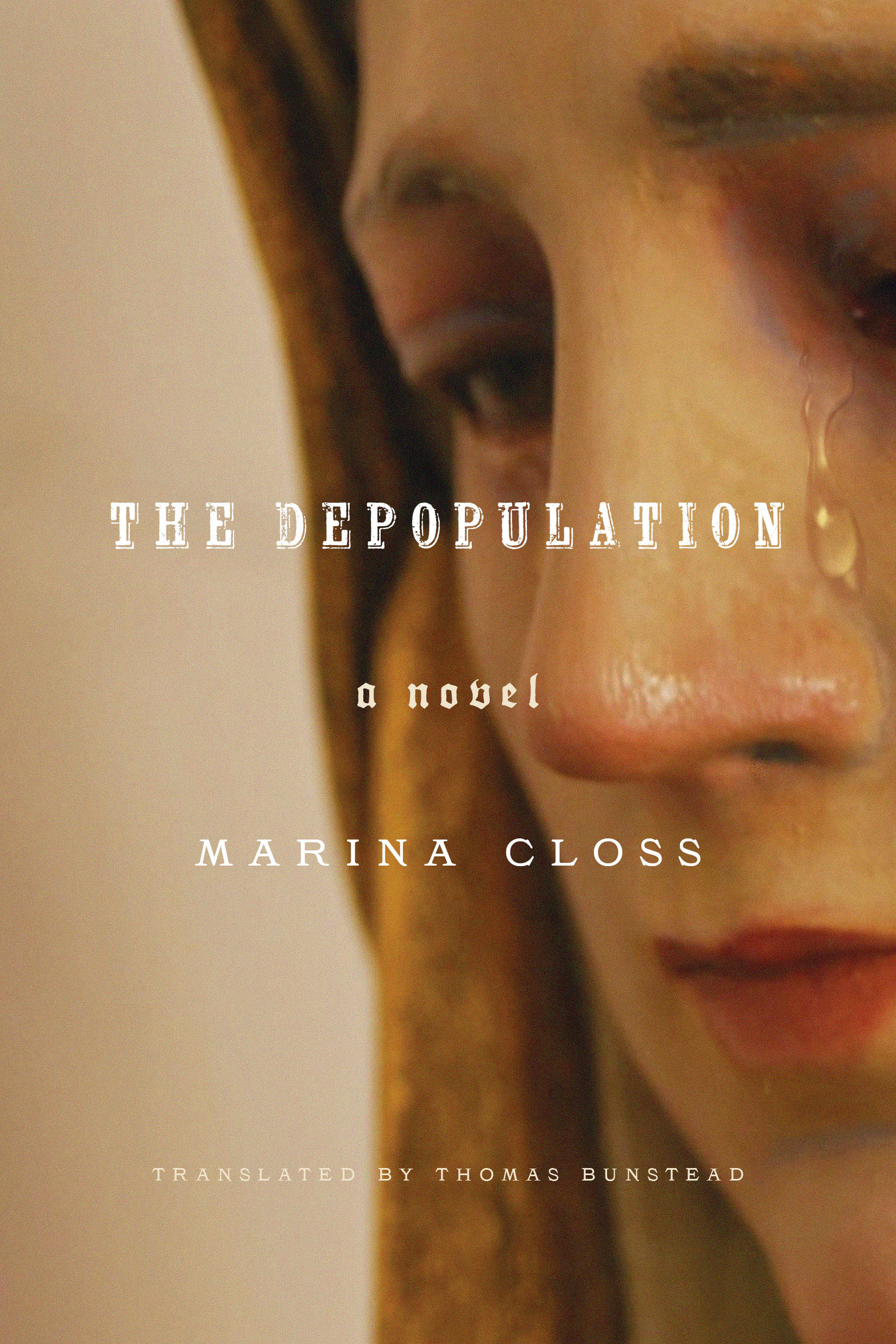
Excerpt from The Depopulation by Marina Closs. Translation copyright © 2026 by Thomas Bunstead. Published by Bellevue Literary Press: www.blpress.org. Used by permission of the publisher. All rights reserved.