Annie bought a fifth of whiskey from the liquor shop beside the Starbucks because money was looming and because Vera’s addendum had unsettled something that needed repair—the image of her lips against Tom Selleck’s mustache, time and again.
She began to think about calling Maria about her dad but could not bring herself to do it. And a sly wickedness threaded through her, just as it did Vera. Actors, dancers, the entertainer. All rash and something darker, mercenary.
After a few swigs, she browsed the Salvation Army racks. She must have looked more depraved, more famished than usual, because the cashier kept hawking her from the counter. She spotted a tank top printed with a voluptuous cartoon moose, long lashes and a beer mug in its grasp. Get Wild in Hope, Alaska, it declared. The cashier softened once Annie handed over the money.
She parked the LeSabre in front of a Chinese takeout joint with blackened glass and dozed for an hour; when she woke, the sun hung low and so did her mood, the whiskey gone and a slow, rotting guilt moving through her, toward some nameless thing or person she could not place.
The day manager met her at the club, still wearing his shiny vest but now loosened and nearly slurring his words. It turned out he handled the night shift as well, a self-appointed workaholic. He had grown aggressively chatty, the overfamiliar sort even when sober.
He guided Annie to the dressing room with one hand pressed against the small of her back. She politely told him she could find her way, but he insisted on introducing her to the girls of Girls, Girls, Girls. She hurried to outrun his hand, yet he clung like Velcro.
She slipped away briefly into the restroom where she drank deeply from the bottle, but when she stepped out he waited outside to resume the journey. The dressing room was now crowded with brightly dressed women, all of them pausing from their makeup to stare hard at her in the doorway.
This is Annie. She’s our dancing dog tonight, announced the manager.
The women offered flat hellos and did not even attempt dog jokes or question the manager’s odd pronouncement, which meant they did not much care for him and wished him gone as soon as possible.
Let’s give her a warm welcome and keep our stage time tight tonight, okay, ladies?
A few terse thumbs-ups were exchanged.
Annie was fairly buzzed at that point. Everyone had their own robe, a stubborn stake, and a place within the domestic glow of the dressing room, and here she was, poised to upset the balance of everything.
She settled into a metal chair between a woman with a riot of perfectly sculpted curls and another in a long pink wig. She pulled out the whiskey to make friends, but the curl-haired woman took the bottle from her hand and warned, you’d better put that away before the manager sees.
No drinking, said the pink-wigged woman.
As Annie began to apologize, the curl-haired woman snatched the bottle back and tossed it back anyway. The pink-wigged woman shut the dressing-room door, downed the whiskey herself, and then handed it to the next girl, who passed it along in turn.
So you’re from Edmonton? asked Curly-hair, wariness lighting her eyes. When Annie said she was merely passing through, Curly-hair seemed pleased and returned to perfectly lining her lips in a deep mauve and sharpening the tips of her elaborate, winged eyeliner.
You’re looking very Tina Turner today, said Pink-wig, which Curly-hair ignored. Annie knew to stay quiet at first. It’s better to make a slow entrance than a bold one in sacred spaces.
The stage schedule was taped by the door. Annie landed squarely in the middle of the lineup between Star and Sage: DOG GIRL, in jagged handwriting, probably the manager’s.
She set to work on her face, glad to occupy herself. After a while, the usual chatty ease returned like a wound healing, the other girls forgetting her intrusion. She painted her lips a fierce scarlet and deepened her eye shadow beyond usual, seeking a sense of shield, but the liner curled around her eyes in a way that made her look witchy and desperate.
Bass thumped from the other side of the wall, and, as if in a dream, the girls dropped away one by one and reappeared, sweating in the familiar old alchemy.
The pink-wigged woman introduced herself as Star. Annie was to follow her in the lineup. Freckles dusted the bridge of her nose and the span of her shoulders. She was tall, sinewy, a touch stooped.
Star said Annie didn’t look like a DOG GIRL, so she showed her the mask. Star was very young indeed, twenty-two, juggling vet school with her studies.
Maybe it’s a sign, Annie said.
What’s a sign?
The dog thing. You being a future veterinarian.
A sign of what? That I’ll take care of you?
Not like that, just, like, a presage that you’re on the right path.
Well, are you a good omen? Am I on the right path?
Yes, you are, Annie replied, because she was finally floating, buoyed by the whiskey, and the girls were stunning in their costumes. Rhinestones, spangled fabrics in hazy, ethereal colors unknown to nature, hair lacquered into place, all ready to be seen and to perform. Not such a grim prospect now that she stood among these entertainers.
All these girls, every single one of them, so beautiful, moving to the same song each night, skin pressed against the cold safety of the pole, the stage, accepting the money graciously. And again, and again, Vera pressing her lips to Tom Selleck’s lips. And again, once more, captured on film, a moment, perhaps forever, in the minds of the men who came and left, who paid their cover and admission, who paid to watch Star whip her hair, lean back on the pole, perfectly poised, a fragile bridge in space.
Star hissed at her to hide the bottle. In the doorway stood the manager, sniffing around, suspicion in the air.
Has anyone seen Penny? he asked, repeating Penny as if he could conjure her out of thin air.
Nope. Not a trace. Try the back room. Nobody looked up from their mirrors. Cold shoulders, a united front until he left.
What’s the money like here? Annie asked Star, who was heading toward the exit, adjusting the elastic on her G-string, running a finger under it.
Uh, it’s decent, usually. But mostly for private dances. They say no touching, but . . .
No touching, no touching. None of it mattered. Everything felt exhilarating and unfamiliar at once, too. They were blessed by this ritual of preparation. So much focus in the mirror, painting and painting and buffing and spraying. Who else prepared so meticulously for their craft? Who else had to be as aesthetically pleasing as they were athletic? Such gorgeous, dangerous instruments, the sharp, sharp rhythm of heels, not merely gears but the machine itself, a device of desire. Without the girls, the men would simply wander, bumping into each other.
And it wasn’t some chorus of girl-power nonsense, no, it ran deeper than that. There were certainly desperate nights, compromised nights, but for all they revealed, there was more withheld. Master performers. The audience, the men, saw as much as they were allowed and nothing more, not even a real name.
Annie should stretch, get ready. She wasn’t in danger of tipping over into drunkenness yet. She remained lucid, aware of the lingering scent of Simple Green mixed with perfume, the talcum powder stench.
She left her jacket draped over the back of her chair and stretched in only the bedazzled bra, bending at the waist, touching her toes, her bust defying gravity. She explored the contours of her joints, sliding her ankles, elbows, and neck, wrists in a slow grind.
Star’s song was winding down. Go, go, urged another girl, pushing Annie toward the door by the butt. She slipped into the jacket and sprinted to the side stage where the smoke machine hissed and sprayed, and there she glimpsed Star, legs splayed, pressed to the floor, arching her back.
Something felt off. Annie’s face was too cool, nearly pressed against the cold air. The mask. She scrambled back to the room for it. All was quiet, too quiet. They had been whispering about her, but who cared.
Done already?
No, no, she muttered, clawing at the box.
Mask on, the girls laughing and cooing, not unfriendly. She wiggled for them, and they clapped.
Back out the door, onto the stage again, passing Star as she left—Jesus Christ, you scared me!—a hand on Annie’s shoulder, the first guitar riffs of “Legs” heating up, pushing her forward onto the stage, the audience, the men, silhouettes on the banquettes, tattered upholstery, then bathed in light, faces yellow, green, and blue, glowing like neon. Did they ever clean the furniture? What lived inside it? The men chuckling among themselves, leaning in, whispering into their friends’ ears, a smirk here and there.
Annie danced for them, and the dancing felt right, satisfying, and the men watched. They watched and drank and, though the music thundered, they remained quiet, discreet in their enthusiasm. They did not yell or holler the way the Club X crowd did; their zeal was controlled, prim.
The manager lounged at the bar, elbow propped, drink in hand. Annie danced and danced. The room felt hotter than it had earlier. She rolled her ankle a touch, but the adrenaline carried her. She arched her spine, exuding more freedom. When she shed her jacket, a collective sigh rose. A man wearing a baseball cap pulled low over his eyes took a sip and shifted in his chair. After she shed her trousers, puddling on the stage, he fished into his wallet and came forward. Annie knelt and he slid a bill, vibrant and Canadian, into the elastic of her G-string. She cupped his cheek, and his eyes grew wet, wide.
The manager moved toward the stage, one hand raised. She rose and kept dancing, of course—no touching, no touching.
When the bra slid down, more men adjusted themselves. Annie glowed, feeling right and glorious, heels slicing the air, legs stretching longer and longer, almost supernaturally, reaching into the room’s far corners, then returning to the dog persona on the floor, hips pumping, the stage’s scrape against her knees a distant ache, as if happening to someone else, not to her; she felt released. More bills stuffed into the G-string, like winning a game of chance, something deeper, more contrived. The song ended, more money, a scatter of laughter tossed around the room, perhaps for her, perhaps at themselves.
Well awoooooo then, the crowd teased again, aging spectators really, as she gathered herself, the money; they nudged and elbowed one another. Some bitch, they hissed with a laugh, the only words she could decipher. Who cared, their admiration beneath, they never spoke plainly, did they.
How did it go? Back in the dressing room, Star gnawing on half a protein bar.
Annie told her it went well. It went good, she said.
She drank more and offered the bottle to Star, who declined, guiding Annie outward to mingle, how the real money is made, she said.
Annie disliked mingling. She did not enjoy soliciting, passing hors d’oeuvres at private events, bowing, please, would you, please, it’s caviar, yes, Osetra of course.
Yet the whiskey did its job. It moved through her, and the Prince’s anthem filled the room, the fake smoke curling like a scent of sex, the girls, girls, girls, girls, writhing, sitting, giggling, tracing a casual arm across someone’s shoulder, faces resetting when they turned away from the men who sat as solid as boulders.
Then a young man, leaning back, on the edge, an outsider, someone easy to target? Quiet, impressionable in the smooth plane of his jaw, baseball cap drawn low, a practical work jacket, duck-cloth, cuffs worn. He wore sensible shoes—like the kind his father used, pull-on Merrells, black leather, a heavy tread; old-school footwear for a kid.
Allowing the beat to pull her along, she followed instinct, the irresistible pulse of the music. Nothing felt truly serious here. None of it mattered, really, right? She signaled to the bashful fellow with the close shave, a simple come-hither. The whole act was ridiculous, yet he rose, dusted his pants, and trailed after her. His friend laughed softly. Watch yourself, he’s got teeth!
__________________________________
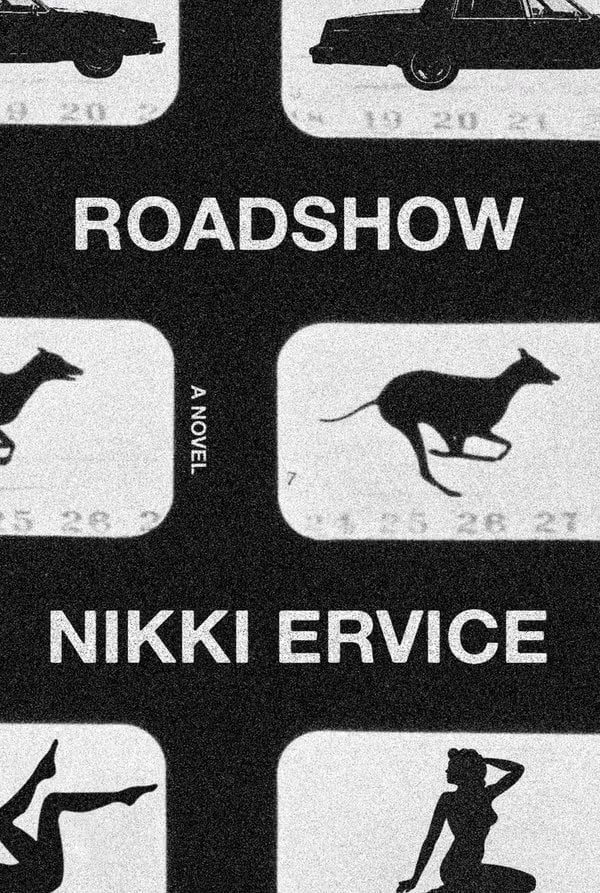
From Roadshow by Nikki Ervice. Published by Astra House. Copyright © Nikki Ervice 2026. All rights reserved.