
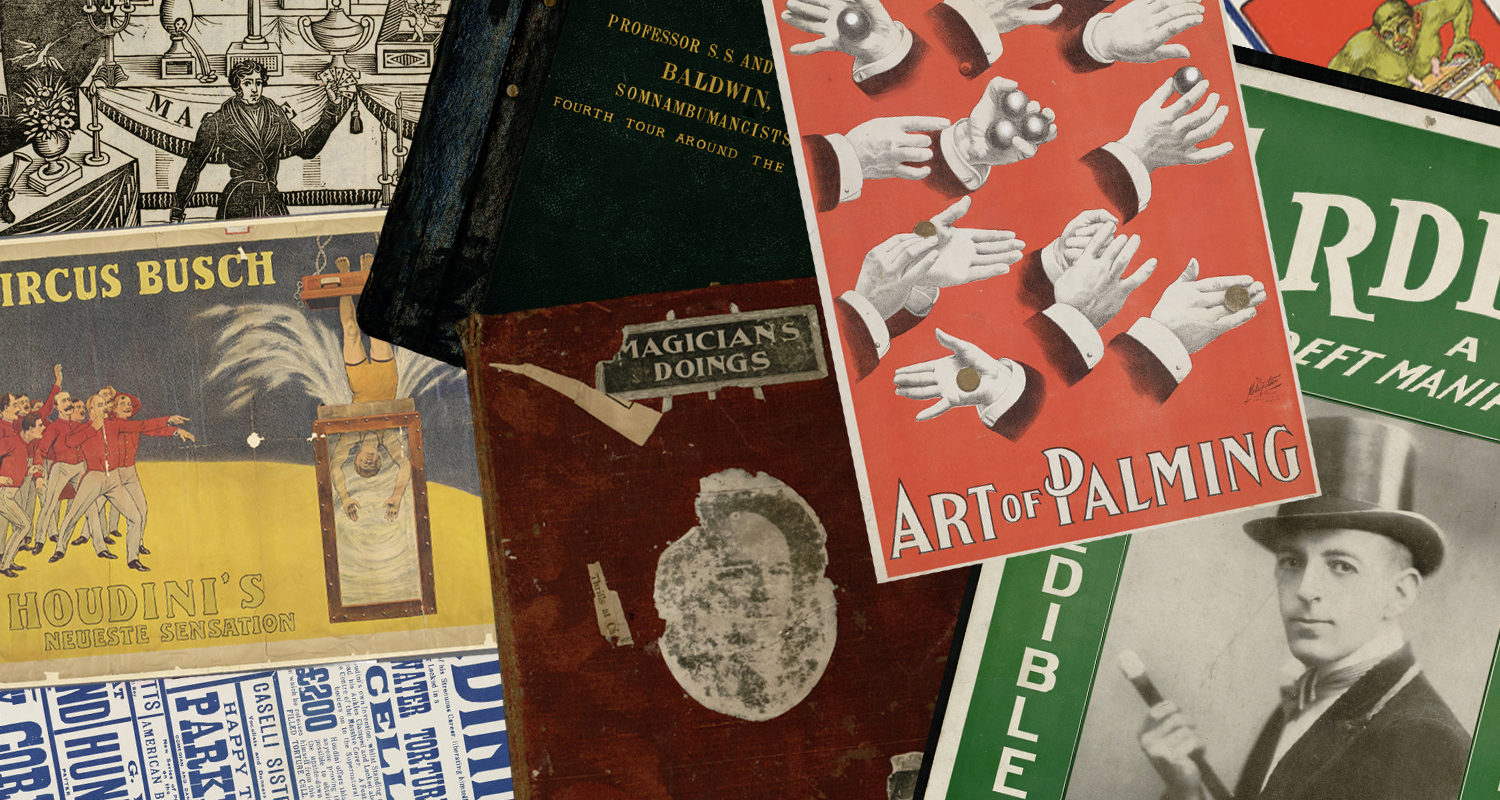
Magician and escape artist Harry Houdini was an extraordinary collector, turning warehouses and his Harlem residence into sprawling storerooms filled with books, posters, newspaper clippings, and more. His penchant for collecting might seem unsurprising for a showman, but his dedication went far beyond the ordinary. Part of his library supported his craft—he amassed volumes on safes and prison architecture, as well as catalogs from lock manufacturers—but a deeper, archivist’s instinct guided him. Houdini sought to document and preserve items connected to the history of magic, spiritualism, and theater, and by the end of his life his holdings grew so substantial that they could rival those of Harvard or the British Museum.
Wherever Houdini traveled, he bought books, cultivated enduring ties with rare-book dealers, and even placed advertisements in magazines seeking new material and leads. The fixation was described as so intense that, according to the introduction to Eric Colleary’s new book Houdini’s Library, a moment of terrifying airplane turbulence prompted him to recall, “Honestly I thought of my wife and theatrical collection.”
Alongside his volumes, Colleary has assembled an exhibition of materials also titled “Houdini’s Library,” on display through January at the Harry Ransom Center at UT Austin. In anticipation of the 100th anniversary of Houdini’s death on Halloween, here are a few intriguing books and items from the magician’s trove.
The Houdini Library Catalog
Houdini himself produced a fifty-three-page typed catalog cataloguing all the books in his collection, complete with his notes on each volume. One of my favorite annotations is for a 1901 work called Entschleirter Magnetismus by Joseph Gregerowitsch: “This Doctor is the best that ever tried this game and he actually believes in it himself. This hypnotism is a wonderful thing for those who believe in the power of the hips.”
Harry Houdini, The Unmasking of Robert-Houdin
Robert-Houdin, Jean-Eugène, was among the earliest sources of inspiration for a young Erik Weisz to adopt the stage name Harry Houdini, honoring that initial influence. Yet as Houdini corresponded with contemporaries and gathered more information, he realized that his idol often exaggerated and borrowed from others. That disillusionment matured into a work titled The Unmasking of Robert-Houdin, a book Houdini financed and translated into French, Robert-Houdin’s mother tongue.
First edition of the 1584, Discoverie of Witchcraft by Reginald Scot
One of the earliest English texts that skeptically questioned the persecution of alleged witches. Houdini had this copy shipped from England during World War I, paying an extra fourteen shillings for “insurance & war risk.”
The Sermons of Bernard de Clairvaux with a forged letter claiming ownership by Martin Luther
Hermann Kyrieleis pursued a brief, infamous career between 1893 and 1896, forging fake documents attributed to the Protestant reformer Martin Luther, including a letter that accompanied a copy of sermons by a 11th-century abbot, a mystic who helped found the Knights Templar. The book itself is authentic, but Luther’s letter is not—Kyrieleis was exposed, arrested, deemed insane, and confined to an asylum. It remains unclear whether Houdini believed the forged letter or simply recognized it as a well-known literary hoax.
Ephemera about Count Cagliostro and the Affair of the Diamond Necklace
An 18th-century scandal surrounding a necklace affected the reputations of King Louis XVI, Marie Antoinette, and numerous nobles, and a magician named Cagliostro was also entangled in the affair. Houdini’s fascination with the event led him to sift through Cagliostro’s Paris residence and to purchase bundles of papers from London and beyond.
Ephemera on the history of magic
Houdini amassed a wealth of items tracing magic’s history—from Albertus Magnus in the 13th century to George Parker Bidder, the 19th-century child prodigy who became a famed engineer; to Henry Box Brown, born enslaved in Virginia, who mailed himself to freedom and later performed magic in England; to Edwin Booth, an actor overshadowed in history by his brother John Wilkes Booth. Among the selections in Dr. Colleary’s volume, my favorite consists of playbills for an oddly named 1826 show titled “Odd Sayings and Queer Doings,” which seems tailor-made for revival as a podcast title.
Information on a rival collector
Here’s a premise for a novel: Houdini had a rival in the world of magical librarianship, Dr. Saram R. Ellison, a man who amassed over 2,000 books on magic and even built scale models of illusions in his spare time. The two were friends, yet frequently contended for the same items. Ellison’s collections were donated to the New York Public Library, or sold—but his wand collection eventually found its way to the Society of American Magicians.
“Grangerized” copy of Life of Edmund Kean by Frederick William Hawkins
Houdini’s library boasted several one-of-a-kind “super-illustrated” editions—rebuilt with add-ons such as pictures, autographs, letters, and other historical ephemera to enrich the original text. Houdini possessed a number of these editions, and one on the life of Edmund Kean expanded into an eight-volume set that presents theater history through the lens of a single prominent figure.
Playbills and ads for automata
Well before today’s tech oddities fascinated relatives online, people were enthralled by automata and “talking machines,” which enjoyed a golden era on the stage in the 19th century. This included “Euphonia,” an 1846 talking machine devised by Joseph Faber and shown in London. It used a bellows for air and a complex internal mechanism to imitate the human vocal tract. It resembles a large loom, with a woman’s head affixed to its side. It’s both eerie and captivating.
Information on imitators
Houdini also kept track of performers who tried to imitate him, including the aptly named “Cunning the Jail Breaker,” who, like Houdini, wrapped himself in chains and wriggled free.
Cotton Mather, The Wonders of the Invisible World
This 1862 book appeared in the library of Houdini’s friend Arthur Conan Doyle. Houdini had sent Doyle a copy of this defense of the Salem witch trials just before he and his wife joined the Doyles in Atlantic City. One evening, Lady Doyle staged a seance claiming to contact Houdini’s mother—she had fallen into spiritualism after their son’s death from wounds at the Somme and a bout of influenza. The moment deeply unsettled Houdini, and he and Doyle subsequently embarked on rival lecture tours. Doyle defended seances and purported proofs of immortality, while Houdini spent his career touring the world to expose the false promises of the practice.
Harry Houdini, A Magician Among the Spirits
Inspired by episodes like Lady Doyle’s, Houdini published a 1924 book examining the history of spiritualism and its “dangerous deceptions,” drawing on his vast collections and his experiences with mediums. He dedicated himself to revealing fraudulent mediums who promised contact with the dead—a crusade that he viewed as a public duty, and which was also personal: his father had died when he was young, and his grieving mother had once taken him to a local medium seeking missing insurance documents.
There is a great deal more in the published volume and the accompanying exhibition—if you find yourself in Austin, a visit to UT Austin is well worth it.
Images from the Ransom Center’s Digital Collections
