
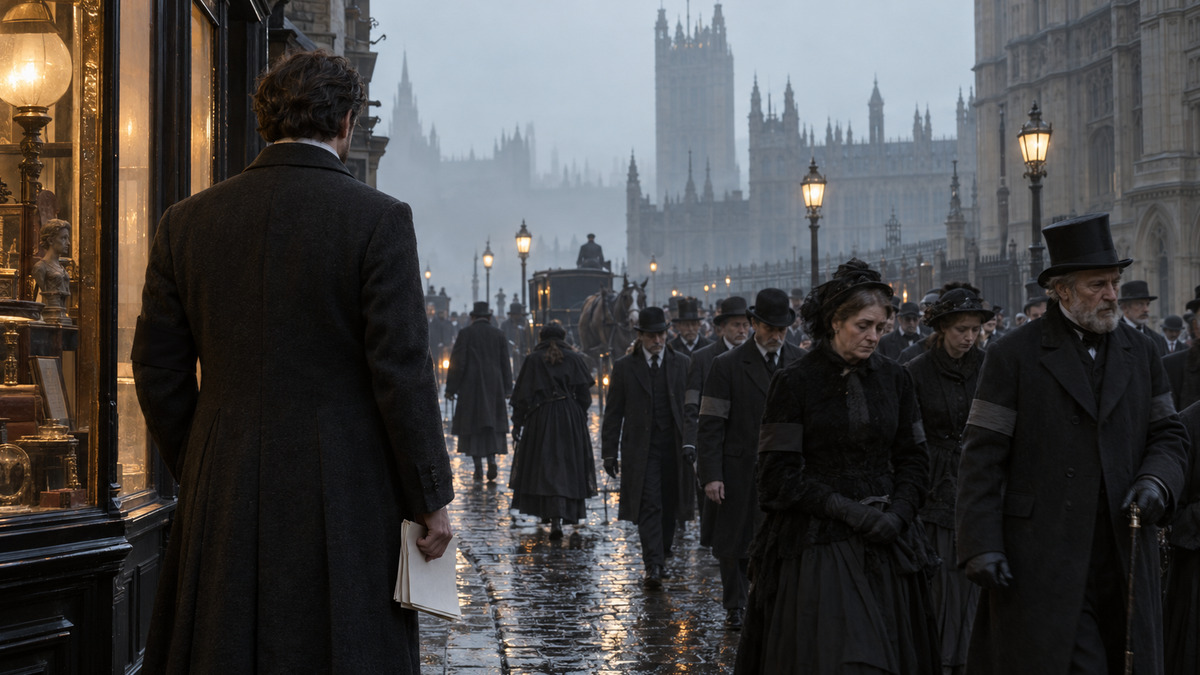
Sherlock Holmes was already more than a successful fictional detective when Arthur Conan Doyle decided he had endured enough. The character had become a public obsession, a publishing phenomenon and, for his creator, an increasingly demanding shadow. What followed in 1893 was not treated as an ordinary plot twist. It felt to many readers like a personal loss, and their reaction revealed how completely a figure made of ink had entered everyday life.
The success that became a cage
Holmes brought Conan Doyle recognition and dependable income, but popularity came with a cost. Readers wanted another mystery, editors wanted another instalment and the detective’s brilliant method threatened to define the author’s entire career. Conan Doyle had wider literary ambitions. He wanted time for historical fiction and other forms of writing, yet every new Holmes story tightened the association between author and character.
The very creation that made him prosperous also limited how the public saw him. Holmes appeared to belong not only to the man who invented him but also to the enormous audience waiting for his next case. Ending the series therefore became a way for Conan Doyle to reclaim control over his own work, even if it meant confronting the expectations of thousands of loyal readers.
A confrontation designed to be final
Conan Doyle did not give the detective a quiet retirement. In “The Final Problem”, Holmes faced Professor Moriarty, an opponent presented as dangerous enough to match his intelligence. Their struggle led them to the Reichenbach Falls, where both men seemed to disappear. The setting supplied spectacle, distance and a sense that no easy return had been left open.
The disappearance was constructed as an ending, not a temporary cliffhanger. Holmes had met the one enemy capable of removing him from the board, while Watson was left to record the apparent loss. For readers accustomed to watching the detective restore order, the conclusion overturned the comforting pattern of the stories. This time, observation and logic did not lead back to safety.
Readers refused to accept the loss quietly
The public response showed that serial fiction could create a bond as intense as attachment to a living celebrity. Subscriptions were cancelled, angry letters arrived and mourning became visible in the streets. Londoners wearing black armbands turned literary disappointment into a public ritual. Whether every detail of that reaction unfolded in exactly the same way mattered less than the unmistakable message: readers believed something important had been taken from them.
Holmes had crossed the boundary between popular entertainment and shared cultural property. His admirers had invested years in his habits, deductions, friendship with Watson and familiar London world. The author possessed the legal power to end the story, but the audience felt it possessed an emotional claim. That conflict now seems familiar whenever a beloved character is removed from a long-running series, yet it was strikingly visible here.
Why the detective could not remain dead
A fictional death is only permanent while its creator and publisher agree to leave it untouched. Demand for Holmes did not vanish after the shock. Instead, absence intensified the character’s value. Readers continued to ask for his return, and the detective remained commercially stronger than many living protagonists who still appeared regularly.
Conan Doyle eventually found ways to write Holmes again, first by revisiting an earlier point in the chronology and later by explaining how the apparent fatal encounter had been survived. The return did more than satisfy disappointed readers. It confirmed that public enthusiasm could influence the future of a fictional world, even after an author had tried to close it decisively.
The attempted ending ultimately strengthened the legend it was meant to contain. Holmes became the character who could survive not only Moriarty and the falls, but also his own creator’s determination to escape him. The episode remains a vivid example of the complicated bargain behind popular storytelling: an author invents a figure, readers make that figure famous, and success can turn ownership into a negotiation between both sides.