
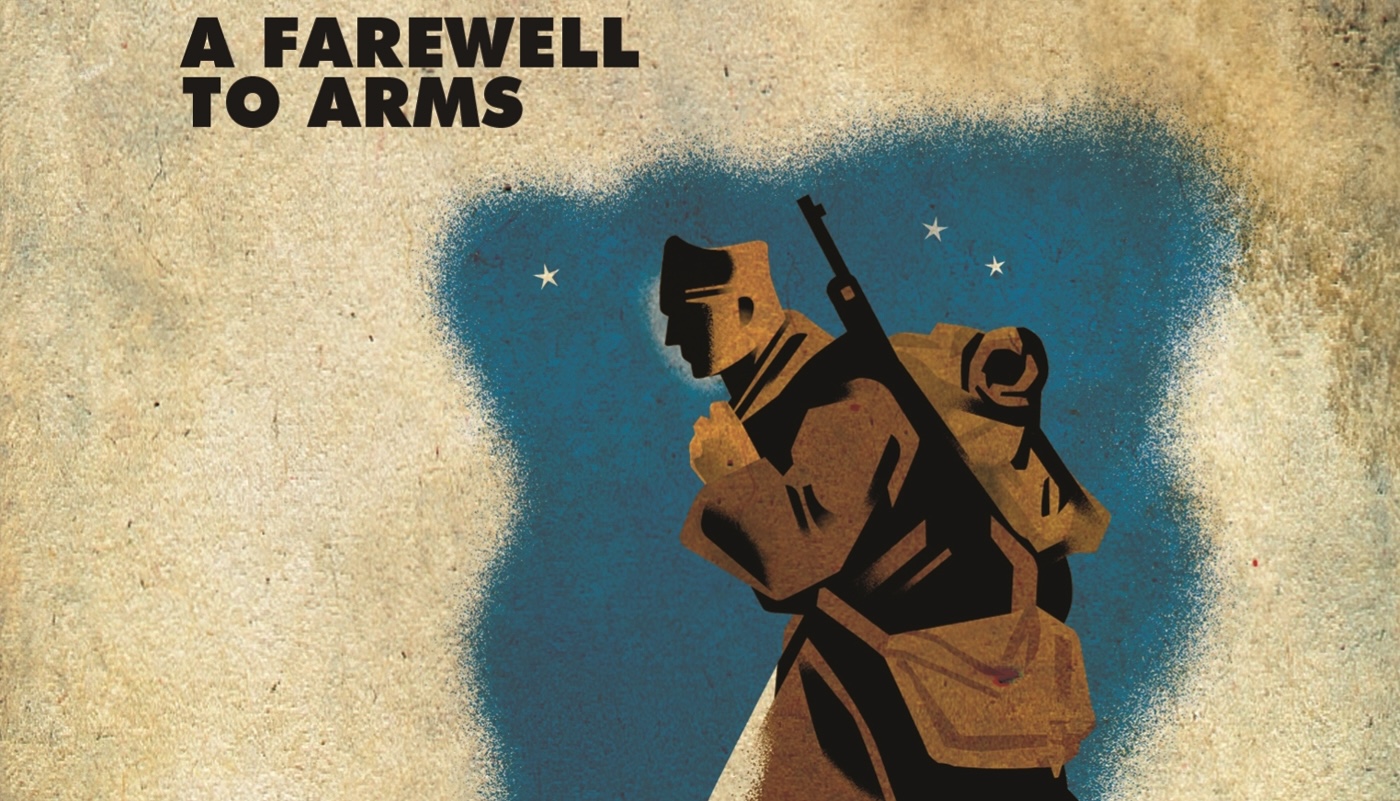
The rising author Ernest Hemingway found himself seething with anger and a sense of injustice. Scribner’s Magazine had chosen to excise a cluster of lewd terms from his latest novel, A Farewell to Arms, as it began its serial run in May 1929. The work, which draws heavily on the author’s own experiences as an American ambulance driver on the Italian front during World War I, was later published in full with the last three phrases reinstated by Maxwell Perkins, Hemingway’s editor at Charles Scribner’s Sons. Perkins managed to secure the restoration of those three lines when the book appeared, including passages such as the rifle‑pointed line, the depiction of women being moved from a soldiers’ house into a truck, and a blunt remark about money. The editor and author negotiated, with Perkins consenting to replace one crude term with a less explicit anatomical word, yet refusing another substitution that would have altered a harsher phrase into something milder (which ultimately appeared as a clipped line about a sergeant). Hemingway, in turn, pressed for the broadest possible use of the language—he argued that emasculation was a minor surgical operation on men, animals, and books, but its effect could be profound. He was engaged in a struggle for “the full measure of language.” Yet he conceded in the end.
Hemingway thus won a portion of his battle. But inevitably, certain terms—along with the novel’s core premarital romance—proved too much for the so‑called Word Police in at least some places. In Boston—a city long notorious for policing any work of literature or art deemed indecent—Police Superintendent Michael Crowley announced that Scribner’s June issue would be barred from sale due to its “salacious” content, even before the book edition reintroduced the offensive terms. Scribner’s responded by rallying to Hemingway, issuing a statement praising him as “one of the finest and most highly regarded of the modern writers,” and pledging to continue serializing A Farewell to Arms in subsequent issues. Yet the publisher also stressed the novel’s “distinctly moral” character. “It is the story of a fine and faithful love, born, it is true, out of physical desire,” the release stated. “If white is to be contrasted with black, thereby emphasizing its whiteness, the picture cannot be all white.”
Spare, truthful words—honest names and honest profanities—had dignity and humanity. It was grand phrases that were obscene in their evasion of hard truths.[/pullquotes]
That defense sidestepped the fact that Hemingway, a admirer of Mark Twain, would have rejected any notion of a simplistic black‑and‑white moral in his novel as a hollow expedient that peddled outmoded values. Still, the press release went out, and Scribner’s hunch paid off. A Farewell to Arms sold 31,000 copies in its initial print run and helped establish Hemingway’s financial independence. As book-industry insiders expected, being “banned in Boston” probably boosted sales—indeed, even among Bostonians who could cross the city line to buy the book elsewhere. One of the novel’s passages struck a provocative note, challenging preconceptions about what qualifies as obscene. In it, an Italian soldier, reflecting on the enormous death toll of a recent offensive, contemplates that the sacrifice cannot be “in vain.” In response, Hemingway’s American narrator, Frederic Henry, reflects on the power and deceitfulness of words:
I was always embarrassed by the words sacred, glorious, and sacrifice and the expression in vain… I had seen nothing sacred, and the things that were glorious had no glory and the sacrifices were like the stockyards of Chicago if nothing was done with the meat except to bury it… Abstract words such as glory, honor, courage, or hallow were obscene beside the concrete names of villages, the numbers of roads, the names of rivers, the numbers of regiments and the dates.
Spare, truthful words—honest names and honest profanities—had dignity and humanity. It was grand phrases that were obscene in their evasion of hard truths. One form of language lied. The other, if used to register authentic emotional experience, didn’t. “Fuck,” “shit,” and “cocksucker” conveyed genuine feeling in real speech. “Glory,” “honor,” and “courage” obscured the truth.
Yet the mini cultural skirmish sparked by A Farewell to Arms wasn’t confined to the open front of public censorship. It played out behind closed doors in the Manhattan offices of Charles Scribner’s Sons, where the prestige press’s own gatekeeping of taste clashed with the realities of a changing literary marketplace. Perkins had weathered this terrain before. In 1922, editors at the firm had raised vociferous objections when F. Scott Fitzgerald proposed a collection titled Tales of the Jazz Age; the word “jazz” itself was deemed dangerous, with Perkins explaining that “the word whatever implication it actually has, will itself injure the book.” Yet the title persisted, and as Fitzgerald predicted, the audience would be the “my own personal public”—the many flappers and college students who saw him as a prophetic voice for their era. For many of those readers, the word’s explicit implications—semen, orgasm, and sex—were part of the allure.
Hemingway’s first major novel, The Sun Also Rises, narrowly escaped rejection by Scribner’s in 1926, despite Perkins’s advocacy. The book’s spare portrait of emotionally adrift young Americans in a postwar Europe confounded the house’s older editors, and Hemingway and Perkins fought to retain the heroine’s sharp epithet when describing her. As one observer noted, Charles Scribner’s would not have countenanced profanity in his own parlor any more than inviting guests to treat it as a lavatory. The house finally agreed to publication, albeit with reluctance, and Boston’s ban seemed merely a foretaste of what the book would endure. Yet The Sun Also Rises sold briskly; by Hemingway’s death in 1961, roughly a million copies were in circulation. Writing on the 1920s, the critic Edmund Wilson mused that the era’s catchword was “Have a drink,” and in the bars of New York and Paris, the young people began to talk with the cadence of Hemingway. Decades later, John Updike observed that “an entire generation of American men learned to speak in the accents of [his] stoicism.”
______________________________
Excerpted from Four-Letter Nation: The Long, Dirty History of American Profanity by Steven H. Jaffe. Copyright 2026 © by Steven H. Jaffe. Reprinted by permission of Simon & Schuster, LLC.