
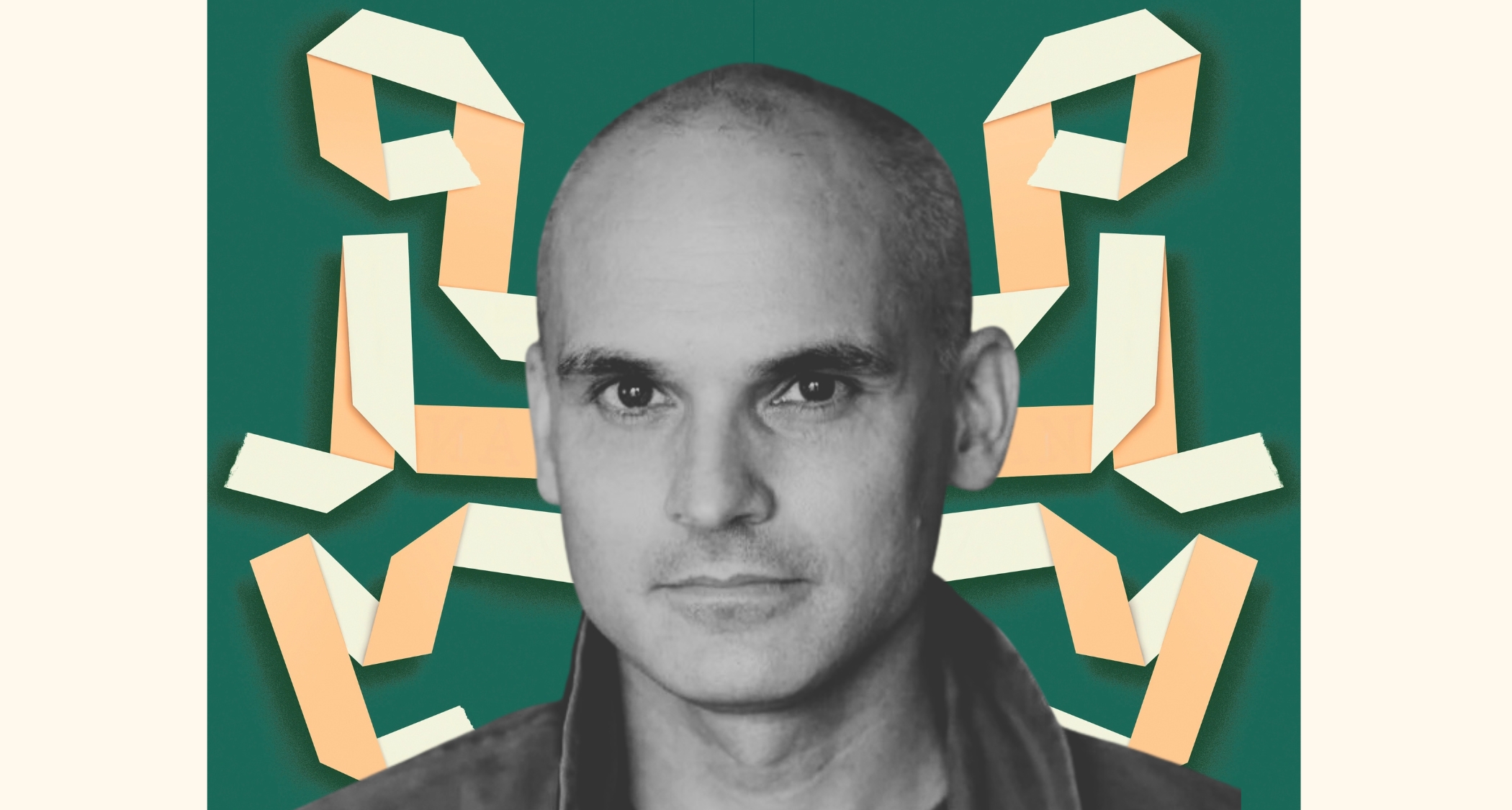
Pulitzer winner Hernan Diaz releases his first novel in four years this week, and he’s parrying a few questions about genre. “I take issue with the word dystopia,” he replies to an opening inquiry. “I don’t think Ply is a dystopian novel.”
Also: “I think the word post-apocalyptic is absurd and oxymoronic. If there’s an apocalypse, there isn’t a ‘post.’ It’s an eschatological word. It’s the end!”
Furthermore, “You used the word dystopia in your first question, and now you use the word nihilism, which I think is an important word. These terms are married, right?”
These quotes make Diaz sound like a challenging interviewee. Really, he’s not—he’s one of the kindest authors I’ve recently met. But I’m not the only journalist who’ll be asking him about dystopias this month, because Ply, Diaz’s third novel, takes place in an urban future (probably New York City) reclaimed by nature. An aesthetic shambles of nonexistent state capacity where crime is low and punk shows—“more like post-punk,” he specifies—reign supreme.
It’s not a dystopia, presses Diaz. It’s something else. A new way of life. A new way of thinking.
“People in this world have lost a lot of things that are very painful to lose,” says Diaz. “The social safety net provided by the state. Rule of law. Healthcare. Education. Things that we take for granted, almost like air or water. We believe these things are natural, but they’re not. They’re constructs.”
As society goes out the window, other things also disappear, “things that were absolutely worth losing.” These include oppressive power structures, environmental suppression, and, top of mind these days, “the commodification of everyday life.”
The protagonist of Ply is a nameless young “pincher,” someone who steals electricity from the spotty grid and delivers it to clients in battery form. Some of her customers are raucous musical groups; others are criminal elements. After she makes a breakthrough in battery storage technology, the pincher is caught in a power struggle, pun intended, between local kingpins.
Ply is a plot-centric novel. But Diaz’s narrative arc is matched by a steady dose of pontification. (“There was freedom in dissolution, joy in disorder,” “Paranoia is not unlike religion,” etc.) Similar to Diaz’s debut In the Distance, his new work can feel like social theory masquerading as old school adventure. This is by design.
“The modern novel since the 17th century has been the home of ideas and how to present them in a narrative, formally appealing way,” says Diaz. “I would dare say that is the partial definition of the novel, and what distinguishes it from other written art forms. All these novels that we think of as adventure novels, like The Count of Monte Cristo, or [H.G.] Wells, they’re constitutional of the novel as a form. I don’t know at what point a literary umpire decreed that this was anathema, that if you can take something out without affecting the structure, you ought to take it out.”
In summation, says Diaz, “I feel that adventure gets a bad rap.”
Diaz grew up in Argentina and Sweden but has lived in New York since his 20s. His latest work completes an all-American triptych: pre-U.S. (In the Distance), peak U.S. (Trust), and post-U.S. (Ply). “It wasn’t deliberate to write this triumvirate of novels,” says Diaz. “I’m not that kind of writer. I’m really guided by emotion. It just so happens that I’m interested in the American canon and American history. As I was starting Ply, I saw the arc that you described. It was like, ‘Okay, I guess this is what I’m doing.’”
This last bit ascribes perhaps too much improvisation to Diaz’s process—could you really puzzle together Trust on the fly? Regardless of plotting, Diaz is an unquestionably methodical researcher, no surprise given his academic background. In Ply, his leg work shows when the pincher meets an eccentric physicist named Pola.
“In the Distance takes place in the West, and I’ve never ridden a horse in my life,” says Diaz. “Trust is concerned with finance and capital, and I was a money idiot when I started writing that book. In the same way, writing Ply—I went to the shittiest high schools imaginable and then went straight into the humanities. So I didn’t have any physics background.”
For Ply, Diaz gave himself a “really demanding” scientific crash course, beginning with general physics explainers and moving to primary sources. “Then I would hit the math wall super hard.” After three or four years, possessing “a reasonable amount of knowledge,” he cold emailed a project director at the European Organization for Nuclear Research (CERN), professing his ignorance—though one imagines the writing held up—and asking for help formulating a realistic particle physics invention to feature in his forthcoming novel.
“She engaged with me and invited me over,” says Diaz. “I spent the week 500 feet underground. It changed my intellectual life for sure. I had meetings with all these engineers and physicists. It was fun to see what a great time they had, being free to imagine [my book’s invention], talking about something completely impossible.”
It might be “impossible,” but Diaz wanted Pola’s science to feel notionally plausible. “It’s an act of generosity toward the readers,” he says. “I’m not just going to make up sci-fi words, like…” He pauses. “Hypertronic decongestant.”
Diaz also benefited from a 2024 writing residency at Columbia University’s Zuckerman Mind Brain Behavior Institute, where he dipped a toe into continued debates around human consciousness. “For all the physics,” he says, “for all the post-punk music, I think that this book is about selfhood. It’s about subjectivity. What is between us? Very literally, in a profoundly physical sense. This is the question at the core of the book.”
“If you accept, as you must,” says Pola, “that we are a collection of cells, made up of molecules, made up of atoms, made up of elementary particles that are ruled by clearly defined physical laws, you must conclude that what we experience as ‘I’ has to be the result of the interaction of matter at this fundamental level. You, I, we emerge from this interaction. We are this interaction.”
“Politically, I’m very suspicious of nostalgia,” says Diaz. “I think it’s inevitably reactionary.”
This stuff can get a bit woo-woo; it’s no surprise that Michael Pollan followed his LSD book with a primer on human sentience. Diaz, who tends to lean on history, underpins his metaphysical examinations with a discussion of social constructs. What does it mean to be a thinking, self-aware human walking around among other thinking, self-aware humans?
“This idea of our subjectivity…” floats Diaz. “It’s very disembodied, this way we’ve been taught to think about ourselves.”
Much of what we call “subjectivity” is, of course, reliant on history. On what we have it in us to know. The characters in Ply don’t have a full picture of their city’s bygone era, when a functioning state administered the construction of now-dilapidated skyscrapers and highways, but they make forays into its meaning. “Struggling to go back in time wasn’t just reactionary; it was insane,” thinks the pincher. “Inaugurating a president would be as absurd as crowning a pharaoh or appointing a caesar. Yes, the state was gone. […] But instead of returning to an obsolete order, why not find the advantages in this territorial fragmentation and institutional disintegration?”
Civilizational nostalgia surfaces again and again in Ply. There are parallels to be drawn in the MAGA crowd pining for the conforming jingoism of the 1950s. But a more apt comparison might be the Mirabilia Urbis Romae, in which Medieval scholars deciphered the staggering ruins of Classical Rome.
“Politically, I’m very suspicious of nostalgia,” says Diaz. “I think it’s inevitably reactionary.” Diaz is more interested in the sort of nostalgia that derives from childhood. “That well of sweet, sad memories,” he calls it. “That particular kind of longing is a vital texture for what I write. I think it has to do with the experience of loss.”
This texture is most palpable when Diaz describes the age gap between Pola—among the city’s oldest inhabitants—and the pincher. “I was interested in this relationship between an older and younger woman,” says Diaz. “I was going through my notes the other day and found something hilarious that I’d forgotten, a note I made to myself about Tove Jansson’s The Summer Book, which features a grandmother and a grandchild. My note said, ‘A punk Summer Book in the future.’ I actually made myself laugh, which never happens.”
Really? From this interviewer’s perspective, Diaz appears remarkably good-humored on the eve of his publicity whirlwind. Ask him about the Planck constant! Ask him about our place in cosmos!
Just remember to lay off the D-word.