

On my second day as a rookie English teacher at my alma mater, Stuyvesant High School, I walked along the fourth‑floor corridor toward my first class.
Hidden behind a thick pillar, a kind-eyed man with an Irish lilt beckoned me from the shadows. “Psst… hey, come over here.”
When I drew near, he blurted out: “Get out while you can!”
He caught my puzzled look, not yet grasping the warning he was issuing.
“It’s five shows a day, before the toughest audience you’ll ever face,” he said with a twinkle in his eye.
The man was Frank McCourt, Stuyvesant’s esteemed creative writing teacher. I was instantly taken with him.
That moment marked the start of the most fulfilling mentorship and friendship I’ve known. Two years later, I followed his counsel and “got out” to pursue a dream in journalism. Even after I left the classroom, our paths stayed intertwined, and our lives continued to intersect.
A few days after his first essay appeared in print, an excited Frank called me from a phone booth on East Ninth Street, near the pub. His voice sounded electric.
Frank wasn’t only a beloved teacher; his true aspiration was to become a writer. Yet no opportunity had opened for him, and he was nearing fifty. I recall one afternoon when the eminent Jerzy Kosinski, author of Being There and The Painted Bird, visited Stuyvesant. After his remarks, Frank approached him and lamented: “How can I become a writer like you?”
Over the years of our teaching together, he confided that, on nights and weekends, he was trying to draft a memoir about his impoverished childhood, but he felt unable to shake free the sounds of the classroom from his memory.
I left Stuyvesant because I accepted the role of Editor at a new weekly newspaper covering Manhattan’s West Side. It was an excellent first journalism post, and I was only 24. Frank told me he was proud to see me chasing my dream.
About a year after I left teaching, Frank and I shared one of our occasional dinners at the Lion’s Head, a well-known haunt for journalists and writers on Christopher Street in Manhattan. That evening, we spotted the venerable columnist Pete Hamill across the bar. Frank admitted he envied Hamill and Jimmy Breslin, two of the more literary columnists who rose to fame in New York during the 1980s.
As he kept his eyes on Hamill and lifted his pint, he turned back to me and said: “You know, I’ve always wanted to be a columnist.”
“Interesting. If you could pick a topic, what would you cover?” I teased him.
“Well, one week I’d visit a pub to gauge the bartenders’ craft and whether the chat is lively. The next week I’d attend a church or synagogue and critique the preacher’s sermon. And the following week I’d sit in on a few classes at a school and write about whether the teachers truly engage the students.”
I nodded and replied: “That could be quite compelling.”
“They’re the three most important institutions in society—pubs, houses of worship, and schools—and nobody writes about them unless there’s a scandal,” Frank elaborated.
Two weeks later, a new monthly column by Frank McCourt, titled “Forays,” appeared in The West Side Spirit.
The debut piece offered a witty, literary meditation on the history and enduring charm of McSorley’s, a pub on East Seventh Street in Manhattan. The city’s oldest drinking establishment, it opened in 1854 and still pours ales and stouts today, 172 years later. McSorley’s had long been Frank’s favorite watering hole.
But midway through our journey, an unexpected obstacle arose: You can’t name a school after a living person.
A few days after his first essay appeared in print, an excited Frank called me from a phone booth on East Ninth Street, near the pub. His voice sounded electric.
“Tom, you won’t believe what I’ve just spotted. Hanging above the men’s urinal is a framed copy of my McSorley’s column. Do you have any idea how many people will see that?!!!”
Years later, once Angela’s Ashes became a global phenomenon and sold more than 10 million copies, I would introduce Frank at an annual event he hosted for my media company, “The Blackboard Awards,” where we recognized twenty‑five Teachers of the Year across New York City. The crowd always hung on Frank’s storytelling and insights.
In the course of my introductions, I’d recount the McSorley’s bathroom anecdote. “Until he wrote Angela’s Ashes, that was Frank’s best‑read piece of writing,” I’d deadpan, provoking waves of laughter from the audience.
I was proud of how Frank and I eventually pursued our own dreams. For him, fame arrived almost overnight on a global stage, though it followed years of struggle. He was never quite prepared for all the attention. He once quipped about the hoopla: “Tom, I’m the mick of the moment.” And he flashed that mischievous grin.
While I edited his essays, I sensed that he was a singular talent—linguistically sharp, blunt, perceptive, and unmistakably unique all at once. His prose seemed to crackle from the page with a command: “LISTEN! This matters.”
I looked forward to featuring his work and helping him see that he belonged in New York’s vibrant journalism ecosystem. He approached his pieces with painstaking care, and it showed in the final drafts. They required little editing—why tinker with a future Pulitzer Prize winner?
Watching Frank teach was like watching a maestro perform: he posed provocative questions, drew more detail from students who offered few words, and made learning feel joyful. His assignments were ingenious: “Go home and write a restaurant review of your mother’s (or father’s) home‑cooked dinner tonight. Include as many sensory details as you can.”
Or: “Go home and craft the most imaginative excuse note for why you didn’t complete last night’s homework. The most inventive one means you won’t have to do homework for two weeks.”
After Frank passed away in 2008, The New York Times published a lengthy obituary online. Within the first week, thousands commented, many former students praising him and recalling how his class had sparked their love of writing.
He taught students who went on to become memoirists and novelists, like Susan Gilman, who told me that Frank saved her life: as a troubled sixteen‑year‑old, she found purpose in his creative writing class, and his guidance fueled her ambition to become a writer—an achievement that would indeed make him proud.
After Angela’s Ashes captivated readers worldwide and earned numerous accolades, I watched his fame with a blend of pride and astonishment. Between book tours, lectures, and television appearances, we managed to reconnect from time to time. On one visit, he asked for guidance about real estate: “We’re thinking of buying a co‑op on West 77th Street. What’s this thing called a co‑op board interview?”
That same year, 2008, I, as a publisher and advocate for education, had the chance to help establish a new public high school on West 83rd Street with local Council member Gale Brewer, a West Side luminary.
At the annual teacher‑awards ceremony that Frank emceed for my organization, he would lament that schools rarely honor teachers with names, preferring to celebrate politicians or astronauts rather than the educators who deserve it most.
Echoing his words, I proposed to Brewer that we name the new school after Frank McCourt—a testament to an immigrant success story that could inspire students from all backgrounds. Coming to New York with little more than hope, he supported himself through odd jobs, spent two decades in the classroom, and then wrote one of the late‑20th century’s most beloved books, Angela’s Ashes.
Brewer approved the concept, and we began the work of building community support for a school devoted to creative writing. Yet again, we encountered a surprising barrier: you cannot name a school after a living figure.
So I called Frank to break the news. “Don’t worry, we’ll find a workaround,” I reassured him, even as doubt tugged at me.
I realized that Frank and I shared a deep friendship—supporting each other through good times and bad, guiding each other’s professional ambitions, and becoming inextricably tied by our shared pasts.
I’ll never forget his response, which still gives me chills as I type: “Well, I suppose I’d better hurry up then.”
A week later, I learned that Frank had collapsed on a cruise and was gravely ill. The news shocked me and intensified my resolve to move forward with the school’s dream.
Frank passed away in July 2009. That summer I dedicated myself to campaigning for Frank McCourt High School. At his memorial service in early September, I joined Frank’s wife, Ellen, and New York City’s Schools Chancellor, Joel Klein, onstage to announce that Frank McCourt High School would open that fall. I stood there with a mixture of sorrow and satisfaction: I already missed Frank, yet I was grateful to have helped turn his dream into reality. In his final weeks, he appeared to be pleased with the progress of the project.
I realized that Frank and I had forged a remarkable friendship—guiding one another through triumphs and trials, pushing each other toward professional aspirations, and becoming inseparably linked by our common history.
__________________________________
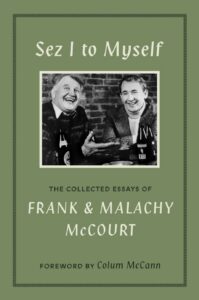
Sez I to Myself: The Collected Essays of Frank & Malachy McCourt edited by Tom and Jonah Allon is available from Abrams.