
Alfred Hitchcock stands as a paragon of suspense, and he remains one of my favored filmmakers from the classic era, celebrated for crafting unforgettable moments and unforgettable figures. One sequence I treasure above most others appears in North by Northwest, when Leo G. Carroll’s spy handler explains the aims of the covert operation asked of Cary Grant, only to have the words swallowed by the roar of passing airplanes. Hitchcock understood how to plunge the audience into the narrative so deeply that the minutiae of the plot become secondary if the rest of the film remains captivating through performances, music, and the way shots are composed.
While many of Hitchcock’s works lean toward thrillers, he also explored other genres. Across his lengthy and varied career, he directed stories about spies and political intrigues, romances, and dark comedies. He also made three films I consider horror or at least horror-adjacent: The Birds, Psycho, and Vertigo. Frenzy tackles a serial killer in a notably graphic manner for its time (1972), but I read it more as a straight thriller than pure horror, since much of the narrative unfolds through the gaze of a man wrongly accused of the murders, rather than placing the audience inside a space of dread and the unknown. The three films discussed here don’t just include horror elements; they also carry pronounced romantic undertones.
Before we dive into the films, though, a note on Hitchcock and his behavior behind the scenes. It’s no secret that Hitchcock was an exceptional director and, to many women in his life, a deeply troubling figure. He objectified women, especially his pale, icy blondes, and when they rejected his advances, he could be rude or worse, sometimes touching or attempting to kiss them without consent. Tippi Hedren, who headlined two Hitchcock pictures, described such experiences in her autobiography during the filming of Marnie, though the mistreatment began earlier, during the shoot of The Birds.
In the climactic sequence, Hitchcock insisted on using live birds for the scene rather than the mechanically operated ones that had been proposed, and Hedren is seen being pecked and attacked. The crew hurled real birds at her, causing injuries and nearly injuring her eye. The production spanned five days for a moment of finished footage, and Hedren emerged from the shoot deeply traumatized, mirroring the ordeal her character Melanie endures.
In light of the revelations about Hitchcock’s conduct toward Hedren and other women in his professional circle—from inappropriate remarks to outright assault—it’s hard to watch that moment (and others) without discomfort. Just as it’s important to acknowledge how romance novels once perpetuated dangerous tropes—dubious consent, exoticizing cultures, even rape—there’s also value in acknowledging the problematic nature of powerful figures in the film industry, from directors and producers to actors and agents. So, while Hitchcock played a pivotal role in shaping horror romance, I’m not praising the man behind the camera.
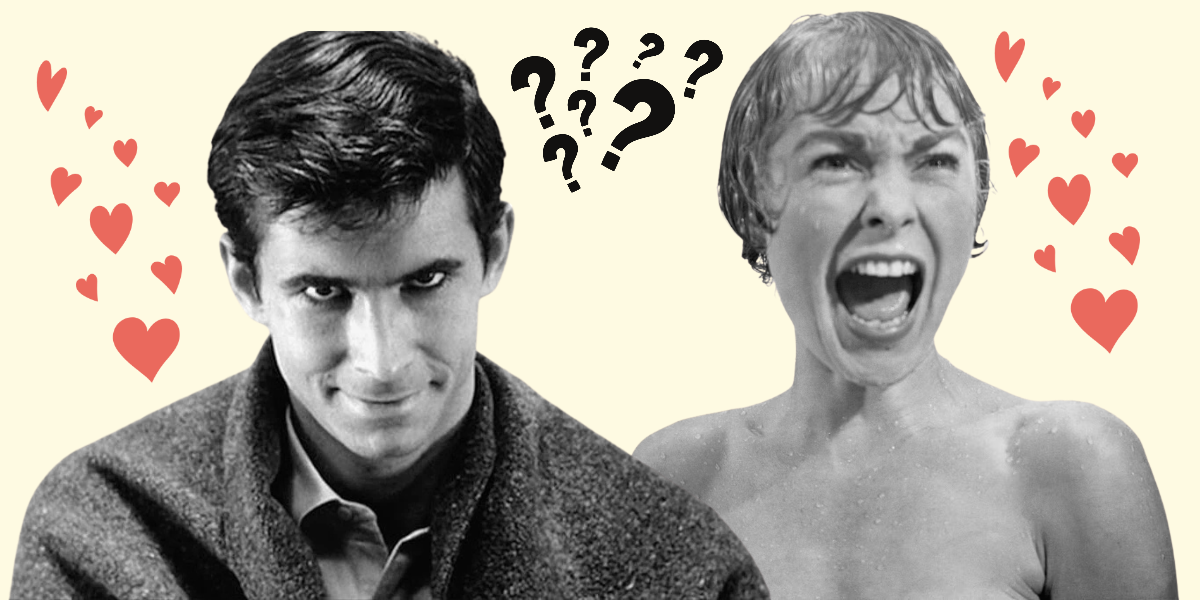
Though Psycho is definitely a horror movie, there is romance here as well.
Psycho (1960) is, arguably, Hitchcock’s most influential and iconic film. It habitually earns spots on all-time-best lists and transformed cinema in numerous ways—from explicit depictions of violence to narrative shocks to the convention of seating audiences before the opening credits to prevent spoiling the twist at the film’s outset. Much has been written about the film’s production (see Stephen Rebello’s Alfred Hitchcock and the Making of Psycho, among others), so I won’t recount many of those details here.
Here’s the gist: the movie adapts Robert Bloch’s novel of the same name, which itself drew inspiration from the real-life serial killer Ed Gein, who murdered at least two women and exhumed many more to assemble a “woman suit” of human skin. Hitchcock’s Psycho marked a major shift from his prior project, North by Northwest, a polished spy romance starring Cary Grant, Eva Marie Saint, and James Mason in Technicolor. Hitchcock shot Psycho in black and white with a tight schedule and a modest budget, using his Alfred Hitchcock Presents crew, lending the film a grittier, bleaker texture.
Though Psycho is firmly a horror film, it carries a strand of romance. Marion Crane (Janet Leigh) is involved with Sam Loomis (John Gavin, who would later inspire Donald Pleasence’s Dr. Loomis in the Halloween franchise). Their relationship feels illicit; the movie opens with them sharing a hotel room after an intimate moment, though they are not married. A rather scandalous opening, which hints at something wilder and more intense than a standard romantic thriller. In 1960, spoilers weren’t as readily accessible, so most theatergoers wouldn’t have anticipated anything but another Hitchcock suspense film for the first act. Marion opportunistically borrows money from her employer so she and Sam can begin a new life together, and the film tracks her as she goes on the run, a straightforward thriller premise, until she ends up at the Bates Motel seeking lodging.
Although the chemistry between Leigh and Gavin isn’t especially strong (perhaps because Gavin isn’t a standout), there’s something compelling and unsettling about Anthony Perkins’s Norman Bates and his attitude toward Marion once they meet. He appears friendly—almost too friendly—and it’s clear he has something to conceal. But Marion has her own secrets, and the Bates Motel parlor sequence, as they share a meal, feels like a dance in which neither party wants to reveal their truth while trying to appear normal.
Undoubtedly, audiences back then remained uncertain about the twist, but when I first watched it, I wondered whether Marion might leave Sam for the shy, awkward Norman. Norman’s attraction to Marion is evident, as he spies on her through a peephole while she changes—romantic from his perspective, certainly not from Marion’s. Norman’s grasp on love seems warped by his relationship with his mother, which distorts his understanding of affection and romance, turning his loneliness into violent behavior.
After Marion’s murder, the film veers squarely into horror, delivering many moments that have since become iconic. Yet the romantic angle functioned as a lure, drawing audiences into a very dark tale while encouraging a false sense of safety—if Marion is the love interest, how could she be killed so abruptly and brutally?
TOP TROPES: Forced Proximity: Marion is trapped in the motel with Norman, and the early exchanges invite the notion that she might be able to help him resist his mother’s domination.
DARK MOMENT: The act of murdering the woman who showed him a touch of kindness and understanding marks the darkest beat in the film.
HEA? No one ends up truly happy here. Sam and Marion’s sister Lila discover Norman’s role as the killer, Marion lies dead in the lake near the motel, and Norman—according to the psychiatrist’s extended exposition at the film’s end—has been fully absorbed by his mother’s controlling personality.
The other major Hitchcock title often considered his masterpiece by many is Vertigo, released in 1958. The story of a private eye who falls in love, loses it, and unexpectedly regains it serves as an emotionally charged, intricate study of obsession and the lengths someone will go to reclaim a life that slipped away. It’s remarkably romantic in many respects, yet it raises a question: is it horrific? Let’s examine.
The opening sequence is intensely tense as James Stewart’s Scottie pursues a suspect across San Francisco rooftops. The chase ends with Scottie slipping and clinging to the edge as his partner plummets to a death. This traumatic event leaves him with crippling vertigo and forces retirement from the force. He takes on a new assignment for an old friend who worries her wife might harm herself, which leads him to shadow Madeleine, played by Kim Novak. It’s easy to see why he’s drawn to her (much to his friend Midge’s annoyance—she’s in love with him). Madeleine is striking and melancholic, spending hours driving through the city and staring at a painting that seems to haunt her. Scottie’s pursuit begins as a straightforward surveillance job, but he gradually becomes captivated by her mysterious allure. When she falls into the bay at the Golden Gate Bridge, Scottie rushes to save her, and from that moment, he’s committed to following her into a dangerous path.
One of the reasons Hitchcock is called the Master of Suspense is because of the way he draws out the tension, keeping the audience on their toes as they anticipate the worst.
The film then unfolds like a romantic mystery: how can Scottie protect Madeleine from whatever threatens her, be it external danger or internal turmoil? Madeleine returns his feelings, and together they investigate the mysteries that haunt her.
But when they reach a Spanish mission, the mood darkens considerably. Madeleine ascends the bell tower and Scottie attempts to follow, but his vertigo prevents him from reaching her in time, and he witnesses her fall to her death. Hitchcock captures the moment with a dolly zoom—the Vertigo effect—an image so iconic that it has been copied endlessly, including in Steven Spielberg’s Jaws when Chief Brody first lays eyes on the shark.
Madeleine’s death shatters Scottie, and the film follows the aftermath of the investigation and a courtroom scene. Scottie is cleared of blame, yet he remains frozen and despondent, and a grieving Midge visits him in the hospital, a portrayal by Barbara Bel Geddes that captures the ache of losing a friend and the impossibility of moving on romantically. After his release, the movie takes a darker turn.
In my view, the second half of Vertigo leans more toward psychological horror than traditional mystery. The romance slowly ebbs away, though Hitchcock still toys with the audience—and with Scottie. He spots a woman who looks almost exactly like Madeleine walking down the street. She insists she isn’t Madeleine but calls herself Judy; Scottie remains entranced and asks to see her anyway. Gradually, he attempts to transform Judy into his lost love, buying her new clothes and changing her hair. His harsh, controlling treatment of Judy—who resembles Madeleine far more than a stranger—strikes many viewers as terrifying. We all recognize this kind of possessive, jealous behavior in a romantic partner from our own lives or those around us. Judy is manipulated into altering her clothes, hair, and even facets of her identity to fit Scottie’s rigid fantasy of a perfect partner.
Why would Judy consent to this? Because she is, in truth, Madeleine, and she still harbors feelings for Scottie. She sinks deeper into the deception, hoping to repair things and build a life with him. A flashback reveals Judy’s role in the ruse (an elaborate murder plot that, like North by Northwest, isn’t essential to the point), and from then on, the audience waits to see how Scottie will react to the truth of his manipulation. Hitchcock’s mastery of suspense stems from his ability to prolong the tension, keeping viewers on edge for what comes next.
Yet in Vertigo, we aren’t simply waiting for the worst to happen: we’re hoping that Judy can save both Scottie and herself and that they might move beyond the past. This same technique of building emotional stakes is frequently used in romance fiction to intensify the journey of the characters—will they end up together, or stay together after they’ve both erred? (For a contemporary nod in horror romance, Clay McLeod Chapman’s Devil Inside features a chapter set in a second-run cinema showing Vertigo as the revival pick.)
Ultimately, though, a conventional happy ending isn’t in the cards for Judy and Scottie. He detects the deception, and in the final act becomes even more cruel. He drags Judy to the same Spanish mission and forces her to disclose her pretense. Even though Judy has complied with his wishes, she dies (and Scottie’s vertigo is cured, freeing him to pursue the next fixation).
TOP TROPES: Other Woman: The complex narrative includes not only the other woman in Midge but also the image of Madeleine that drives Scottie to control Judy. Secret Identity: Judy alternates between pretending to be Madeleine and presenting herself as Judy, then returning to the Madeleine role. The concept of identity constantly shifts in Vertigo.
DARK MOMENT: Scottie realizes Judy is wearing Carlotta’s necklace (the same piece Madeleine owned) and understands that she is the same woman he believed he had lost.
HEA? Scottie misses out on a true HEA twice—first with Madeleine, then with Judy—and the second woman dies.
So, labeling Vertigo as horror (or horror-adjacent) might feel like a stretch to some viewers. Yet there’s no denying that The Birds (1963), Hitchcock’s follow-up to Psycho, sits firmly within the horror domain. This film unsettles deeply as it depicts a world where birds of all kinds suddenly begin attacking people. But the terror doesn’t begin with the bird attacks; after all, horror evolves by shifting us from normalcy to unease, doesn’t it? Hitchcock’s craft here is to establish mood and invest the audience emotionally so that the predicaments feel plausible even when the events are inexplicable.
But the reason these frightening scenes work so well is that Hitchcock knows there must be some emotional investment from the audience, especially when the actual events are so random and inexplicable.
It opens with Tippi Hedren, the newly anointed Hitchcock heroine. After Grace Kelly’s retirement from cinema to wed Prince Rainier, Hitchcock searched for a new leading lady. Vera Miles in Psycho and Kim Novak in Vertigo didn’t satisfy him completely. Hedren—the model who hadn’t appeared in feature films before—was beautiful, poised, and notably new to the industry, ready to please. She comes alive in the film’s first act as Melanie Daniels, a fashionable, capricious socialite who is told she needs to mature after a misstep abroad.
She crosses paths with Mitch, a self-important attorney portrayed by Rod Taylor, who pretends to confuse her with a pet-store clerk. He’s aware of her reputation, and the meet-cute setup promises a lighthearted romantic plot sprinkled with witty banter. After the misunderstanding, Melanie impulsively buys the lovebirds that Mitch had wanted from the pet shop and plans to deliver them to his younger sister at their residence in Bodega Bay. En route, Melanie is attacked by a seagull, a single event that foreshadows the nightmare to come.
The remaining story descends into a spectrum of nightmare-level absurdities. Melanie, Mitch, his mother, and his younger sister (Veronica Cartwright in a veteran horror role) are confined in a tiny town as more birds begin to assault the people nearby. There are moments of extreme tension—like the birds multiplying on playground equipment and the close-ups of the farmer’s eyes after they have been plucked—that linger long after the credits. Yet the power of these scenes lies in Hitchcock’s insistence on emotional involvement from the audience, even when the events feel arbitrary and unexplained.
The budding romance between Melanie and Mitch unfolds as a classic rivals-to-lovers arc: they start with sharp clashes but are drawn to one another despite obvious flaws that suggest they should not be together. They must contend with external challenges beyond the birds themselves, including Mitch’s protective mother (played by the remarkable Jessica Tandy) and his ex-girlfriend who still has feelings for him, portrayed by Suzanne Pleshette in a poignant, small role. Mitch recognizes the depth and warmth beneath Melanie’s confident exterior, sensing the hurt and loneliness she hides just beneath the surface of her performance.
The emotional beats begin light and sweet, gradually becoming more tense and perilous as the bird threat escalates. Inside Mitch’s family home, the trio tries to stay safe while the siege outside intensifies. The climax arrives as Melanie hears a sound upstairs and, against every expectation, investigates alone. She opens the attic door to find hundreds of birds there, swarming and attacking until Mitch arrives to rescue her. The scene is visceral and terrifying, and Hitchcock’s choice to use ambient sound—no musical score—heightens the fear by letting us hear only the birds’ fluttering and Melanie’s fading cries.
Mitch carries Melanie away, badly traumatized, and the new “found family” exits the house to find flocks of birds perching everywhere around their home. Hitchcock leaves the ending deliberately unresolved: does the bird threat conquer the world, or can this fragile unit endure? Yet the romance remains intact—Mitch has pulled Melanie into his circle of loved ones, and he intends to protect the trio as best he can.
TOP TROPES: Rivals to Lovers: Melanie and Mitch begin with friction—her pranks irritate him—but external pressures force them to join forces. Found Family: Melanie’s life feels lonely until she’s welcomed into Mitch’s circle, though his mother is slow to accept her. Meet-Cute Misunderstanding: A cluster of misunderstandings sets up the couple, a familiar trope in romantic comedies that leads to a far more unsettling kind of film here.
DARK MOMENT: The most harrowing moment for the couple’s relationship comes when Mitch seems to side with his mother against Melanie, driving her to tears.
HEA? The pair ends up together at the film’s close, though Melanie is wounded and catatonic, and the audience is left unsure when—or if—the birds will strike again. But they are together, so we’ll call it a cautious kind of closure.
__________________________________
Excerpted from Love Never Dies: Romance in Horror Movies by Emma Cole. Copyright 2026. Excerpted with permission by Beacon Press.
