
I crafted my memoir, Huna, in English, which amounts to writing within a paradox. Huna recounts the Egyptian revolution, six years of political detention in Egypt, and my exile in the United States. It enters English already carrying the weight of how such stories are commonly received in this language: the Arab prison memoir as a torture exhibit for a detached reader far away, where suffering can be devoured, at worst, as proof of the Other’s barbarity, and, at best, as a sincere exercise in goodwill toward the unfortunate Other “over there.” It’s a genre that, as the Palestinian poet Fady Joudah recently described to me, can resemble a “parody of the self,” the self compelled to perform a recognizable, palatable wound even when dissent is present, simply to be legible.
That tension of composing Huna in English grew sharper amid the recent years of genocidal violence in Gaza. English was not merely the language used to lubricate the killing, to euphemize it, and to authorize it; it was literally stamped onto the missiles and rockets that murdered Palestinian kin. It became impossible to continue writing as if this pressure did not color every line I laid down.
Western publishing tends to press toward legibility: a touch of translation here, another set of italics there, a footnote, perhaps, a guiding handrail for the assumed reader stepping into the foreign room. I don’t oppose explanation in principle; quite the contrary, it can be a craft of care, part of what a writer owes a reader. Yet in the particular political tension of this book, written in this language and navigating this literary marketplace, undemanding explanation can exact a heavy cost to one’s dignity. How openly must a world reveal itself before the presumed reader considers it worthy of coming near?
This is what the duality of the ‘anbara’s language and content reaches toward: an invitation toward, more than anything, a mode of relation between author and reader.
So, while composing Huna, the question expanded beyond why I chose English to what English demanded from the book in return. I’ve written elsewhere that “when I reach for Arabic, I reach for radical love; when I reach for English, I reach for currency.” Currency as circulation, political reach, the power to name. Also, the power to forge transnational solidarity across the very borders that crush our bodies. The craft challenge, then, was how to write, imperfectly, a dignified work of literature in the currency of English without letting English rule the entire book.
I found it helpful to think alongside Édouard Glissant’s notion of the “right to opacity”: a text does not have to surrender to transparency before intimacy can begin. Why equate the sense of welcome into a text with mastery and conquest of the writer, when opacity can instead be an invitation into another kind of relationship?
And so, at times I expanded when expansion felt like care. At other moments I allowed meaning to accumulate through rhythm, gesture, and context when demands for explanation enact violence. And at times I left things unsaid, inaccessible to readers who do not speak Arabic. Yet the most decisive arena where I wrestled with that tension was the very architecture of the book.
Huna unfolds as an ‘anbara, an ancient Egyptian prison call-and-response tradition in which inmates speak across cells, replying through the narrow opening in a door labeled naddara. The ‘anbara prison poem begins when a prisoner presses their lips to the naddara and cries out “عنبر، كله يسمع,” summoning every ear and tongue, even the metal of the building, to abandon all else and grant the caller complete attention. Then comes a ten-line poem. Most political prisoners adapted the late Egyptian socialist poet Ahmed Fouad Negm’s ten-line version of the ‘anbara opening, crafted during his eighteen years of imprisonment from the 1950s through the 1980s.
I grew to love ‘anbaras, how they carved out space for celebration and mourning alike—announcing a comrade’s release, comforting a father grieving his distant newlywed daughter, recounting a tale, or toasting a sentence reduced—a communal holding place of sorts.
Huna takes the holler and the ten opening lines of Negm’s ‘anbara as its structural spine. Each becomes an Arabic section header, left untranslated, rendered as a piece of typographic art by Kristyan Sarkis, a Lebanese designer specializing in Arabic type.
If the reader lacks Arabic, these headers frame the book merely as shape, weight, and curvature. The text is held together by something inaccessible to them, and thus some readers might experience these foreign inscriptions as alienating. That very discomfort is precisely where I want reading to begin.
And because opacity is not an act of refusal for its own sake, I did not want it to degenerate into another parody, with English cleanly standing for empire and Arabic for resistance. Arabic remains dear to me, yet I know well that languages do not map neatly onto the political loyalties we attach to them. Arabic has carried our prison poems, yes, but it has also served as the language of our captors; English has carried empire and, conversely, has become one of the means through which those who endured empire have spoken back, and reached toward one another.
The text is about relation; the text is relation. I do not have to become fully knowable to you in order for us to meet; you do not have to share my language to answer the call.
The anbara thus refuses to create a simple divide between Arabic insiders and English outsiders. An Arabic reader may understand every Negm line and still choose to side with the state that imprisoned us. Arabic grants semantic access but not necessarily political closeness. A reader who does not know Arabic may understand none of those words and still feel drawn into what they enact and conjure. This is the dual aim of the ‘anbara’s language and content: an invitation above all to a new kind of relationship between author and reader.
The ‘anbara, then, also disrupts hierarchy. There is often a presumption that a reader enters a text from the vantage of the marginalized Other in order to extend sympathy to the writer-victim. In prison, the anbara travels from lips pressed to one mesh door to ears pressed against another. If Huna itself becomes an ‘anbara, a shout directed to my kin behind bars, then the reader, too, can only receive such a ‘anbara by approaching the naddara of their own prison cell. The hierarchy flattens: the reader-empathetic becomes a fellow prisoner; the writer-victim becomes the theorist who articulates the call. The book thus invites the reader to confront the fact that no one reads or listens without a position. Which cell do you inhabit that you have overlooked? Are you my accomplice or my jailer? Can you name honestly which door, which mesh of a naddara, you are using to hear me?
In Huna, then, I aimed to honor what Sheira El-Malik—drawing from Glissant himself—suggests when she writes: “there is no distinction between literature and the worlds in which it is produced, or with the methods or modes of study of that world; they all belong to the world and they shape worlds.” I view Huna’s craft as a prefigurative literary microcosm for the world I wish to build, the world where I want to make art and stand in solidarity. The text is about relation; the text is relation. I do not have to become fully knowable to you in order for us to meet; you do not have to share my language to answer the call.
So, dear reader, step to your own cell door, press your ear to the meshed wire of your own naddara—listen closely.
_______________________________
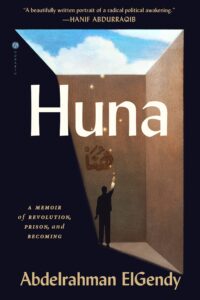
Huna: A Memoir of Revolution, Prison, and Becoming by Abdelrahman ElGendy is available from Hogarth, an imprint of Random House, a division of Penguin Random House, LLC.