
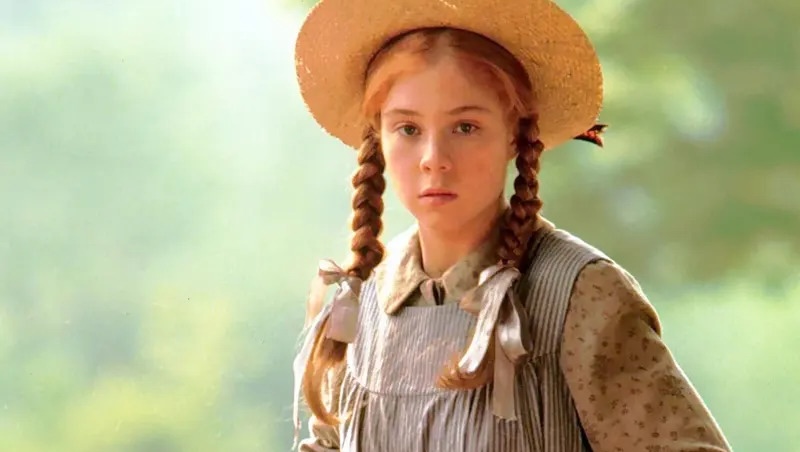
“How dare you!” Anne Shirley seethes. Anne stands in her one-room country schoolhouse wearing a gingham dress. She grips in her girlish hands the pale wooden frame of her writing slate—or rather, what remains of it. The rest of her slate has flown in pieces around the school room. Anne Shirley has smashed her slate over Gilbert Blythe’s head.
Anne Shirley is the heroine of L.M. Montgomery’s 1908 novel, Anne of Green Gables. Gilbert Blythe is her enemy. He has taunted her beyond what any eleven-year-old girl should have to endure. He has pulled her long braid—but that’s not all he has done. Gilbert has lifted Anne’s braid, holding its red length up for the students around them to ridicule, and hissed the mocking word: carrots!
Anne of Green Gables is one of the most enduringly popular Anglo-American girlhood novels. Never out of print, continually adapted to stage and screen, in the 1980s Anne was enjoying a surge in popularity unprecedented even in its own successful history. Across every retelling, every book cover, Anne’s red hair remains central to the story’s drama. The famous “slate-over-the-head episode,” as Margaret Atwood once described it, anchors every adaptation. In it, Anne Shirley displays the full-throttle girlish passion so many of us love her for. She has acted out. But for us readers, for viewers, she has acted rightly.
When Anne brings down her slate, full force, on Gilbert Blythe’s head, the students in the schoolhouse gasp. Her teacher punishes her. Even she feels a little shocked. But she is not sorry. Righteous anger fuels her. “How dare you call me carrots!” And truly, how dare he? Even if he didn’t really mean it or understand the full scope of what he had done. What worse insult could you hurl at a sensitive, story-loving girl than to say: You have the wrong hair.
*
America loves the past. For all our sense of ourselves as forward looking, uniquely modern, and ahead of all the rest, we remain nostalgic for our origins. Our “city on a hill” sense of our own exceptionalism emerges from “our” national story, one about our foundations in freedom, godliness, liberty and justice for all. We fought a war of revolution. We bravely set out into the wilderness. We fought for freedom again and again.
Girls often want power, the power granted to them by the myths of America’s happy story. Also, they resent that power’s demands.
Our history, it’s implied, inaugurates the best version of our future. We narrate the transition between our American past and our coming American destiny all the time. We tell the story over and over as a story. We want to get back to greatness, again. “In no other country on earth,” said a campaigning Barack Obama, “is my story even possible.”
In my girlhood, I learned to love the past in a very particular way: by devouring classic novels of white, anglophone girlhood. I liked novels about the past, and I especially liked novels and stories from the past. I liked how these stories connected my American girlhood to a long history of American girls. The books made my life feel important. Books like Anne took part in an overarching cultural project by which, as Toni Morrison would later write about her own novel The Bluest Eye, a whole idea of a culture “could take root inside the most delicate member of society: a child; the most vulnerable member: a female.” These novels told me that, much like the past, I was lovable. In fact, one lesson of these novels seemed to be that American girls were loveable in much the same way that America’s past was—as an ideal. (The problem is that, as the books themselves sometimes seemed to know, ideals are always different from reality.)
Sometimes the historic girl novels I loved traveled outside of the US itself. They took place in British great houses, or other reaches of the British empire, like India. Anne of Green Gables, famously, is Canadian, and it may seem strange to include it in a catalog of novels specifically for American girls. But Anne, in fact, was published in Boston—its setting is Canadian, but its publication and marketing history are entirely American. No Canadian press published the book until the 1980s. The global scope of this novelistic narrative reach only made my sense of my American girlhood more powerful. The books’ capacious geography felt like a girlish form of manifest destiny. And indeed, girls’ fiction was literally a part of the US imperial project. (In the aftermath of WWII, US State Department libraries in Japan distributed translated girls’ fiction like Anne as a part of a cultural reeducation project.) America was the best version of a vast and astonishing project, these books conveyed. American girls, these stories made it seem, were the best of all possible girls.
Here’s the problem with America’s past: Despite how much Americans seem to love it, when you look at it squarely, it’s a mess. Anytime you try to pluck out a heroic act of liberty and justice to admire, you’re likely to find a hydra-headed tangle of cruelty, displacement, selfishness, violence. Much like whiteness itself, America can only admire its virtues by strategically omitting most of its own history. It’s thorny and uncomfortable, and it’s been a problem for white Americans since our founding moment.
For nearly that whole time, popular fictions have been trying to make American history more palatable. Girlhood fictions, for reasons I’ll explain, perform that flavor-enhancing role in particularly powerful ways. Because girls are believed to be delicate and vulnerable, virtuous and admirable “sweethearts” even when also strong willed and unruly, stories about girls can, by a kind of narrative moral alchemy, make the places they are from seem as though they have those qualities too. Just like a winning gymnast could amplify a nation’s victories, an impassioned girl character could also smooth over a nation’s violence. Synecdochically connecting girls to country could make a country’s mistakes seem like admirable unruliness too.
American girls—at least, some American girls—can find a tremendous kind of power by reflecting back to America a flattering version of itself. But as Mary Lou Retton shows, that power comes at a cost. This flattering version is not true; it’s not real. And to become its emblem, you have to try and make yourself into a less true, less complicated, less honest version of yourself. This, too, feels thorny, uncomfortable, bad. Girls often want power, the power granted to them by the myths of America’s happy story. Also, they resent that power’s demands. They are conflicted. I was conflicted.
And my theory is: This inner conflict finds a symbol in the many girlish fictional heroines who have—who hate having, yet whom we love for having—the wrong hair.
*
“If I was very beautiful and had nut-brown hair,” asks Anne, “would you want me?” These are some of Anne’s early words in Anne of Green Gables. She has just learned that the people she believed had adopted her—a lonely, aging brother and sister— do not want her after all. Anne’s arrival at Green Gables is a mistake. Maybe the problem is her lack of beauty. Maybe the problem is her hair.
The aging brother and sister, Matthew and Marilla Cuthbert, quickly dismiss Anne’s sense that the problem involves hair or beauty. They wanted a boy. They need help on the farm. Marilla, especially, feels determined to send Anne back. “I don’t want an orphan girl,” she tells Matthew, “and if I did, she isn’t the style I’d pick out.” Marilla does not specify what “style” she would like. Anne, loquacious and emotional, seems not to be it.
Anne’s surprise arrival at Green Gables happens in the novel’s second chapter. You might expect that the question of whether Anne might stay at Green Gables would create an organizing tension for the novel’s plot, give its story a shape. But in fact, the Cuthberts adopt Anne in fairly short order. The remaining story has very little “plot,” if you compare it to other orphan novels like Harry Potter or The Wizard of Oz. There’s no villain or dramatic conflict driving a conflict forward. There’s just—“just”—the picaresque pleasures of reading about Anne’s adventures as she adapts to her new home. Another way to put this is that the pleasure of Anne—and L. M. Montgomery’s true literary genius, across her oeuvre—comes from finding significant and dramatic the subtle machinations of acceptance and judgment that make up most girls’ lives, every day.
Adapting to her new home, for Anne, is hard. Is it hard because of her hair? Despite the Cuthberts’ eye-rolling, the book itself seems uncertain. “People who haven’t red hair don’t know what trouble is,” Anne explains. Anne is sweet-spirited and loving and tries to be good, but she’s also hot-tempered and drama prone. It’s not just the slate. She “flies” in a rage at a neighbor who calls her ugly and redheaded. She accidentally gets her best friend drunk. She buys hair dye from a peddler that turns her hair green (she was aiming for black but got the symbolic color of her envy instead). She also saves a dying child from the croup, falls off a roof, and almost drowns in a pond.
No one in her small town has ever met anyone like her. The question of the novel is: How will living in her new home change her? What will it take for someone as impetuous as Anne to fit in? “Her temper matches her hair I guess,” says the insulted neighbor. The red of her hair is the visible sign of her fiery, unregulated nature. If her hair can’t change, can she?
*
My personal first encounter with Anne of Green Gables came in 1983. I had gotten a hardcover copy of the book for Christmas. I have a visceral memory of my Aunt Nancy reading the first pages to me. We were sitting in my parents’ bed, on the white-and-green-leafed sheets my mother I’m sure had picked out. The book was large, with a picture of redheaded Anne holding her flower-bedecked hat onto her head and gazing into the distance. Aunt Nancy’s voice was quiet and even as she read the opening pages about the Green Gables creek and the watchful eye of Mrs. Rachel Lynde. My mother and my aunt were with me as I turned toward the past that, through stories, we felt we all shared.
But my particular hardcover edition, I did not then know, wasn’t one that any other woman in my family could have held. In 1983, the Anne of Green Gables copyright had just entered the public domain. Publishers around the world jumped at the chance to reap the benefits of the novel’s long-standing popularity. Editions exploded. Between 1908 and 1983, the original publisher reissued the novel 30 times; between 1983 and 2009, 781 new editions would appear. One of these was my own beloved hardcover, one of the most precious objects I ever owned.
For all the conservative positioning of Anne as a rebuttal to more urban, racially diverse, multicultural programming…Anne had more significance than this neat divide between contemporary culture and conservative history.
Anne was everywhere, and she wasn’t alone. My edition of Anne of Green Gables was part of a renewed and intense 1980s uptick in stories about historic anglophone girls. All of L.M. Montgomery’s novels were reissued: the Emily of New Moon series, the Story Girl, Jane of Lantern Hill. As publication of girlhood books surged, the books’ stories moved into other media. In the late 1970s and 1980s, mass-media productions of girlhood novels were everywhere. Laura Ingalls Wilder’s Little House books were on TV from 1974 to 1983. Francis Hodgson Burnett’s The Secret Garden was made into a movie twice (1987, 1993) and also a Broadway musical (1991; my Grammy bought me the CD). In 1990, Disney and the Canadian Broadcasting Company collaborated on a Story Girl television show. In 1986, a woman named Pleasant Rowland (her name is really Pleasant Rowland) began her extremely successful efforts to mass-produce the historical novel experience, starting her line of American Girl dolls and their companion books after, as she puts it, “an inspirational trip to Colonial Williamsburg.” The 1994 movie of Louisa May Alcott’s Little Women starred ur-’90s girl emblem Winona Ryder, showing that even the edgy among us harbored an inner love for the pinafore.
I read all these stories, and I watched all these shows. I like to think I would have loved these novels—and I do love them, more than almost any other books I have ever read—even if they had never been adapted for screen. But it’s undeniable that the media spectacle intensified their attraction. Every girl I knew, not only the bookish ones, understood themselves through these stories. Most white women my age will still sort ourselves into types around our favorites. Some (me) love Anne best, some Emily, some Laura, some Jo. Regardless, we were all old-fashioned girls.
But even for girls with other favorites, Anne of Green Gables became a 1980s event. In 1985, the director Kevin Sullivan produced, with primary funding from the Canadian Broadcasting Company and support from PBS, a record-shattering Anne miniseries. Its enormous success and rave reviews meant that, as a 2013 Vulture article would claim, “for girls growing up in the ’80s, Anne of Green Gables was seminal TV viewing.”
It’s true. Anne was for girls. But importantly, it wasn’t just for girls. It was also for everyone who cared about girls or wanted to think about them. Critics hoping to draw large audiences to the Anne television spectacle emphasized its universality. It’s “[o]ne of those rare television efforts,” said the Chicago Tribune, that “serves up, for the youngsters, both rebelliousness and silliness, and—for the adults—bite, wit, irony and just plain joy.” Jay Rayvid, director of PBS, made an even more expansive claim in the Montreal Gazette: “What Kevin has managed is what Lucy Maud Montgomery did with the novel.” “He has created a universal story based in Canada, in an era that holds a great deal of nostalgia for all the western world.”
Rayvid’s words capture the slippery history I described above: Anne is about a girl in Canada, he concedes, but it is really about all girls, and in fact, all of us—all American PBS watchers, and everyone, everywhere. I’m not surprised that Rayvid, facing the threat of tremendous budget cuts to PBS under Reagan’s austerity budget, advocated for his programming under exactly these terms: the “universal” appeal of Anne’s “era.” America loves the past! In the 1980s, it loved this sunny Reaganite nostalgia—much like, now, it loves an angrier MAGA version. To a budget-cutting president, Rayvid offered a story that was simultaneously about “all the western world” and, specifically, a young, white girl.
I, too, find it extremely pleasurable to consider Anne’s turn-of-the-century era in the way Rayvid described it: as a time full of “just plain joy.” It’s pleasurable for me even though I know that claim isn’t true.
And I don’t mean a little bit not true: It’s not true at all. The 1890s, Anne’s moment, saw, for example, the instantiation of US legal segregation (in the Plessy v. Ferguson decision) and the extension of the Chinese Exclusion Act. It was an era of surging extralegal violence against immigrants and racial minorities, amply documented by Ida B. Wells, among others. But PBS didn’t argue for its worth by broadcasting any of Wells’s accounts of Southern Horrors—lynchings, mob rule. Instead, it focused on Anne, a novel about a well-meaning orphan. Doing so, PBS could make telling a sanitized history feel pleasurable and virtuous. How could it be wrong to tell a story of an orphan girl’s struggle to find love? Isn’t a child’s struggle to feel accepted a genuinely universal one, even as it’s also protected and niche?
This sanitized history had the added benefit of appealing to many viewers who felt, as critics have throughout American history, that the 1980s present was degraded compared to the idealized past. Take for instance one punchy critic in a Long Island newspaper, who claimed that “the story of brave little Anne Shirley” is “a splendid antidote” to “the songs of Madonna and films about getting high in high school.”
The songs of Madonna! Here this critic snaps our focus away from Anne’s “timeless” appeal to its specific appeal in the 1980s—a moment when government resources were on the line, and a debate was raging about women and what role they might play. The famous television version of Anne of Green Gables was being produced just as Madonna was on her enormously successful concert tour promoting Like a Virgin. Americans in the 1980s loved both these unruly women. What can we say about their overlap? Is there any connection to make between Anne, smashing her slate, and Madonna, “touched for the very first time”?
One interpretation might be that Anne and Madonna are opposites. It’s not hard to see Anne as a part of a conservative backlash to, or rebuttal of, other ’80s media. Set against cultural products like Madonna’s albums, art that was economically and sexually frank and that openly emerged from New York’s diverse downtown scenes, Anne offered a literally whitewashed (there is, in the books, whitewashing) version of a sweet, clean, anglophone historic ideal.
It’s true that Anne was often positioned in just this way: the innocent opposite of more contemporary, complex, urban stories. Sullivan’s Anne first aired on PBS the very same night, for instance, that the erotic multicultural dance fable Flashdance was first shown on network TV. Anne won the 1986 Emmy for children’s programming over another show about an orphan girl with iconic hair: (the more Madonna aligned?) Punky Brewster.
But for all the conservative positioning of Anne as a rebuttal to more urban, racially diverse, multicultural programming—and for all the real danger in Sullivan’s historic erasures—Anne had more significance than this neat divide between contemporary culture and conservative history. Conservative pundits may have wanted Anne to be a model orphan, but that desire just threw her unruliness into sharper relief.
For me, the gap between Anne and Madonna (or Punky) was not so extreme as it may seem from the outside. I loved all three. All of them, in different ways, expressed something confusing that I myself felt: a desire to be admired and desired, alongside a sense that the admiration on offer was rigid, judgmental, and unfair. Anne’s old-fashionedness may have made her seem, to the casual viewer, more conservative than Punky. But Punky, for all her pigtailed, torn-jeans contemporaneity, never did anything so passionate as to smash a slate. She never showed the friction that came from being the emblem of a falsely “joyful” history. Punky endured difficulties, but she was never anything but adorable. Nobody who mattered ever told her she had the wrong hair.
_______________________________
From Tangled: Seven Iconic Moments in White Women’s Hair and What They Tell Us About Power, Pleasure, and Complicity by Sarah Mesle. Copyright © 2026. Excerpted with permission by Beacon Press.