

Between 2017 and 2022 I devoted myself to a manuscript I treasured, a quiet coming‑of‑age novel about three young women growing up in Wisconsin. The work showed early promise. Its opening chapter earned me a fellowship back to the University of Wisconsin, the place where I had completed my MFA a year prior, and where generous colleagues and staff supported me as I drafted my debut. Yet when my agent and I sent my second book to publishers in 2022, the reception was far from what we hoped. Rather than begin a second round of submissions, my agent proposed I start on another novel—something grander, more plotted, more flashy, something better matched to a market that was increasingly inhospitable to literary fiction.
I had invested five years into that first book, and my agent’s counsel plunged me into a profound despair. In addition to my sorrow, layers of bitterness and resentment piled up. My largely unexamined beliefs about genre and where literary fiction fit in made “commercial” writing feel inauthentic. Still raw from the rejection, I wondered what I was even doing. What was the point of writing fiction—especially literary fiction—in the first place?
I received each gift with the sincerity in which it was offered, and it was this generosity that reminded me of why I write in the first place. To connect with readers.
Literary fiction asks a great deal of its readers. Without the safety net of genres and familiar tropes, a literary work requires a reader who is willing to go anywhere. Picking up such a book means stepping into the lives of others and practicing empathy without any guaranteed escape. Often it is precisely the things a reader has tried to avoid that confront them head-on. It demands a level of emotional bandwidth that feels burdensome in a world where daily life can resemble a near‑dystopia. And on top of that—what was I doing writing fiction when so much else needed attention in the world?
For clarity, I have never doubted fiction’s power or society’s need for it. Reading novels makes people more empathetic, more imaginative, and more willing to wrestle with what it means to be alive, not merely how to live a better life. My question was about me—what was I doing writing fiction if there didn’t seem to be a clear demand for my own stories? By the time I finally crawled out of lockdown, knees weak and heart punched, I found myself at an all‑time low.
That autumn I walked into my neighborhood independent bookstore and applied for a job. The decision felt almost instinctive, as if a version of myself—ancient and instinctual—was guiding me away from sorrow and toward safety. A writer friend once asked whether it hurt to work in a bookstore, surrounded by others’ publishing triumphs while my own project had collapsed. “Not at all,” I replied. “Because it reminds me I was a reader long before I was a writer. It reminds me what the point of all this is.”
Moreover, working beside fellow readers began to feel like returning home to family. On the schedule I counted cash and lined up shelves; off the schedule I would slip in early or stay late, finding a quiet corner to read. I started to have good days again—days when I could write. On rough days, a coworker would hand me something especially fitting—perhaps a Patchett, a Baldwin, or a Proust. They might offer a manga or a lovingly placed poem. I received each gift with the same sincerity it was offered, and it was that generosity that reminded me why I write in the first place. To connect with readers. To craft a world someone can retreat into when they don’t feel at home in their own.
From a publisher’s vantage point, it often seems as if everyone is chasing a single, universal “big book,” a notion that had long blocked my own writing. Yet as I watched my fellow booksellers excel at their craft, I realized the goal was the opposite: not to churn out the same book again and again, but to discover the right book for a single reader at a single moment in time. To do that, again and again.
I firmly believe that writers can’t pull anything over the eyes of readers. If they’re phoning it in, it shows.
That realization changed everything. Free from the pressure of universal appeal, my writing gradually reformed into a new project. I began sending drafts to my agent in 75‑page installments, and with each submission I felt as vulnerable as I had when I was first presenting my second book to editors.
Slowly, Tiger’s Mouth began to take shape: a tale about two young men who, in one another, discover the one person capable of saving a life that has felt beyond repair. It speaks to those burdened by tangled friendships and complicated parental ties, those who chase ambitious dreams while feeling stretched thin along the way. The one rule I kept by was simple: if I finished this, I would let myself quit. If I managed to sell it, I could quit. If I didn’t sell it, I could quit too.
When the draft finally came to completion last year, I wasn’t sure whether it was any good. I had no yardstick left, and I was emotionally exhausted. My agents—now two—sounded hopeful after a few rounds of edits, and they declared the manuscript done. I asked to read it once more, just to be sure.
I trusted their judgment about market viability, but only I could decide if it was any good. What if, in chasing their standards, I had abandoned my own voice? I’m convinced writers can’t fool their readers. If a writer is phoning it in, it will show. If you presume to know a character’s essence without studying them closely, the character never comes alive. Reflecting on the arduous years spent crafting Tiger’s Mouth, I doubted the book would betray the darkness I’d felt while writing it, and I worried that my own anxieties and insecurities would glare back at me once I read the first chapter.
Seattle summers can stretch on almost endlessly, and it was during one such sunlit afternoon that I opened the very manuscript that had come to symbolize everything I hoped for—and everything I feared. In the bright light of my office, there was nowhere to hide. I started reading, and what I took away surprised me. Yes, it corresponds to the state of mind I’d carried over the past few years, but not in the way I had imagined. Tiger’s Mouth is a story about friendship and chosen family in a moment when the systems of the world are out of balance and pose risks to our lives. The darkness I’d endured—my own inward preoccupations and society’s real threats—made its way onto the page, but it didn’t overwhelm the narrative. I had hoped for joy and redemption for my characters (and for myself), and that impulse came to guide the book’s direction, perhaps more than anything. Readers will decide for themselves how it lands.
This is a story that begins in solitude but ends in communal connection. On the day Tiger’s Mouth sold, I was at the bookstore, speaking with my agents in the office while my colleagues listened in from the shop floor. When the call ended, I kept my phone in my hand a moment longer, savoring a blend of exhilaration and disbelief. Walking out, tearful, I was met with the share in my coworkers’ joy that amplified my own. There could be nothing more rewarding than celebrating alongside people whose work had taught me to do mine better. Their cheers made me wonder whether anyone writes alone at all. I had longed for success, sure, but what I truly needed was nourishment: colleagues who could lift me when I was emptied, predictable routines to measure my days, and a place to go that happened to be close to where I began.
__________________________________
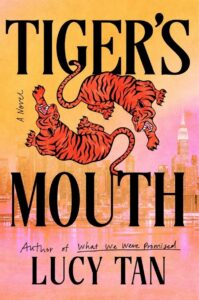
Tiger’s Mouth by Lucy Tan is available from Ballentine Books.
