
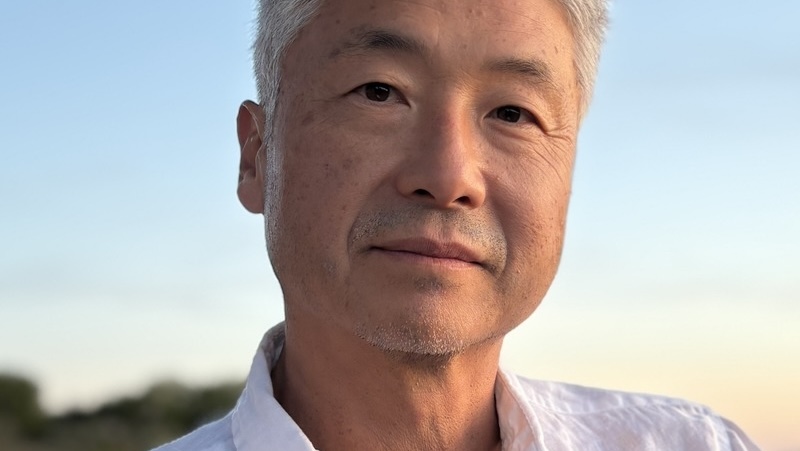
Chang-rae Lee’s family history informs most of his novels, especially his latest, A Tender Age. Lee was born in Seoul, in South Korea; his father’s family hailed from Pyongyang, the capital of what is now North Korea. He arrived in the United States when he was three, grew up in Westchester County, and later attended Exeter and Yale before entering a writing program at the University of Oregon. There, his thesis became what would become his celebrated debut novel, Native Speaker, a covert-ops tale in which a first-generation Korean-American, Ed Park, is hired to pull together intelligence on a Korean-American politician. Native Speaker earned the PEN/Hemingway Award. Lee has continued to produce notable novels while teaching creative writing at institutions including Hunter College, Princeton, and, currently, Stanford. My own favorites among his works include On Such A Full Sea, a dystopian vision set in the former Baltimore’s lower wards, and The Surrendered, which I described as a “harrowing and elegiac” meditation on the wounds and cruelties of war in a Boston Globe review. The Surrendered won the Dayton Literary Peace Prize and was a finalist for the Pulitzer Prize.
A Tender Age is a coming‑of‑age novel marked by Lee’s characteristic emotional nuance, precise language, and stylistic flair. It unfolds through the distant consciousness of an adult Jeon-Gi, who recounts the year leading up to the summer he turns eleven, in 1976, as he begins to transition from the cherished son at the center of a closely knit family—where his Korean immigrant parents seem flawless—to the more intricate world of adulthood in a second language.
Lee opens with a retrospective chapter, presenting the adult Jeon-Gi: “…we can’t help but keep going back to the old times, futilely scratching at a spot,” he writes. “It doesn’t matter how significant a certain event or instance was, sometimes the barest irritation will draw incommensurate attention and the skin can go raw before you realize it. Lately, I can’t seem to help but linger on this time or that, those tender ages rife with curiosities, and go over in serial fashion what I might have done or said to defuse a tricky situation or take a more principled stand or else assuage my frustrated heart.” Then he moves into the visceral point of view of “a mere boy” who is emotionally isolated, frequently bullied, and curious, until he acts in impulsive ways that shock those around him.
What motivated you to write this new novel? I asked Lee. “Perhaps it’s my own not-so tender age, but I’d been musing a lot about my family’s early years in America, and my own adventures in the ‘wilds’ of suburban New York City,” he explained. “It was a time when we were learning so much about making a life in our bustling tenement, a place so rich in events and personages, and I wanted to capture something of those energies before it was lost to me.”
*
Jane Ciabattari: Why focus on the summer Jeon-Gi turns eleven?
Chang-rae Lee: For me that particular age represented a threshold—still very much a child, emotionally and physically, while simultaneously standing at the edge of a more adult awareness, even if not fully formed. There’s a visceral, gut-level clarity Jeon-Gi possesses that, in certain moments, doesn’t align with how he imagines the world ought to be, which makes for riveting episodes within the narrative.
JC: How difficult is it for a young boy from immigrant parents to navigate a second language and a world his parents are still learning to master? What options does he have? To what extent does Jeon-Gi’s universe mirror your own experience?
CL: Every child of immigrants understands how intricate this “new world” can feel, and despite their parents’ best efforts to steer proceedings, they mostly walk through it alone. It’s a journey filled with excitement and fear, and it carries a heavy burden of responsibility, since the child is often the one leading the way. I definitely felt that pressure—striving to do right by everyone while never truly knowing if we were headed toward safety or toward some storm.
All immigrant children know how complicated this “new world” is, and that no matter how much their parents may try to ride herd, they are essentially traversing this realm solo.
JC: The book places the dual morality of Jeon-Gi’s parents against the customs and expectations of the culture he’s growing into, creating a persistent tension. Do you see it as something that can ever be fully resolved?
CL: Probably not. Any culture wields enormous influence, staining the deepest aspects of who you are, and it can feel nearly impossible to reshape yourself into a new form within a different culture. We live within a tight window of time and space. Yet I do think that by examining these intersections and clashes we gradually reshape the culture itself, nudging it along a subtly altered path through our presence and actions.
JC: The narrator’s interior life often feels more vivid than the outward world of his immigrant parents, his sister, the boys at the shabby playground, and his school. Where does that perspective originate?
CL: The narrator, like any narrator, observes and thinks from a vantage point removed from the chaos of boyhood life, which affords him the mental space to decelerate, to calmly and methodically probe ideas and feelings that once overwhelmed him. I certainly wanted the narrator to convey the full surge of Jeon-Gi’s emotions while staying above the flood of sensation, so as to recreate and understand them anew. That understanding for the narrator carries a quiet mourning for the boy who endured and for the sly, untethered boy who was always there, even before the unfortunate events.
JC: There are scenes of intense cruelty among rival boys. Were these moments difficult for you to write?
CL: Not as hard as I expected, even though they hit close to the bone. I’ve written far more intense sequences in previous novels, and the process remains the same: you write with a bit of nervous flutter, like the butterflies before a major event, then you become so deeply immersed in the fictive moment that you simply lean into it, focusing on the word that comes next.
JC: The prison‑camp sequence is depicted through a lens of naïveté that is ripped away as the inmates reveal many of prison life’s common cruelties. How did you research these scenes, and to what degree is it a misstep to include Jeon-Gi, who isn’t yet a teenager, among the older group and risk the harm it could cause him?
CL: When I was young, I watched a TV documentary about a “scared straight” program similar to the one depicted, and I later found a few online resources and videos. I remember thinking how thrilling and terrifying it would be to take part in something like that, which Jeon-Gi experiences, though it’s clearly a grave mistake with consequences he cannot fathom.
I do think that in examining the various intersections and clashings we are also, if very finely, re-forming the culture, pushing it with our efforts and presence along a slightly altered path.
JC: Jeon-Gi’s parents want him to feel a stronger sense of belonging by sending him to a Korean church camp, a choice that brings moments of joy and, later, disastrous actions. How did you craft the camp’s realities—the storms, the meals, the bunk assignments, and the exchanges between boys and girls, especially Jeon-Gi and Susan, who matters to him, and the witnessing of adult sexuality?
CL: My own youth included many seasons at a church-run Korean camp, so I know those camping details intimately. I can still taste the “camper’s stew” we cooked during overnight stays, and Jeon-Gi helps prepare it in the novel. Some other elements are drawn from memory and lightly fictionalized, though I won’t go into further specifics.
JC: Dickens, the camp’s chief rival, is a forceful presence. “His self-assurance filled me with loathing and envy… He somehow sensed my own feeling that I ought to be punished for my failings, his nose for someone’s tender spots a capacity I realized I wished I had more keenly. This is what they mean by keeping your antagonists close; you think you are learning how to deal with a foe, anticipating their tactics, their antagonisms, rehearsing all the ways of defending yourself, but what happens is that you begin to see certain concordances, reflections of the contours of who you might be.” The closeness of their bond from the first day of camp is visceral. How did you fashion this relationship? Did you draw on any moments from your own life—from boyhood, at university, or in academia?
CL: Those camp days remain incredibly vivid for me and my friends. Even now, almost half a century later, I’ll bump into a former camper and we’ll reminisce about a moment or person as if it happened yesterday. I did mine own share of tough moments that later fed into the material—the Dickens episode is a clear example—but most of those years were marked by lighthearted, carefree joy and a sense of natural fellowship that’s rare in adult life. I treasure those times.
JC: At times you shift forward to hint at Jeon-Gi’s future (such as his reunion with Susan). This adds a thread of suspense. When did you begin weaving these future-present interludes into the narrative?
CL: I don’t think I ever deliberately “added” them as distinct inserts; rather, I felt a need for the narrator to reappear at moments to provide context. It’s more a case of following the rhythm and listening to where the writing itself wants to pause or surge, rather than constructing a formal plan.
JC: What are you working on next?
CL: I’ve begun outlining a new novel about a youthful romance, so you could call it another coming-of-age tale. It’s ultimately hopeful but tinged with sorrow as well, and it draws a bit from my own life. So perhaps I’m riding a streak of self‑inspired storytelling.
_______________________________
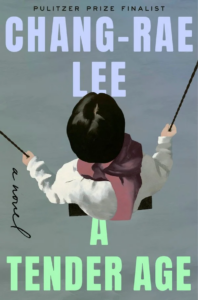
A Tender Age by Chang-rae Lee is available from Riverhead Books, an imprint of Penguin Publishing Group, a division of Penguin Random House, LLC.