
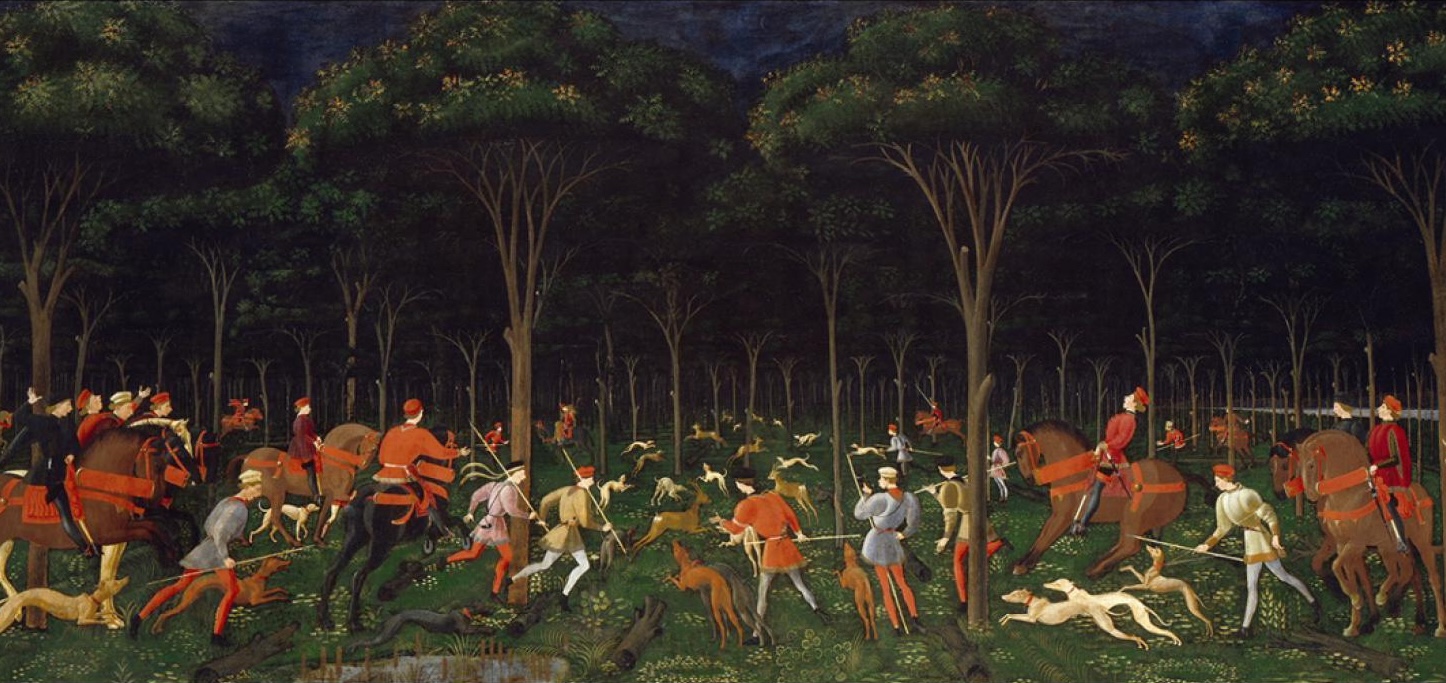
Europe is not a continent of deserts, but in the early Middle Ages, Europeans began to assimilate biblical notions of the wilderness by applying the same philosophy to a regionally appropriate context: the forest. In the absence of the arid, rocky deserts of the Middle East, early Christians looked instead to a tangle of trees and briars growing up outside their lonely settlements and recognized some unifying, shape-shifting quality.
Europe was not a desert by geography, yet during the early medieval era, believers started transplanting biblical visions of wilderness onto a local stage: the woods. With the Levant’s dryness out of reach, they turned to the thickets that surrounded their isolated towns and discerned a common, elusive character that could shift its form in response to human perception.
Though to modern eyes these landscapes might seem a world apart, to medieval monks the linguistic parallels were obvious. Early Latin translations of the Bible from the fourth century onwards used terms like desertum and solitudo in their depictions of the wilderness trials faced by the prophets—that is, stressing emptiness and inhospitable emptiness rather than climate or geography.
In fact, a great deal of Europe was already a land left to itself after Rome’s retreat from much of the West. The gradual unraveling of urban life endured for many centuries, affecting both former imperial territories and the so-called barbarian societies that had become the main trading partners of the era.
A succession of deadly pandemics swept through what remained; to survivors like the Roman historian Procopius, it sometimes seemed that “the whole human race came near to being annihilated.” Widespread crop failures coinciding with a longer spell of atmospheric cooling produced repeated famines.
As the landscape was brought back under control, its wilder elements came to be regarded with ever more suspicion and distrust, as a symbol of earlier misrule.
This rupture manifested itself as a rapidly rewilding world. Towns emptied out or were abandoned entirely; farmland lay fallow; forests reclaimed spaces; busy roads fell silent and grand villas stood vacant. In turn, these shifts were mirrored in the remaining inhabitants’ evolving attitudes toward the natural world and to wild places as not only hardships but also as realms touched by the supernatural. In some respects the medieval wilderness has a specificity of its own, yet it also provides a broader window into how a sense of security and our feelings about wild nature interact. Loss of control, or the fear of losing it, holds a powerful sway over us.
Such a dynamic is far from unique to the Middle Ages.
European settlers’ desperate bid to “dominate” the unfamiliar and feared American wilderness offers another clear instance; in ancient Assyria and Egypt, rulers staged public hunts of lions and hippopotamuses to display their capacity to quell chaos and ensure public safety.
Medieval Europe itself was a place of disorder: a era of mass migrations, raids and wars, during which populations collapsed by a third to half, perhaps dropping to as few as 18 million by the middle of the seventh century. (For context, today’s population is put at around 750 million.) Pollen analyses reveal that large portions of northern Iberia and much of central and eastern Europe were largely emptied of people during the fifth and sixth centuries, allowing trees to reclaim fields that had once been cultivated. This represented a dramatic reversal of the long, steady trend of forest clearance that had persisted since the Neolithic.
Left unmanaged, the wild woods seized great tracts of land that had been tilled. In Brest, Brittany, forest cover stood at roughly 40 percent in 100 BCE but rose to nearly 90 percent four centuries later. Provence was almost entirely abandoned. Transylvania, a region that later history often frames in nationalist terms, appears to follow a similar trajectory. While neighboring groups—Franks, Burgundians, Ostrogoths, Visigoths and their peers—fought among themselves, the forests nevertheless quietly staked their own claims by beech and oak and pine. If humanity fenced itself against nature, it was a battle it was losing.
The forest resurgence did not endure without consequence in the long view—the longue durée, though it did recur in waves over successive centuries—but the shift in power from human to nonhuman entities would cast a long shadow. Deeply held fears took form in folk stories about dark woods and the biases against the wild creatures that might reside there. The European wilderness, the terra deserta, became a symbol of hard times—truly dark ages—that had to be endured and overcome and should not be allowed to return readily.
Later, around the turn of the millennium, the tide turned and Europe’s population recovered, doubling between the tenth and thirteenth centuries. The wilderness retreated again; fertile lands were tilled anew, drained, and replanted. Wild forests were felled or coppiced, paths beaten, and undergrowth grazed down. Old stonework was repurposed into new houses, churches, and city walls.
But as the landscape was brought back under control, its wilder elements came to be regarded with ever more suspicion and distrust, as a symbol of earlier misrule. Urban populations—now living more comfortable, refined and polite lives, and increasingly at odds with the dark, shadowy woods—began to see them as threatening, places haunted by criminals (in truth) and by the restless dead (hard to verify). By the time Dante began his Divine Comedy in the fourteenth century, entering the selva selvaggia—the wild wood—this attitude had become deeply entrenched. In short: even as wilderness declined, it asserted a growing presence in the medieval imagination.
Fairy tales and other late medieval romances routinely unfold within the dark woods or among the tangle of briars around ruined castles—where archetypes such as the woodsman, the knight, the lost child, the hermit, and the doughty outlaw recur. Ferocious predators with gleaming teeth lurk beyond the illuminated gaps: she-wolves, foxes, hungry bears. Myths too are steeped in the supernatural; half-human, half-beast beings—centaurs, satyrs, fauns, and werewolves—straddle the line between human and animal. The forest could shelter witches and sorcerers, camouflaged as the old and frail, yet capable of summoning both wonder and terror, blessings and curses.
Folklore operates as a dream-like logic, a fabulist way of processing the era’s anxieties. “Hansel and Gretel,” and a broader family of tales of the same mold, emerged from famine and probe the abandonment of children and even cannibalism, re-enacting the darkest chapters of the so-called “Dark Ages.” (One particularly disturbing variant comes from Romania, where a girl is compelled to kill her brother and prepare him as a meal.)
The wild woods, in their unrestrained exuberance, came to be the stage on which medieval society’s fears and preoccupations could play out, clothed in wolves’ disguises. Real dangers could be dressed in the glitter of fairy tale, confusing and challenging people, and ultimately allowing them to be confronted and overcome. The forest of myth was an eerie, volatile realm, a harbor for treacherous and unpredictable figures who might devour you in an instant. Yet it was also a wondrous, enchanting space. It was a carnival of reality where children could be lost and predators roam, but where white stags could leap through sunlit shafts, birdsong filled the air, and free foraging of honey, berries, and acorns was possible. Clearings could be hacked away, huts built, paths beaten. But they could also swallow you whole, given half a chance.
*
Europe’s crisis of late antiquity is worthy of study in its own right. Yet it also reveals a great deal about how attitudes toward nature and wild landscapes shift in step with social conditions. Cultural and historical context shapes our interpretation of the world around us, which in turn shapes how we engage with it; in this way, wilderness will signify different things to different peoples and be praised or condemned in turn.
The wild woods, in all their unrestrained glory, came to serve as the theatre in which the fears and preoccupations of medieval society might play out in wolves’ clothing.
As famine, war, pestilence and death swept through, religious thinking grew increasingly apocalyptic and self-denying. In response to fresh crises, belief leaned toward asceticism and sometimes mysticism. Influenced by the Desert Fathers and adapting their teachings to local circumstances, penitents withdrew to hermitages or remote abbeys to reflect—the discipline and order of monastic life, the stillness of the cloister—appearing ever more attractive as a mode of life in an uncertain world.
Some early Celtic monks, including saints Brendan and Columban, originally sought solitude on sea voyages—“to discover the desert in the impassable sea”—but more often they sought quiet among forests, as Columban would eventually do later in life.
Their lives were chronicled in hagiographies, saints’ lives often embellished with folkloric motifs, focusing on marvelous feats and miraculous acts. A recurring motif was the taming of wild beasts: Saint Francis (1181-1226) famously subdued the feral Wolf of Gubbio, which allegedly terrorized the Umbrian town until the saint confronted it, after which the creature followed him and subsisted on scraps. Stories like these resonated with people who had once distanced themselves from wild lands, yet were now confronted again by the animals that inhabited them.
La période des grands défrichements, as France puts it, saw forested cover shrink by about half between 800 and 1300 CE. Similar patterns were repeated across much of Europe. The Domesday Book notes that by 1086, roughly 90 percent of natural forest had already been cleared from the English lowlands. By 1500, Europe-wide firewood shortages were evident; in some regions people dug moats around woods and chained entrances to protect them from depredation.
The loss of habitat and decline in game forced wild predators to shift their behavior: they began preying on livestock or venturing into towns to survive. The chronicler Adam of Bremen, for example, described in 1072 how residents observed “hogs and dogs desecrating the church…wolves howling in packs on the city’s outskirts, contending with horned owls in horrific contests.” Rabid wolves terrorized towns in Wales in 1166, in south Germany in 1271; Salimbene di Adam’s 1247 chronicle of Italy speaks of wolves gathering “in great numbers around the moats of the cities, howling with hunger, before breaking through the walls and devouring anyone sleeping outside.” They were said to “break down wooden house walls and snatch infants from their cradles.”
“Nobody could believe unless they had seen as I have seen the horrible things done during that time,” declares the friar. And perhaps it is hard to believe. Nevertheless, his account demonstrates how wolves were increasingly demonized as the Middle Ages progressed; recast as fairy-tale antagonists and as omens of doom. For medieval people, the intrusion of the wild into the safe city’s borders produced a fear akin to body horror. Earlier writers had once celebrated “wolf music,” a dissonant chorus of howls in the dark that promised bloodshed and cunning at a safe remove. Now the call was coming from inside the house.
The wild beasts of the wilderness were thus feared, revered—and hunted. Wolves faced a concerted extinction campaign: trapped, burned, strung up, poisoned and hunted to oblivion in much of Europe, a reflection of a deep-seated enmity toward the “big bad wolf” deeply ingrained even after real wolves ceased to be a threat. And the wolf’s demonization took on religious overtones, drawing on biblical shepherd imagery in which the wolf is cast as a false prophet.
(European settlers would later bring lycophobia to North America; in Puritan New England, a legal mandate to set wolf traps appeared in 1642, and wolf-hatred persisted for centuries. Americans, as Barry Lopez notes, “set wolves on fire and tore their jaws out and cut their Achilles tendons and turned dogs loose on them…they even poisoned themselves, and burned down their own property torching the woods to get rid of wolf havens.”) By the early twentieth century, the species had vanished from most of central and northern Europe and was greatly diminished in the United States as well.
The brown bear, which had long held symbolic, even divine significance in many pagan cultures and remained part of royal iconography into the Middle Ages, also fell from favor. By the eighth century, Charlemagne organized mass bear slayings while the Church, wary of its earlier sacred standing, denounced the bear as indulgent and noted its unsettling resemblance to humans. Saint Augustine even went so far as to call the bear “the devil himself.” Once widespread across Europe, bears now survive mostly in its most remote corners—the Nordic states, the Carpathians, and the Dinaric Alps. From the Middle Ages to modern times, both wolf and bear persisted in the cultural memory, haunting beneath beds and in the dark corners. Even after live wolves disappeared, they lingered in the minds of the living. The woods and forests became synonymous with fear and danger.
____________________________

From The Savage Landscape: How We Made the Wilderness by Cal Flyn. Published by Viking, an imprint of Penguin Publishing Group, a division of Penguin Random House, LLC. Copyright © 2026 by Cal Flyn.