
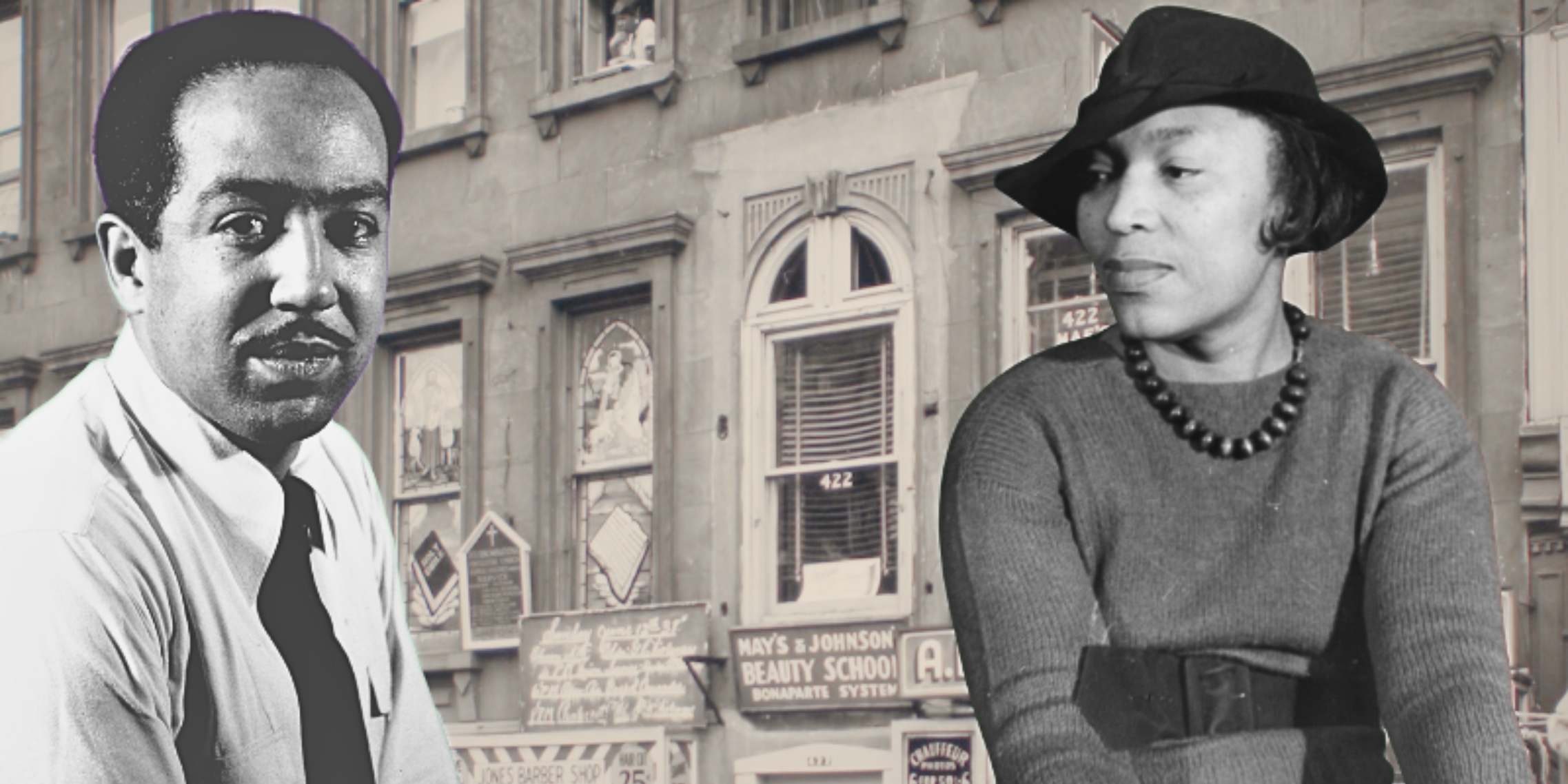
If the Harlem Renaissance was—according to Henry Louis Gates Jr.—“surely as gay as it was black,” it was also disabled. Steeped in a nascent Black disability culture characterized by rejecting eugenics, medical segregation, and ableist politics of racial respectability, writers like Langston Hughes and Zora Neale Hurston used their writing to recount their experiences of racist medical abuse.
In his 1944 essay for the Chicago Defender, “On Human Loneliness,” Langston Hughes contemplates the sense of isolation found in waiting spaces such as jail cells, dental offices, and clinics. He writes, “A doctor’s office is even more intently lonely, though it may be crowded with people. Each person has his own illness, or his own fear of illness.” The backdrop of medical segregation during Jim Crow frames On Human Loneliness, revealing how unjust systems of care isolate individuals from the moment they enter waiting rooms and continue to reverberate into the present. By the time Hughes wrote about these medical scenes of waiting in 1944, he had already endured significant illness and delays in receiving treatment.
The fragility of economic and social life created by the patronage system—exemplified here by Hughes’s and Hurston’s ties to their white benefactor Charlotte Osgood Mason—directly exposed both writers to medical malpractice and coercion. Mason withdrew financial support from Hughes and Hurston in the early 1930s as retaliation for what she perceived as a lack of deference to her influence. As Hughes recalls in The Big Sea (1940), “She held the power to shape people’s lives—lift them up or push them down whenever she pleased.” The anxiety of losing Mason’s friendship and sponsorship caused Hughes’ stomach to churn and his appetite to vanish. He described Mason as “possessive,” “terrifying,” and overly controlling of both the themes and the volume of his literary output. He was crushed when he realized that his decision not to beg for money from Mason did not strengthen the bond as he had hoped, but ended it altogether: “I thought she’d liked me, my patron. But I guess she only liked my writing, and not even that any more.”
Through literature, film, personal accounts, and photojournalism, Black writers such as Hurston and Hughes registered the deep disappointments of modernity and progress for vulnerable citizens living under Jim Crow.
The day Mason severed their alliance, Hughes attended a dinner gathering and, when the room began to spin, had to leave to seek care for his troubled stomach and mind, as the world “started to float away.” His primary care physician then referred him to a cluster of white specialists who “took samples of my blood, my urine, my spit, and whatever else there was about me to take, charged me a steep price up front—and a week later told my doctor that I had a Japanese tapeworm.” Hughes was ushered into a large room where a doctor lounged on a couch in an old dressing gown; after already paying multiple high fees and consulting six doctors, the examiner merely looked at Hughes and “barked,” “You’ve got no Japanese tapeworm.” He was charged an exorbitant ten dollars for a single glance from this disheveled physician.
Waiting for a diagnosis that never arrived and drained of funds after a harrowing sequence of medical neglect and malpractice, Hughes could no longer afford a safe haven to recover. He returned to Cleveland to recuperate at his mother and stepfather’s modest home, where “my mother kindly offered me the only bed while they slept on the davenport.” A decade after describing these troubling episodes in The Big Sea, Hughes crafted one of his most enduring expressions of the violence inherent in waiting—“A Dream Deferred”—transforming the passive lack of agency into a metaphor for a dream that might “fester” and “run” like a wound or “explode” in the face of perpetual deferral of justice. In other words, his ongoing illness left a lasting imprint on his literary production.
Zora Neale Hurston endured similar medical mistreatment during a visit to a costly white-owned clinic. Her 1944 Negro Digest essay, “My Most Humiliating Jim Crow Experience,” captures the dilemma of how racism shapes Black health across the twentieth century. In 1931, based on Mason’s misguided suggestion, Hurston consulted a doctor in Brooklyn for intestinal discomfort, recalling that the clinic’s reception area “was more than swanky, with a gleaming hammered copper door,” and that the receptionist reacted with obvious embarrassment when she arrived. She was promptly alienated by both staff and physician, and placed in what appeared to be a dirty linen closet instead of a proper examination room.
Despite the overt signs of Jim Crow, Hurston remained for the examination: “He went through a series of motions, slid a tube down my throat to extract bile from my gall bladder… Being the sort of objective person I am, I did not leap up and storm out in anger as I initially felt inclined to do. I stayed to observe what would transpire, and to torment him further.” During this frigid procedure, Hurston chose to impose discomfort on her oppressors by staying in the office as a form of passive resistance. In the end, the doctor charged her twenty dollars for the abrupt and unfriendly visit. In response, she rose, tilted her hat at a daring angle, and left, promising to send a check—never to be paid.
By studying the literature of the Harlem Renaissance through the lens of disability…we can encounter the myriad Black disabled and ill lives that deeply contributed to the formation of modern disability rights.
Hurston’s defiance—her refusal to depart quietly or to pay an exorbitant fee—illustrates the intertwined histories of literary craft, racial resistance, and an emerging disability-justice consciousness. She later wrote that leaving the office left her “feeling the pathos of Anglo-Saxon civilization,” and she grew increasingly skeptical of medical modernity and white “civilization,” mocking the untenable model of white supremacy as reflected in medical segregation.
Through literature, film, personal accounts, and photojournalism, Black writers such as Hurston and Hughes chronicled the disappointments of modernity and progress for vulnerable people living under Jim Crow, helping to cultivate a Black modern disability consciousness that questioned and resisted dominant narratives. This protest manifested in two principal ways. First, a surge of Black-authored narratives foregrounded Black disabled individuals. Second, there were pointed critiques of how whiteness during this era encompassed some disabled people while white disability advocates co-opted discourses of white supremacy to advance their aims, often excluding disabled people of color. In short, the white disabled subject gained traction as a modern identity at the expense of Black disabled individuals.
These erasures of disability—and the health-based activism of Black Americans, then and now—contribute to present-day inequities in racial health outcomes. In Black Crip Modern, Black thinkers such as Langston Hughes, Wallace Thurman, Claude McKay, Pauli Murray, Chester Himes, and Zora Neale Hurston navigate illness and disability alongside systems of racism, sexism, transphobia, and homophobia. Yet none of these writers are typically recognized as foundational figures in disability culture due to a lack of intersectional inquiry into their lives and works, as well as the ongoing dominance of what Christopher Bell has famously called “white disability studies.”
By examining Harlem Renaissance literature through the prism of disability, and by underscoring how artists, writers, and activists challenged the idea that respectable disability equaled whiteness and masculinity, we encounter a spectrum of Black disabled and ill lives that significantly shaped the modern disability rights and disability-justice movements.
____________________________
Black Crip Modern: Race, Gender, and the Roots of Disability Consciousness by Jesse Waggoner is available from NYU Press.