
Across cultures, there are varied ways to express that you matter to someone. In Nigeria, conversation typically begins by checking on your welfare: How you dey? How’s the family? How’s work? How are your parents? And even how’s school? Each prompt is answered with a simple “fine”.
Then comes the question that actually matters: you don chop? Which translates to, have you eaten?
Growing up, I saw this everywhere, and it reminded me that food, more than anything else, is how we take care of one another.
The reply “I’m fine” won’t satisfy anyone. It’s a yes-or-no matter. Either admit you haven’t eaten or provide a full account of what you ate, where you ate it, and who cooked it. Nobody is checking your stomach; they’re asking whether you’re well taken care of.
Feed the body first, sort every wahala later. Nigerians believe you can’t face your problems on an empty stomach.
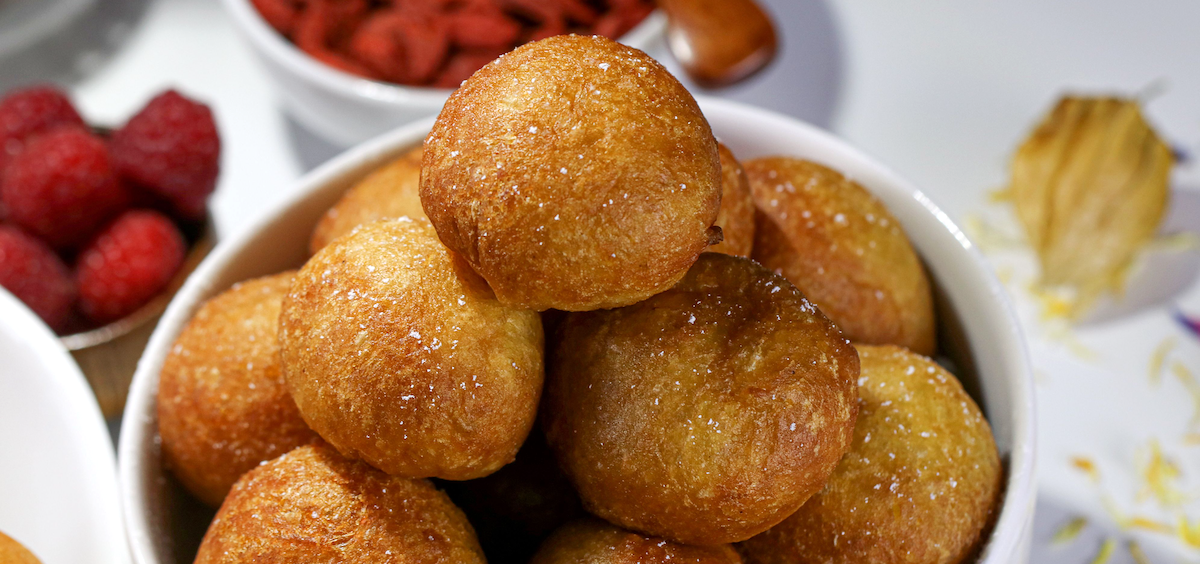
Nigeria’s ethos repeats itself: growing up, I saw this everywhere, and it reminded me that food, more than anything else, is how we take care of one another. Whenever you attend Nigerian events—weddings, funerals, naming ceremonies for children, birthday parties—one constant remains, and it’s always served first. Puff Puff. You take one or two (not more) unless you want to attract side-eyes.
If you’ve never had it, puff puff is soft dough composed of flour, water, yeast, sugar, and whatever you’d like to add, fried in hot oil. The outside is tender while the inside stays fluffy and slightly chewy. It’s gently sweet and inviting enough to make you say, “Can I have some more, please?”
(Pro tip: Best eaten while hot.)
Before the jollof rice, soup and eba, or pepper soup, there must be puff puff. I see it as the host’s way of saying: you’re going to enjoy this event, but first you must chop.
Magic is the fun part.
When my family hosts a gathering, the most vivid scene for me unfolds in the backyard. There, one person—usually my aunty—stands beside a large pot of oil, frying batch after batch and handing them out to share. I would grab two each time I stepped outside to collect more to return to the crowd. Someone was always nibbling them as fast as they came off the heat.
My mother’s love language, in my view, has always been puff puff.
There was a stretch when she paused work to focus on the family, and puff puff became a weekly ritual. Everyone in the house wanted a piece. Sometimes we saved some for breakfast; other times we looked forward to a quick bite when we returned home and dinner was still in the works. The kitchen carried the scent of whatever else she cooked: Okazi soup, my favorite, with enough habanero pepper to make me sweat, or coconut rice and chicken stew, which was her favorite. Most days we leaned into the kitchen, helping in any way we could. My task was to assist with puff puff; my real job was to lick the remaining batter from the bowl when we were finished. I took both duties seriously.
Now I realize that she wasn’t just feeding us. My mother wanted us to stay close, and abundant food was one way to keep us together. The more I grew, the more I understood that meals were not merely nourishment but a core means by which we gather and care for one another. So, when I began writing Love, Witches, and Wahala, it felt almost certain that food would become a thread through the narrative.
I knew it would be a love story, but I didn’t want it to be purely that. I wanted it to be about family and community, about the people who show up for you. Nneka, the heroine, runs Ezenwanyi Pastries—a bakery where she crafts puff puff alongside other Nigerian snacks. Even Dakoru, the man who becomes entangled in her life, is drawn to the shop in part because of its puff puff. Nneka feeds her neighbors because that is how you keep a community strong. She also unintentionally blesses a batch with a spell, triggering absolute wahala. I will admit, though, that my mother’s puff puff never did that. Although she did sometimes seem to know exactly what we had been up to.
I think that’s what my book is all about. Magic is the fun part.
Wherever you are as you read this, with whatever challenge you may be facing, you chop?
If not, pull up a chair; I’ll make you some puff puff.
__________________________________
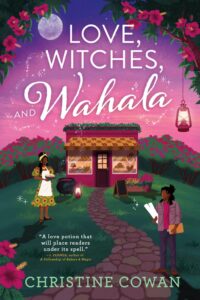
Love, Wtiches, and Walhala by Christine Cowan is available from Orbit, an imprint of Hachette Book Group.
