
As a child, I consistently preferred imagined realms to the tangible world. Being an only child who wrestled with social anxiety and was not athletically inclined, I spent most of my youth buried in books, dreaming of slipping away to Narnia or Camp Half-Blood, or any other number of invented places that felt far more thrilling than my cookie-cutter suburb.
Fandom and publicly “being a fan” has surged into mainstream culture in recent years, but during my middle and high school days it still carried a touch of stigma. I had friends and classmates who enjoyed the same books and films as I did, yet I usually existed on the outer edge of the bell curve—the person who cherished those things a little too much. I learned quickly that I was more palatable when I pretended to like things a “normal” amount, while inwardly I longed for someone who could match my enthusiasm for theories, discussing foreshadowing, and wandering down rabbit holes.
It felt like I’d been handed the keys to a new universe I hadn’t even known to look for.
When I moved across the country for college at eighteen, the last place I expected to find that community I’d been craving was in one of my freshman year roommates. We’d already established over the summer that we had similar taste in books and both liked to write, but once the semester was in full swing, she talked me into making a Tumblr account. I had been aware of online fandom in theory—I’d been casually reading fanfiction since middle school and I had some experience with Livejournal and similar online fan forums—but poking around Tumblr for the first time was revelatory.
For once, I was no longer the weird girl who was always too into things, because I was surrounded by a sea of other weird people who were just as into things as I was—sometimes more. We could be too into those things together instead of awkwardly trying to shave our passion down to a socially acceptable level. It felt like I’d been handed the keys to a new universe I hadn’t even known to look for.
When I started writing Cut to the Ending, my debut romance about an ambitious up-and-coming screenwriter and the (very hot!) nerd she recruits to teach her the canon of a world-famous fantasy franchise so she can score her dream job, it was a self-indulgent mishmash of my favorite things. A tough-as-nails black cat heroine willing to do whatever was necessary to achieve her goals. A socially anxious cinnamon roll nerd love interest who is obsessed with her. And a sprawling Lord of the Rings-esque fantasy franchise that, over the course of two decades, spawned a massive fandom waiting for a delayed final installment. I didn’t set out to write a book about two people connecting with themselves (while also falling in love!) through the awe-inspiring power of discovering a mutual love for a piece of media, but when the very same friend who introduced me to Tumblr all those years ago read an early draft and told me I’d accidentally written a love letter to fandom, I knew she was right.
Max is not me, but I gave him pieces of myself and my relationship to fandom spaces: a quiet, socially awkward kid who didn’t have a lot of friends but found solace in fictional worlds; family members who supported him, but didn’t always understand him; and a college roommate who laughed when he hung a Magician’s Gambit poster in their dorm room and insinuated he was too old to still be into that sort of thing. But I also gave both Max and Delaney my joy: the lightning strike moment of finding your people and being welcomed into a space that wants to celebrate you and your passion instead of judge.
The most beautiful part of fandom to me has always been its inherent power to bring people together. Whether it’s in person or online, whether it leads to a lifelong friendship or just a brief meeting in the tags of a really good post or a convention center bathroom line, you’re meeting on the shared ground of a shared love. Fandom is an outlet for creativity and personal expression. It spawns writers and artists and gives them a place to experiment and play and hone their craft. It encourages us to think critically about the media we love precisely because we love it, like the best kind of English class discussion (except usually with more kissing).
Cut to the Ending is releasing into a time when fandom culture and being a “fangirl” is more socially acceptable than ever. Gone (hopefully for good) are the days of pretending be totally normal about that TV show I’d just reblogged nineteen nearly identical gif sets of on Tumblr or hiding my laptop screen and blustering through a badly architected lie when someone asked what I was working on. The honest answer: fanfiction that I will never publicly claim but is still floating around online and, despite being nearly a decade old, still racking up the occasional kudos. Ten years ago, that admission would have earned me mostly side eyes, if not outright derision.
Now, the lines between our online lives and our “real” ones are blurring more than ever before, and while there are pros and cons to that blurring, the person I was at eighteen never could have imagined being her true self without the safety of an anonymous online username. Even when I didn’t know it, I was writing Cut to the Ending for her, and for the thousands of other people out there who, like me, have struggled to find a community that not only accepts them, but celebrates them.
___________________________
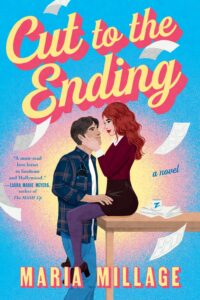
Cut to the Ending by Maria Millage is available from Little, Brown.
