
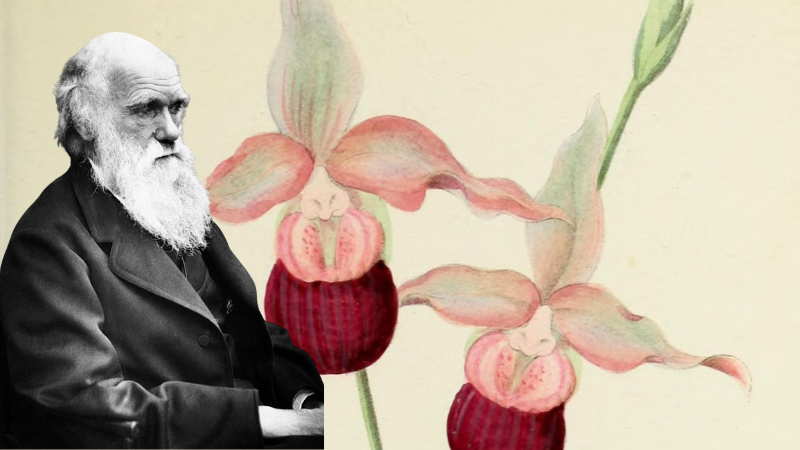
Nestled within the tarmac ring that encircles London—the M25—Down House, the home of Charles Darwin, feels distant in time and space from the modern city, almost ghostly in its atmosphere. It is as if Darwin could reappear at any moment. Inside, his study is a jumble of letters and open volumes, with insect specimens and fossils scattered about; his chair, mounted on casters so he could glide around while gathering things, still seems to carry the memory of his presence. A wooden slide leans against the wall—an adaptation Darwin made to let the children slide down the stairs on cushions.
In truth, the traces of his offspring linger too: a gnarled mulberry tree climbs up the side of the house, supported on stilts, the very tree from which the Darwin children would descend from their bedroom window. There’s a display honoring Annie Darwin, the beloved daughter who died at ten; her death struck her father with the final blow to his belief in a Christian god. Emma, who tended the garden, planted the same flowers, and the kitchen garden still yields the same vegetables that fed the Darwins and their staff.
Antony O’Rourke, the current head gardener, guides me through the grounds and even invites me to harvest a few greens. The next evening I savor chard and cavolo nero from Emma’s kitchen garden. It feels almost sacred. I scrape my boots on the same boot scraper outside the greenhouse that Darwin used. I tread the Sandwalk, the contemplative path Darwin walked each day around the property.
This is the magnificence of orchids: their form can cloak deception, their sexuality, their longing, and their behavior is arrested in place.
The path winds through woods that did not exist in Darwin’s era because he himself planted them. People speak of our obligation to the future and the actions we must take now for people not yet born, and walking beneath the mature trees Darwin created filled me with affection and gratitude. I discovered the spot along the path where he would place a stone to tally his laps (his children would add stones after he passed by, as a playful trick). In Darwin’s woods I felt a pleasure born of something he started but never witnessed. And within his woods are several plants that would fascinate him now.
Here and there, in the deep shade beneath beech trees, grows a species of orchid known as the violet helleborine (Epipactis purpurata). Antony explains that these orchids time their bloom to coincide with the drop of fruit and the patrol of wasps seeking nourishment. Bees avoid the dark understory because there are few blossoms to lure them, but wasps do not mind the gloom and are drawn to the helleborines by a nectar laced with compounds produced through a fungal partnership. When the wasps sip it, they become dusted with pollen and appear momentarily intoxicated. They neglect their grooming; they move awkwardly, leaving pollen attached to them as they stumble to the next blossom, a pollination spree in disguise. If you inspect the orchid’s blossoms, you’ll notice a shield-like mechanism that prevents pollen from dropping from the male to the female organs, blocking self-pollination.
Nevertheless, the pollen-bearing parts are tucked away, making wind-pollination unlikely. This points to insect pollination as the likely strategy. Thus the orchids’ grandeur lies in their ability to mislead—appearing a certain way while carrying out a different function—an effect that extends to trees, whose centuries-long lifespans house countless dramas and births within what outwardly seems static. And underground, their alliance with fungi holds even more complexity.
Darwin had long since nurtured a fascination with orchids, perhaps shaped by the quasi-romantic attachment his grandfather Erasmus felt for them and which he wove into his own writings. In The Botanic Garden, Erasmus Darwin’s dramatic two-part verse from 1791, orchids are depicted as “harlot-nymphs” attempting to lure their hosts:
The scaly monsters roll’d
Ring above ring, in many tangled fold
Close and more close their writhing limbs surround
And fix with foamy teeth the envenom’d wound.
Recall that phrase “tangled fold”—we’ll return to its meaning later. Charles Darwin, well aware of his grandfather’s passion for orchids, developed a deep fixation for the subject at least by around 1855, if not earlier (he moved to Down House in 1842). By meticulously studying the flowers of orchids sent to him by cultivators and collectors worldwide, he learned to infer from structure which species rely on insects for pollination and which can self-pollinate. Even more, he could infer the likely pollinator from the flower alone. When he received specimens of an extraordinary orchid with a nectar tube roughly thirty centimeters long, extending from the flower’s opening to its base, he predicted the existence of a moth with a tongue of matching length. It was an evolutionary detective work comparable to an astronomer predicting a planet’s presence through its gravitational influence, the method that led to the discovery of Neptune.
Less than two decades after Darwin’s death, such a moth was discovered in Madagascar and christened praedicta to honor that intuitive leap. Erasmus Darwin had once speculated that orchids mimic insects in order to discourage robbers and prevent nectar from being stolen: the resemblance to a fly or a bee suggested that “it is probable that by this means it may often escape being plundered.” He was not correct in his reasoning. Bee orchids engage in what is called sexual deception mimicry, and they use two separate stages—visual and chemical. In other words, they imitate female bees in both appearance and scent to attract male bees. Erasmus died several years before Charles was born, leaving him to inherit a mystery his grandson would eventually illuminate.
During Darwin’s era, violet helleborines did not grow around Down House—they were introduced by the gardeners—but Darwin would have been delighted nonetheless. He especially cherished a related species, the marsh helleborine, and had specimens sent to him for study. “The examination of that species,” he wrote to a plant supplier, “has been one of my greatest pleasures, which I owe to you. I fear I am quite unreasonable; but this subject has become a passion for me.”
Violet helleborines are exceedingly particular—they demand a mature beech forest rooted in clay soil with a chalk overlay. Darwin grasped this. One motive for choosing Down House in his move from London was its geology, since Downe sits at the edge where the clay-rich Thames basin meets the chalk downs, a locale rich in plant variety. He did not yet understand why helleborines can endure the forest’s gloom; he did not know that they feed through fungal threads radiating from their roots into the soil and weaving with the beech roots. Some orchids forgo their green camouflage entirely, turning albino and subsisting entirely—parasitically, some would say—on nourishment from the fungal network.
By 1858 Darwin had examined around a hundred blossoms of Orchis muscifera (the fly orchid) and was primed to devote himself fully to orchids when, around June 18, he received a letter from Alfred Russel Wallace. Darwin knew Wallace only vaguely, as they had corresponded before. But this letter was different. Born in 1823 (Darwin was then a schoolboy collecting insects and rocks), Wallace had spent the previous eight years exploring the Malay Archipelago and had already begun to establish himself as a notable naturalist in Indonesia, Malaysia, and New Guinea.
Wracked by fever, Wallace—who had just read Malthus (Darwin had read him in 1838) and had long contemplated evolution—presented an idea about how species could change over time. He didn’t label it natural selection, but it carried the same core concept: more individuals are born than can survive, those with advantageous traits survive more effectively, the advantageous traits are heritable, and over generations the population adapts to its environment. That was the essence of the theory he sent in his correspondence.
Darwin, then fifty and not in robust health, was stunned. Orchids suddenly took a backseat. Here was a skeleton of the theory he had spent decades trying to articulate. Darwin and Wallace agreed to publish jointly, with a summary of their views presented at the Linnean Society. The following year, 1859, Darwin released On the Origin of Species by Means of Natural Selection. He managed to publish it so swiftly because, over the years, he had been quietly assembling a more comprehensive manuscript. I even saw the cabinet at Down House where he hid that manuscript, anxious about the upheaval it would unleash.
In 1844 he wrote to his wife, asking that in the event of his sudden death she should forward the manuscript to a trusted editor to ensure it was published. What Emma would have thought upon receiving such a request is unclear; did he mention it to her first, then simply send the letter to convey what to do? The text doesn’t reveal. But above all, the Darwins belonged to the Victorian upper class, with a sense of discretion. Perhaps he sent the note to spare them awkward conversations about his mortality. Emma’s diary entries don’t readily reveal her feelings. When Darwin finally died, on April 19, 1882, the diary simply notes, “fatal attack at 12.”
*
As it happened, Darwin’s pause from orchids proved useful: when his orchid-focused book finally appeared in 1862, it helped him address many of the objections raised against natural selection in the preceding years. Yet the essential symbiotic nature of orchids—the keystone of their enormous evolutionary and ecological success—remained undiscovered until the late nineteenth century. Even then, scientists viewed the orchid–fungus relationship as a mere quirk of biology, not the central partnership that sustains one of the planet’s largest flower families and signals a fundamental process that shapes all living systems.
Bernard and Loudon, Erasmus and Charles Darwin: they dared to imagine possibilities that had never been contemplated.
Much remains unknown. The arrangement benefits the orchid, but what of the fungus? In most cases the fungus trades sugars from photosynthesis for the nutrients it supplies to the orchid. That exchange does not hold for certain plants lacking chlorophyll, such as the bird’s-nest orchid, which parasitizes the fungal network without offering anything in return. Yet even normally photosynthesizing orchids draw on resources from the fungal bank more than previously believed.
Our understanding evolves. At one time all orchids were believed to be parasites on trees. It was the pioneering gardening writer Jane Loudon who first demonstrated otherwise.
Loudon, who died in 1858, a year before Darwin published the Origin, was a woman ahead of her era. In 1827, at twenty, she published an extraordinary science-fiction novel, The Mummy!, about the Egyptian pharaoh Cheops revived in the year 2126. (Some people suppose she drew inspiration from Mary Shelley, who had released Frankenstein at age twenty in 1818.)
She was also a trailblazing author on horticulture and especially orchids, which at the time were not considered a pursuit suitable for women (indeed, neither was study, nor voting, nor the rights afforded to men). Loudon argued that orchids are not parasites but epiphytes, living upon trees without tapping into them. She described a species she called the monkey’s-throat orchid, noting, “it has a most singular red and yellow flower, part of which resembles a skeleton’s head with vertebrae of the neck, and part two folded bat’s wings.” Most orchids are epiphytes that perch high in the trees, enjoying light and wind exposure, which helps pollination.
And the fungal connection that Bernard initially discovered—the thread that penetrates the orchid’s developing cells—extends beyond the plant’s own cells to the bark of trees, reaching the roots and seeds of other orchids. DNA analyses of the fungi found in orchid roots and in tree bark reveal that orchids growing on the same tree share a common fungal network.
Bernard and Loudon, Erasmus and Charles Darwin: they possessed the courage and foresight to imagine possibilities beyond the ordinary. I like to imagine how they would react if told that orchids on trees and those on the ground are linked through a shared fungal network, and that symbiosis is the engine behind the extraordinary success of orchids across time and space.
What would Erasmus Darwin have made of Telipogon peruvianus, an orchid from Peru that appears extraordinary? He already knew of the bee orchid and the fly orchid, which imitate insects—though his reasoning was not entirely correct. Telipogon mimics two entities: a fly that consumes the nectar and the actual fly itself. The blossom’s form and coloration resemble a daisy with yellow ray florets that an associated fly seeks. Yet at the center lies a structure that mimics the fly. The lure of both the flower the fly feeds on and the female fly herself proves potent for the male; he does not physically mate with the flower as in some species, but engages in elaborate pre-copulatory behavior, which suffices to pollinate the bloom. In circumstances where orchids are scarce, authorship of attractiveness becomes essential. China offers the sole known example of a mammal-pollinated orchid: Cymbidium serratum, whose petals are green but with a vividly colored lip that pleases a wild mountain mouse. When the mouse consumes the lip, pollen adheres to it and is transferred to the next blossom on the journey.
An even more provocative “what if” is the thought that Charles Darwin might have known that orchids dispatch nourishment to their offspring through the subterranean fungal network. Passionate about orchids as he was, Darwin likely observed that wild specimens often appear in clusters. You could find an older plant with several younger ones scattered nearby. Orchid seedlings lack chlorophyll and therefore cannot photosynthesize; in the wild they rely entirely on sugars donated by mycorrhizal fungi to germinate and grow. Might the clusters around a parent plant indicate that the offspring are receiving sustenance from their parent?
In a painstaking set of experiments conducted in 2023, botanists at the University of Sheffield cultivated common spotted orchids in a laboratory growth medium. Orchids are notoriously finicky, and it required a surprising addition of pineapple juice to coax the seeds to germinate. Once the plants connected to a fungal network and grew in the lab, researchers supplied them with carbon dioxide tagged with a slightly radioactive carbon atom. This enabled the scientists to trace how CO2 absorbed from the air becomes sugars through photosynthesis and then travels through the underground fungal web to nourish seedling orchids that have not yet developed chlorophyll. Parental care, as researcher Katie Field terms it. Katie showed me the orchids thriving in their pineapple-enhanced medium. The striking contrast between their solitary lab appearance and the revelation of a parent-to-offspring provisioning system mediated by a different species was striking.
___________________________
From Togetherness: Symbiosis and the Hidden Story of Life’s Greatest Collaborations by Rowan Hooper. Copyright © 2026. Available from Alfred A. Knopf, an imprint of Knopf Doubleday Publishing Group, a division of Penguin Random House, LLC.