
I am seated in a frost pocket in West Virginia, watching a Canada warbler.
It is World Migratory Bird Day in spring, the second Saturday of May, and I have spent the past week in search of warblers. The Appalachian Mountains unfurl as a verdant carpet for songbirds making their seasonal journey between the warmth of Central and South America and the northern habitats they need to breed and raise their young. Some individuals will merely pass through and press on toward the boreal forests of Canada; this warbler may be among them. Others discover a favorable niche along the 2,000 miles of mountain ridges that stretch from southwest to northeast. Their path follows the uneven, parallel spines of ancient rock, a rugged landscape of knobs and hollows. As the land rises and sinks, these small travelers seek the microclimate and plant communities that suit them best.
I have a moment of spatial and temporal dislocation: I could be much farther north, or I could be watching a landscape emerging from the last ice age.
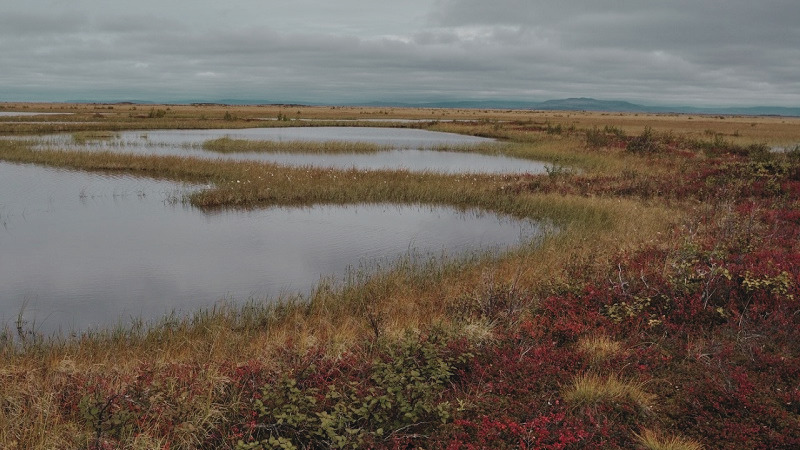
To track the birds, I follow the terrain, which brings me to the Cranberry Glades Botanical Area, a peatland tucked within the Monongahela National Forest. The protected zone hosts an assemblage of peat bogs that resemble the muskegs found in northern Canada. At an altitude of 3,400 feet in the Allegheny Mountains, the Glades occupy a pocket where cold air sinks from the surrounding slopes into low depressions—frost pockets. These pockets generate climate conditions that sustain plant species more at home in boreal regions, survivors from colder epochs long past. This dense, damp habitat is where the Canada warblers feel at ease.
The Glades are waking into spring, still clothed in the dried sedges left from last autumn. The word “glade” derives from the Middle English, or Old English “gloed,” meaning a bright, sunlit clearing in a forest. I step onto a boardwalk that traces a loop along the edge of Round Glade, winding through a thicket of alders and giant rhododendron, and skirting a corner of Flag Glade. The wooden walkway bears the weathering of many seasons; unlike elevated routes in other peatlands I’ve visited, this boardwalk sits directly on the uneven bog surface. The Glades overflow with Sphagnum mosses, black chokeberry, skunk cabbage, and a creeping mat of teaberry. Cinnamon ferns form small mounds, with fiddleheads tightly coiled and reaching for the light as they begin to unfurl into bright green fronds. The deep‑red, leathery leaves of the northern pitcher plant push up from the moss, rising beneath the faded flower heads from the previous summer.
I watch the Canada warbler flit between branches in a red spruce (Picea rubens), another species tied to cooler climates. Red spruce forests once covered a million acres across the central Appalachians, before being diminished by logging, fire, acid rain, and wind damage from the loss of sheltering trees. It is estimated that only 10 to 20 percent remain in these mountains, though restoration efforts and tree planting are slowly expanding that hold.
The warbler taxi-cabs to an eastern hemlock. It sees me as well, its bright eye ringed by a bold white circle. This male’s lemon-yellow underparts are crossed with fine black streaks that form a necklace across its chest. I sit still and listen to the birdsong in many voices and the soft hush of wind through the fresh green leaves of the alders. I have a moment of spatial and temporal dislocation: I could be much farther north, or I could be watching a landscape emerging from the last ice age.
The Cranberry Glades stands as a relic from another era, formed more than 10,000 years ago. Like many northern peatlands, the Glades came into being as the last glacial period waned and the earth grew warmer and wetter. The planet has hosted numerous ice ages, but it is the Pleistocene that compels our curiosity because it intersects with human expansion across the globe. People were part of Pleistocene history, adapting to colder northern climates and moving through unglaciated regions to the south of the glacial margins. If my distant ancestors gazed out across a half-frozen landscape, they would have seen something akin to this place.
Healthy peatlands represent massive carbon sinks.
To understand peatlands requires thinking on a timescale that dwarfs human lifespans. Peatlands are ancient ecosystems whose histories extend for millennia rather than decades. The formation of a peatland is a painstaking process; in the span of a single human lifetime, a peatland may only deepen by a few inches.
Peatlands are wetlands that accumulate organic matter, preserving the bounty of life and death within layers of watery peat. Peat becomes a kind of time capsule; cores drilled from deep peats reveal the peatland’s long-vanished chapters. As decay slows in the saturated, acidic peat, leaves, seeds, and pollen are preserved intact or in fragments. Scientists examining these cores can identify the plants that once filled the peatland and reconstruct shifts in environmental conditions over time. The organic material in peat is more than historical record: it is a carbon treasure chest.
Plants, like all living things, rely on carbon. The carbon dioxide they absorb through photosynthesis is transformed into plant tissue, and when the plants die, much of that carbon is returned to the soil and the air. The carbon cycle is unending, but in peatlands it moves remarkably slowly. This ability to sequester carbon in the ground gives peatlands a powerful influence within the planet’s climate system.
Healthy peatlands stand as colossal carbon sinks. A frequently cited fact is that peatlands occupy only about 3 or 4 percent of the terrestrial surface, yet they store more carbon than all the world’s forests combined. Yet peatlands that are damaged—through drainage, fire, or a warming climate—can release that stored carbon back into the atmosphere, contributing to the high greenhouse gas concentrations driving climate change.
What happens to carbon beneath our feet is part of a grander narrative, one that delves deeper into the earth and farther back in time. Around 350 million years ago, the Carboniferous Period painted a prolific era in Earth’s history; plant life flourished, and the climate was warm and wet. Lush forests of giant club mosses and ferns produced enormous amounts of organic matter. As plants died and settled in mud, they formed deep layers of peat. With the right ingredients—time, heat, and pressure—this organic material carbonized into coal, giving birth to a new energy source.
The full tale is more intricate: shifting sea levels, cycles of peat burial and flooding, and tectonic pressure from the ancient supercontinent Pangaea. These forces ultimately generated vast coal seams that fueled the Industrial Revolution. Some of these coal beds traverse the mountains of West Virginia—not far from my present surroundings. West Virginia stands as the country’s top producer of bituminous coal, with active mines spanning nearly half of its 55 counties. In 2025, the state yielded 86 million short tons of coal, an increase of 8 percent from the year before.
Although U.S. coal production has been receding for almost two decades, there remains a substantial quantity still to be mined. A map of remaining coal reserves in West Virginia reveals a diagonal belt across the state containing an estimated 1.6 trillion tons still in the ground.
Here, the threads of time and human history intertwine into a single, unruly knot. Peatlands draw carbon from the atmosphere and store it for millennia. Coal—the product of countless years of buried carbon under heat and pressure—carries an even longer legacy. When this stored carbon is released back into the atmosphere, the climate system responds: carbon dioxide and methane are potent greenhouse gases that warm the world. The carbon cycle accelerates as carbon accumulated over eons is suddenly reintroduced. Peatlands and coal beds share a common fate: left undisturbed, they can keep carbon locked beneath the surface.
If I measure time in reverse, I feel myself a relatively new arrival—Homo sapiens appearing perhaps 300,000 years ago. The Canada warbler, singing from a hidden perch, belongs to a lineage that evolved around one to two million years ago. The Sphagnum mosses surrounding me arose roughly 14 million years ago, descendants of mosses that trace back 400 million years, making their lineage older than the coal seams threaded through these mountains. But if I shift my gaze forward in time by a thousand or ten thousand years, what will this place look like? Will the deep hollows retain their mosses, still shaded by red spruce and eastern hemlock? Will the air still hum with birds and insects?
The cadence of a bird’s life follows the seasons. My life, by contrast, spans years that seem to accumulate all too quickly. The peatland around me records its history across millennia. Trudging along the boardwalk through the Glades, I sense a pull to slip backward into the past. How far would I want to go? Not as far as the ice ages, perhaps. I treasure the calm and quiet of this peatland pocket and feel grateful to be here, living in the present.
__________________________________
Water, Carbon, Time by Jennifer de Mooy is available from the University of Minnesota Press.