
You’ve almost certainly heard of Dr. Livingstone. You’ve probably heard someone utter (DOCTOR LIVINGSTONE, I PRESUME) more than once and smiled, not fully realizing that, in doing so, you were re-enacting the birth of news as something you could manufacture. Let me briefly sketch James Gordon Bennett, the affable yet unconventional proprietor of the New York Herald in 1869. A man who showered cash on anyone who had qualms about his conduct. The sort who, after every reputable casino had barred him from stepping foot on their gilded floors, built his own casino. Or the kind who, when he grew tired of land, sailed the seas aboard a yacht with a cow on board, so he could enjoy fresh milk whenever he wanted. In short, someone who did not mind which way the world was turning, because he could redirect it to suit himself. The kind of person who, when reality failed to yield news that could sell newspapers, simply produced it. Or sent out someone who could.
One might say that, before the discovery of David Livingstone—the British missionary who disappeared and was presumed dead somewhere in the far-flung reaches of Africa in the late nineteenth century—news had been nothing more than what happened. A ship sinks—like the Titanic would in 1912—and the papers, the next day or whenever they could confirm the events, reported on it. They could make it as spectacular as they wished, but they weren’t pulling a rabbit from a hat. The event had already occurred. Yet Bennett wasn’t going to wait for reality to deliver any (GOOD) news. Oh no. He intended to hunt for it. Not personally, of course. One of his top correspondents. Or so he regarded Henry Morton Stanley when he pulled him aside in 1869 and asked him to remove one thousand pounds from the bank and launch a search for Livingstone.
We need to know because we know. As the supposedly sole beings who know we will die, we require a purpose for what we’re doing here.
According to Fergus Fleming, he told Stanley: “When that thousand pounds runs dry, withdraw another thousand, and when you’ve spent that, take out yet another, and so on until you locate him.” Fergus Fleming is the writer of a gripping volume called Ninety Degrees North: The Quest for the North Pole. Because, after all, Bennett wouldn’t settle for Africa alone. Bennett and his leading correspondents would carve out a niche dedicated to locating lost explorers. Then they would sell a mountain of newspapers. For locating a missing explorer was almost like striking a gold mine—think of the wealth of stories each examiner could return with. All of them would be utterly fascinating. Fascinating enough to fuel a serialized stream of articles—installment after installment—so enticing that each new chapter felt like a genuine true tale. And wasn’t every one of those vanished explorers a real story told in sections?
And hadn’t the Loch Ness (MONSTER), since 1933, evolved into a genuine tale told in installments?
No doubt, that’s precisely what happened. Only this time it wasn’t a strictly factual tale—it was a creatively true one.
From that moment, one could argue, reality began to twist enough to accommodate the possibility that such a thing might exist. Could so many people have misread what they’d seen? Could their observations have been misinterpreted? Such reputable individuals? Why would they lie? Not a single day passed without a sighting. The press received letters. And not just from ordinary folk. Every published piece stressed that the “spotter” had been a doctor, a lawyer, or an engineer—in other words, someone with a respectable career risking that respectability for this. And what was this thing? A (MONSTER). Damn. All those people were crossing a boundary. And there’s always a line between the strange and the acceptable, of course. It seemed every article tried to blur that line. Welcome to the (NEWS) (FACTORY). Welcome to a world after James Gordon Bennett and Dr. Livingstone, I presume. A world facing what serial journalism would regard as an inexhaustible bonanza. One that, furthermore, had opened a (BREACH) in reality.
And this seldom happens. Because the world doesn’t often view itself as a (FANTASTICAL) place, despite having always been one. Because the notion of reality is invasive and controlling, and aims to deny the possibility that something unaccounted for could exist—anything that the human writing species hasn’t yet encountered. It’s a curious thing. Things simply exist. Events would unfold in exactly the same way, even without our narrating them. Gravity would still pull, but the word would not be spoken. It would simply not be named. Like the Martian mountains Ray Bradbury imagined in The Martian Chronicles. Humans have devised countless explanations to help them sleep at night. You probably do this too. People do this because they can’t help themselves. T. C. Boyle notes that humans possess the free will of birds. We act because we could not refrain from acting. And perhaps that’s true. We crave knowledge because we know. As the sole beings who acknowledge our mortality, we need a purpose for our existence. We need to know because we know. Humans have discovered a code capable of predicting the future. And of steering away from any lingering mystery. Of leaving the dark behind. What we are. What we do here. What all this is. They’ve achieved it, yes. But have they truly? Here lies the (BREACH) that the Loch Ness (MONSTER) opened. A breach that, each time, invites the possibility that something not yet cataloged could exist. Or, in other words, a certainty that reality is a construct forever under construction.
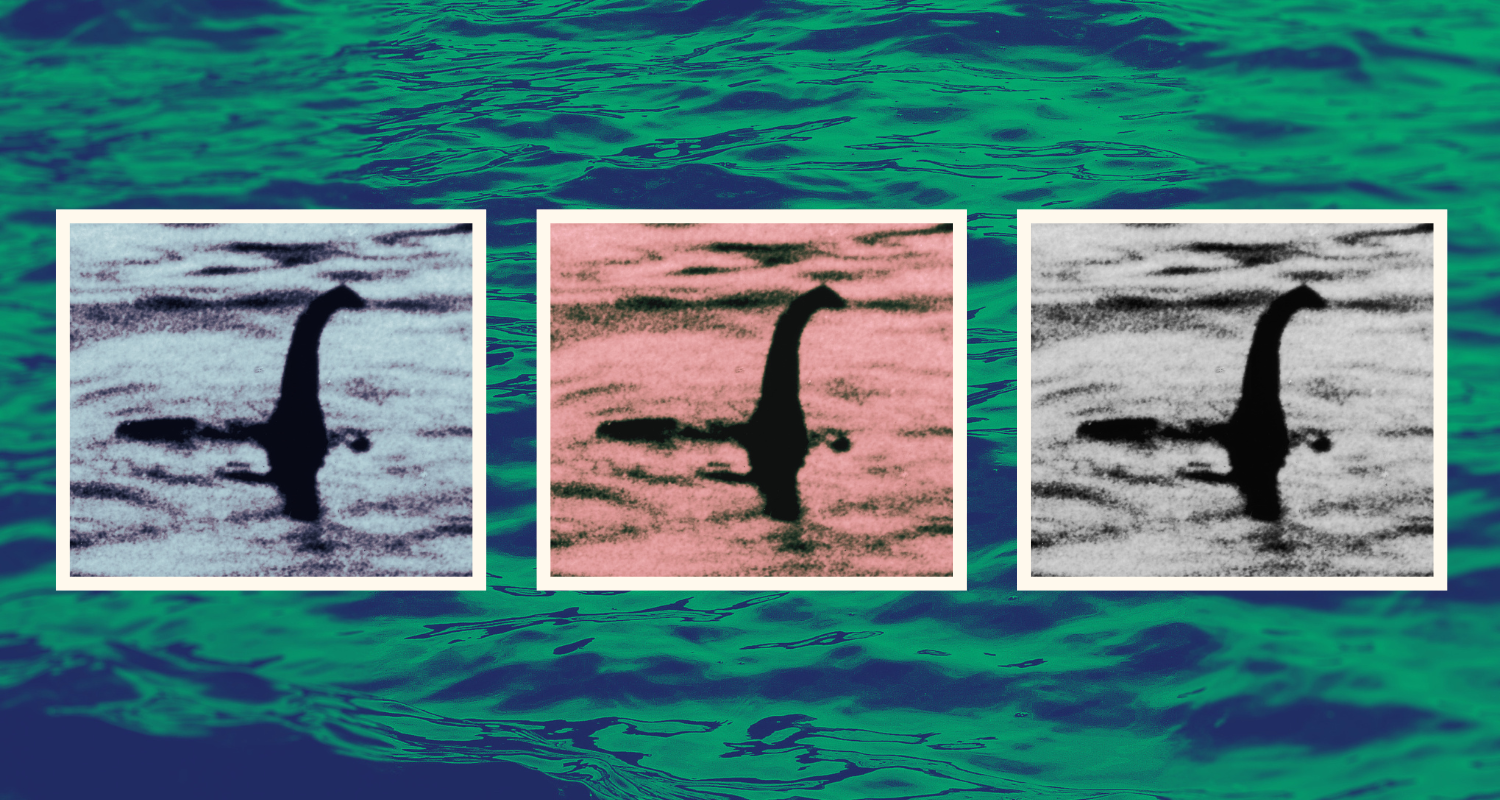
The flood of sightings in 1933, and the first photograph of the (MONSTER) in November of that year—a photo that became the first tangible proof that something might lie beyond the surface—gently forced the debate onto the table; namely, the clash between those who treated the construct as nothing or as a potentially mutable possibility, and those who would never, under any circumstance, accept the existence of something that ought not to exist. Because monsters don’t exist, and dinosaurs vanished sixty-five million years ago, could Loch Ness—so saturated with life, so intimately connected to civilization—conceal a prehistoric creature? Was reality suddenly resembling Arthur Conan Doyle’s The Lost World? In The Lost World, Doyle imagines the chance that a remote corner of the globe remains untouched by humans, where dinosaurs survive as if nothing had happened. And that solitude includes humanity.
The novel appeared in 1912, and within it, the expedition—where Doyle, unsurprisingly, places a journalist, Ed Malone, from the Daily Gazette—unearths that other lost world at Mount Roraima in the Venezuelan Amazon. That, at the very least, served as the inspiration for the mist-shrouded plateau in the fiction, and didn’t the isolation become part of the credibility pact that could make such a discovery plausible, even in a novel? And how could something like this ever be believable, then—that it might occur among people?
For there to be reality, and for there to be what is told about it, it’s crucial to keep the distinction clear when discussing impossible things. I mean, how could a prehistoric creature have persisted in a lake that people fished in, swam in, and sailed upon? Not to mention the creature’s longevity. Could something have forever lived, here or anywhere, since the dawn of time? When confronted with such a possibility, as with anything that arises, humans craft a narrative to make sense of it. But how could that make sense? Once the (NEWS) (FACTORY) began turning, it unleashed the most astonishing example of humanity’s desire to believe that, somehow, we’re not alone.
It isn’t by coincidence that, in a near future linked to counterculture—yes, the Loch Ness became a haven for many, when Charles Manson and his Family, the residents of Spahn Ranch, murdered the future—a future in which monster-hunters would crowd the lake’s shores, a certain man named Frank Searle—remember that name, forever wearing a badge that read (I’M ALMOST FAMOUS) as he lived by the water—boasted of having photographed both the (MONSTER) and a flying saucer at once. But that is a future tale. The first thing the (NEWS) (FACTORY) would present, evidently, would be proof. Because, to be credible, admissible, believable, the possibility of a frequently sighted (MONSTER) had to be proved. In other words, if almost anyone who drew near the lake could see it, why wouldn’t they photograph it? If Nessie were a narrator—that is, if she were someone attentive to the need for the story to move forward, and to do so by pursuing what might render the tale acceptable, admissible, believable—she wouldn’t take long to supply the world with that image. Yet, as a skilled narrator, she wouldn’t simply hand over the photograph the world demanded. She’d be coy about it. She’d give them something that could be anything.
The lake is nothing more than a stage. A backdrop for the selfie one is about to snap. A small conquest, a nerdy triumph, and perhaps laughable, or perhaps not, merely an I WAS THERE, and an YOU KNOW? (IT WAS JUST A BUNCH OF BLACK WATER), and perhaps it hadn’t even occurred to them—or it had—that something might appear and that, in another era, that something could have proven deadly, yet now could be worth a substantial prize—awarded not by the state, as the bus guide will assure me, but by the betting house William Hill, which also runs an annual contest for the best Nessie photograph, rewarding one thousand pounds as the BEST NESSIE SIGHTING OF THE YEAR AWARD. And yes, you can browse the list of winners and their shots, and if you wish to join, you must do so through the Official Loch Ness Monster Fan Club—but it hardly seems that was what was happening. It felt more like each of them possessed a ridiculous trophy, a trading card, a memento in their collection, an I WAS THERE, and no, of course they hadn’t seen a (MONSTER) (I JUST SAW A BUNCH OF BLACK WATER) (PITCH BLACK) and (IT WAS RAINING), and the megaphone-holding guide spoke as much about the monster as about Scotland, the loch, and Urquhart Castle, next to which so many Nessie photos have been snapped over the last century, and (DID YOU KNOW?) (THEY WERE JUST A BUNCH OF RUINS) and (YOU COULD WALK BETWEEN THEM, YES) and (WHAT DOES THE LAKE LOOK LIKE FROM THERE?) (OH, THE SAME THING) (ALL THAT BLACK WATER).
_______________________________
Excerpted from There’s a Monster in the Lake: The World as a Fantastical Place by Laura Fernández, translated by Alexis Almeida. Copyright © 2024 by Laura Fernández. English translation copyright © 2026 by Alexis Almeida. Reprinted with the permission of Graywolf Press, Minneapolis, Minnesota.
