
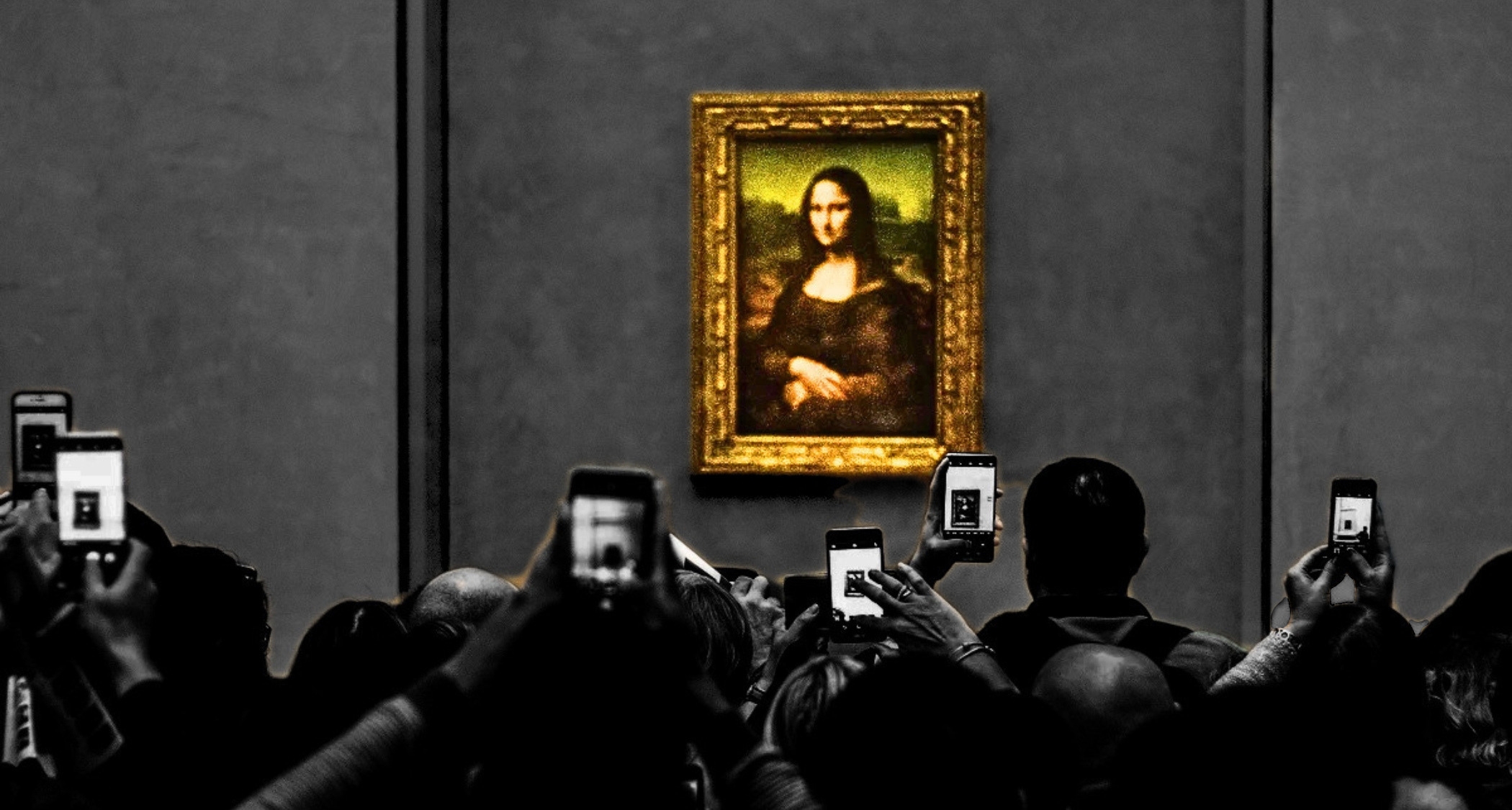
When I visited the Louvre Museum in Paris, I was struck by how small the Mona Lisa looked in person—a common reaction—and by how most of the people in the room were not looking at the painting itself. They were frantically trying to get pictures of it on their phones, sometimes with themselves in the frame, sometimes not. It seemed futile, especially given the reflections caused by the thick protective glass that encases Leonardo’s famous work. Many could barely see the painting clearly with their own eyes, yet they were focused on capturing it.
If asked before arriving what their goal was in visiting the museum that day, a likely answer would have been that the point of the visit is to witness the art. In fact, the behavior I describe is more akin to witness themselves witnessing art.
Susan Sontag once observed that a photograph does not tell us what the thing looks like, only what a photograph of the thing looks like. In that crowded gallery, I saw an entire room of people trading the thing itself for the image of the thing, convinced that the capture was more valuable than the contact. The experience had already been translated into something shareable before it was fully experienced.
The moment you become visible, the reflection starts talking back.
One could argue that the camera is simply recording the moment, but the truth is that the camera is redefining the purpose of the moment.
This pattern repeats everywhere. At concerts, the front rows glow with raised screens. Fans watch the performance through their cameras, checking their framing while the musician performs, sometimes as close as only a few feet away. At scenic overlooks, people turn their backs to the landscape to stage a selfie photograph. At restaurants, plates grow cold while lighting is adjusted and angles are tested. At children’s school performances, parents watch their child through a phone screen even though the child is directly in front of them partaking in an event that will only happen once.
The common thread is that these behaviors are more about verification than they are about documentation. The experience feels incomplete until it exists in a form that others can observe.
Presence alone is no longer enough. The moment must be seen in order to count.
We once imagined the audience as a passive receiver of content, a row of quiet observers sitting in the dark while the performance happened safely on a stage. That structure implied distance. The performer performed and the audience reacted.
That arrangement no longer exists. Now the audience sits on the stage with us. The audience shapes the performance while it is happening. Visibility now arrives with immediate feedback, and feedback carries expectations.
The moment you become visible, the reflection starts talking back.
Human beings have always adjusted their behavior when they feel observed. Psychologists have long documented what happens when people believe they are being watched. Performance changes. Speech becomes more cautious. Actions become more deliberate. Even the suggestion of observation can alter behavior.
In laboratory settings, people cooperate more when a picture of a pair of eyes is placed on the wall. The mere impression of an audience reshapes our conduct, whether we realize it or not.
Digital life has turned this psychological tendency into a permanent condition. The audience has become a continuous presence. It exists not only in front of you but inside your imagination. You begin to carry the audience in your mind.
Sociologist Charles Horton Cooley described something he called the “looking glass self”; the idea that we form our identity by imagining how others see us. We picture their judgment, interpret their reaction, and adjust ourselves accordingly. Social platforms have industrialized this process by providing constant signals about how others respond to us. Identity becomes a feedback loop.
Look around long enough and you begin to notice how deeply this has reshaped public behavior. Politicians pause mid-sentence, scanning the room for applause lines that will guide what comes next. I’ve often had the surreal experience of watching a Senator prepare to respond to my question, palpably calculating what they want to say, pausing to consider how that could be received negatively by the audience, and then modifying it in their minds before uttering a single word.
Meanwhile, journalists monitor dashboards showing which headlines produce outrage and which disappear quietly. Doctors record medical advice in short clips designed for engagement. Professors structure lectures with an awareness of how a sentence might circulate online. Live streamers adjust their performance and content in real time based on their perception of the mood in the live chat from their viewers. Even ordinary conversation has changed. People speak with the cadence of someone anticipating reaction. They compress complex views into shareable positions. They test opinions aloud as if rehearsing them for an invisible audience.
Those parts become the public identity. A process of identity compression begins.
The audience is present even when no one else is in the room.
For creators, the shift arrives quietly, slowly, and over time. There is rarely a moment when someone consciously decides that engagement will become the primary goal. The realizations accumulate. A topic you care deeply about produces little response. A more dramatic framing attracts attention. A sharper joke spreads widely. A simplified explanation receives more praise than a careful one. You notice which moments land. You build around those moments. The process feels like learning. It feels like professional growth. Approval begins as feedback but over time it becomes direction.
The mechanism behind this shift is straightforward. Modern platforms transform social reaction into measurable data. Likes, views, shares, retention graphs, clickthrough rates, and watch time convert human approval into numbers. Those numbers create a system of behavioral conditioning.
The structure resembles a slot machine. You produce something and receive a variable reward. Sometimes the response is strong. Sometimes it is weak. The unpredictability increases engagement. Each post becomes a pull of the lever. Each notification becomes a signal that something has happened. The brain responds to these intermittent rewards with powerful reinforcement. Over time, behavior reorganizes itself around whatever produces the strongest response.
Creators refresh analytics dashboards frequently. I have creator friends who often refresh their live YouTube analytics dozens of times during a single dinner. They ask me, don’t you do it too? I explain that I do, but not during dinner with friends! They study which thumbnails produce more clicks. They experiment with tone, pacing, and framing. A YouTuber notices that anger increases retention. A commentator sees that certainty produces more shares. A podcaster observes that controversy drives downloads. The system teaches through reward and silence.
The audience becomes a training environment, available to provide instant feedback to anything a creator publishes.
At first the relationship feels collaborative. The audience is helping to refine my voice. When a segment receives double the watch time or a comment section fills with enthusiasm, the response seems to reveal what resonates. You want to give people work that connects with them.
Yet the signals are not neutral. They favor clarity over ambiguity, intensity over reflection, and familiarity over surprise. A complex person contains many tones and interests, but the system elevates only the parts that generate measurable reaction.
Those parts become the public identity. A process of identity compression begins.
Audiences prefer stable characters. Predictable personalities are easier to follow and easier to share. Contradiction confuses. Evolution disrupts expectation. Complexity requires attention.
You trim the parts of yourself that require patience from the viewer.
Platforms reward consistency because consistency produces reliable engagement. A persona forms, develops, and becomes ingrained in the audience’s conception of you as a creator.
You may have a wide range of interests, doubts, and evolving views, yet the public version of you becomes narrower over time. The system selects a handful of traits and amplifies them: the confident take, the sharp joke, the declarative stance. These traits become your recognizable identity. You begin to perform the version of yourself that performs best.
This process extends beyond professional creators. Ordinary users experience the same pressures on a smaller scale. People learn which posts receive the most approval. Vacation photos emphasize happiness even when the experience was stressful. Political opinions become more certain than the underlying beliefs.
Personal updates are shaped to signal competence, success, or moral clarity.
On professional networks, individuals present a polished version of their careers. On social platforms, they present a curated version of their lives. Over time the curated version becomes habitual. The performed identity begins to feel natural.
The self adjusts to the audience.
I have felt this in my own work. When I present a story through a cleaner and more declarative narrative, the numbers rise. When I slow down, introduce context, or express uncertainty, the response softens slightly. Nothing dramatic, only a few percentage points less watch time or a thumbnail that produces less curiosity. Comments that say the segment felt different.
Those signals accumulate. Eventually they begin guiding decisions before the work is even finished. You delete a paragraph of nuance because you can already imagine the drop in engagement. You adjust tone to maintain momentum. You trim the parts of yourself that require patience from the viewer.
The process feels efficient. It feels responsible. It feels like professional discipline. Yet the traits that make a person thoughtful, hesitant, exploratory, or contradictory gradually disappear because they do not perform well inside a high-speed feedback loop.
A complex self becomes a simplified projection because simplicity travels more easily across networks designed for speed.
Then one day the version of you that performs best begins making decisions on your behalf.
Audience capture operates through reinforcement rather than coercion. The audience provides rewards and the brain converts rewards into habits. Neural pathways strengthen around what- ever produces approval. A certain tone becomes easier to access.
A certain stance becomes instinctive. The change feels like growth even when it represents narrowing.
The biology is simple. Approval triggers dopamine. Dopamine reinforces behavior. Repetition builds identity. The crowd becomes an external regulator of internal preference.
This is why audience capture rarely feels like pressure. It feels like alignment. It feels like belonging. You experience warmth when you conform and discomfort when you deviate. No one issues instructions. No authority imposes rules. The gravitational pull emerges from aggregated reaction.
Over time they become a character in the imagination of their audience. They perform that character because the performance receives validation. A complex self becomes a simplified projection because simplicity travels more easily across networks designed for speed.
The result resembles a translation from three dimensions into two. A living, evolving individual becomes a flattened version of themselves that fits neatly within a screen.
This is the beginning of capture. The audience ceases to be a destination for your voice and becomes the structure that shapes it. Expression gives way to expectation. Exploration gives way to repetition.
Eventually you are speaking as the audience, representing what the audience “would want,” rather than speaking to the audience.
__________________________________
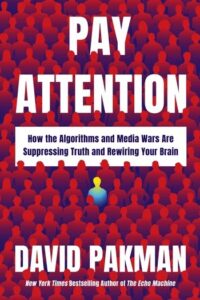
From Pay Attention: How the Algorithms and Media Wars Are Suppressing Truth and Rewiring Your Brain. Used with the permission of the publisher, Harper. Copyright © 2026 by David Pakman
