

Washington currently estimates that Americans spend 12 billion hours a year filling out government forms, meaning the average person spends six 8-hour workdays filing their taxes, signing up for Medicaid, renewing their driver’s licenses, and applying for government loans. At prevailing wages, this uncompensated labor is worth $430 billion a year. If Washington were to create a Department of Bureaucracy to take on the paperwork it shunts to citizens, the agency would require 5.9 million employees, making it four times the size of the active-duty military. The DOB’s payroll would be larger than that of every other federal department combined.
The nation’s paperwork regime frustrates every resident, and particularly lower-income residents who use more government programs and interact more frequently with public officials. The political scientist Elizabeth Cohen has done seminal work exploring time as a potent, if obscure, form of political currency. “The devaluation of a person or group’s political time is a structural obstacle to equality,” she writes. Yet we can’t measure time and effort as easily as we measure dollars, and we don’t even try. The 12-billion-hour estimate is an undercount, and an egregious one.
Pamela Herd and Donald Moynihan, two of the foremost scholars of American public administration, have identified three key types of administrative costs the government imposes on citizens. First are learning or research costs. People need to figure out what is out there, from emergency shelters to passport agencies. They need to determine what they qualify for and how to apply. The United States has no measure of—and little appreciation for—the research costs it imposes. The government doesn’t do a lot of outreach. It doesn’t centralize information, create cross-enrollment pathways, or distribute benefits automatically. Politicians focus intently on whether something exists, not whether it is accessible.
Time and effort cannot be measured as readily as dollars, and we rarely even attempt it.
Policy changes create research costs too. Consider how American families have negotiated the end of Roe v. Wade. In a jarring ruling in 2022, the Supreme Court revoked the Constitutional right to an abortion and allowed states to ban the procedure. Old local statutes upheld by Roe suddenly took effect. (Wisconsin began enforcing a criminal abortion law passed way back in 1849.) Red-state legislatures rushed to enact stringent prohibitions.
The country’s jurists and lawmakers did not merely criminalize abortion. They fostered a climate of deep uncertainty, driving up learning costs exponentially. Women needed to determine whether they lived under a complete ban, a post-viability ban, or a “heartbeat” restriction. Hospitals had to decide if their staff could provide an abortion to a minor or to a survivor of rape or incest. Physicians faced questions about what actions to take if a pregnant patient presented with organ failure, or if a fetus suffered a fatal anomaly.
“What exactly counts as the life of the mother?” asked Jennifer Jury McIntosh, an obstetrician and spokesperson for the Society for Maternal-Fetal Medicine. “Is that life today, or during this pregnancy? How close to losing her life must she be for us to decide to terminate? That feels weighty, because my sense of what is lifesaving—what I feel is saving a life—may not align with a prosecutor’s interpretation.” She feared that failing to terminate a dangerous pregnancy might amount to medical negligence, while terminating could expose a provider to criminal charges. Her fears proved prescient. In 2023, an Oklahoma woman with a cancerous molar pregnancy was kept waiting in a hospital parking lot until doctors judged she was sick enough for a termination.
Next come compliance costs, “the time and effort spent on the often tedious task of filling out forms, documenting status, or responding to bureaucratic directives,” as Moynihan and Herd describe them. These are the most visible and intelligible form of time taxes. And Uncle Sam keeps a partial, opaque tally of them.
The Paperwork Reduction Act of 1980 obligates Washington to quantify and lessen regulatory burdens. Rules affecting businesses must demonstrate a net social gain, shown through rigorous cost-benefit analyses. Washington weighs the value of clean air against the value of commuting by car. It weighs the burden of Department of Labor safety mandates against the cost of lost limbs. But for regulations to even undergo a cost-benefit test, they must carry an annual price tag of $200 million or more, or “adversely affect in a material way” jobs, productivity, competition, public health, or the government itself. The Office of Information and Regulatory Affairs, or OIRA, doesn’t require that agencies perform cost-benefit analyses for regulations that affect individuals. Requiring a company to spend $300 million on fire-retardant materials counts. Requiring someone to endure a forty-one-page application does not.
OIRA does produce a rough estimate of how long the average person takes to finish a given federal form: eight hours for the IRS’s Form 1040, for instance. These estimates are frequently unreliable. “OIRA sometimes conducts field studies, observing real people collecting information, keeping records, that sort of thing,” a veteran OIRA staffer told me. “But sometimes, the numbers simply fall out of the sky, and you have no idea where they came from.”
Moreover, OIRA tallies only federal paperwork, ignoring forms issued by states or municipalities. Picture a Louisiana mother struggling to pay bills who applies for SNAP, best known as food stamps. She encounters an 8,350-word form. Page one asks her to separate SNAP from two other programs, the Family Independence Temporary Assistance Program and the Kinship Care Subsidy Program; a flowchart shows which sections to complete based on eligibility and enrollment choices. Page three asks for documentation in up to thirteen categories: pharmacy receipts from the last three months, four pay stubs, baptismal records, proof of household members. Page six covers drug court and “alternatives to abortion”; page seven lists penalties for misusing benefits on a cruise or at a psychic. Page fifteen requires reporting income from twenty-four sources; page sixteen asks about fourteen housing costs; page nineteen asks about ten kinds of assets your family may possess.
The government does not account for compliance burdens that do not involve forms. Yet these burdens can be crushing. To qualify for disability insurance, a person must visit a physician, describe their condition, obtain a diagnosis, have the doctor fill out a form, fill out more forms themselves, and bring documents to a Social Security office, then pursue a dispute before a special judge. That time is real, even if it isn’t counted.
We do have some methods to gauge the compliance burdens, however. Some programs track “procedural denials”: the number and share of applicants rejected because they could not complete the paperwork correctly. In Louisiana, one in four SNAP beneficiaries cycles on and off the program every year due to bureaucratic glitches. The state terminates about 15 percent of welfare cases annually for procedural reasons. In 2018, it disenrolled 15,689 children—children!—from its public health coverage due to “failure to comply.”
The work of the political scientist Carolyn Barnes highlights a third category of cost: redemption costs, or the effort required to use a benefit or exercise a right. Medicare draws far fewer costs; seniors simply present their insurance card to receive care. Other programs are maddeningly finicky. Women fleeing domestic violence cannot secure a rental with their emergency housing voucher. Hurricane survivors cannot find hotels that participate in the Transitional Shelter Assistance program. Parents using WIC, a nutrition program for women, infants, and children, must sort out which eggs and which grapes they can purchase. “If you pick a different grocery store, you might not find the brand, you might buy the wrong brand or size, and you end up doing arithmetic all over again,” a mother told Barnes.
Finally, there are psychological costs. Frustrating interactions with the government amplify distress and trauma. They erode self-worth, alter political views, and reshape civic responsibility. The government does not quantify the emotional toll of waiting for your spouse to join you, of struggling to obtain help as a young parent, of seeking medical care for a dying family member from an insurer, or of standing in a polling line in a state with a painful history of disenfranchisement. It is hard to believe that Uncle Sam truly cares. As the political thinker Martha Nussbaum has noted, “What cannot be counted will remain vague and unbounded, escaping human grasp.” As McKinsey consultants like to say, you cannot manage what you cannot measure.
*
While Washington muddles through public administration, Silicon Valley has poured hundreds of billions into making transactions effortless. With a few finger taps, I can summon any media I desire, hail a black car to my door in minutes, have a meal delivered within an hour, and order a closet full of clothes for overnight arrival. Yet I have spent hours wrestling with my taxes and countless days as a reporter watching people struggle to navigate Medicaid, the permit system, veterans’ benefits, farm loans, and SNAP.
The picture isn’t simply “businesses good, government bad” or “businesses sleek, government clunky.” Corporations use fine print to achieve their aims. They fashion a frictionless path for purchases while making it cumbersome to exit. They make buying easy and rapid, while cancellations are slow and difficult. They show that administrative burdens can be a potent, adaptable instrument.
Not long ago I attempted to cancel a gym membership. The manager asked me for a doctor’s note or proof of relocation. I pushed back; she relented. I later realized I had signed up for several “free trials” I forgot to cancel, leaving me paying $40 monthly for apps I didn’t want. Months earlier, my family stayed in an Airbnb-style rental without a secure front door. I had to consult the city’s tenancy code and verify housing rules to secure a refund from the owner.
In every instance, I was purchasing a service, not a physical good. I was entering into a contract rather than owning a thing. This placed me at the core of the bureaucratization of modern life and the cradle of these time taxes. We have become a nation of subscribers, sublessees, and members, with straightforward transactions stretching into extended, legalized processes. By 2018, the United States had 826,537,000 consumer-arbitration agreements in force—a figure noted as a significant undercount by the researchers. Another study found that 99 percent of consumers did not read the contracts they sign, effectively surrendering broad constitutional rights “lock, stock, and barrel,” in the words of Shennan Kavanagh of the National Consumer Law Center.
We have transformed into a country of debtors and policyholders, relying on intermediaries and guarantors as well as on insurers, lenders, and service providers. Signature boxes and document portals have become the price of and barrier to basic necessities such as housing, shelter, and health care.
We have grown into a nation of credentials. The share of jobs requiring postsecondary training has climbed to 68 percent, up from about one-quarter of a century ago. The share of jobs demanding an occupational license has risen to 22 percent, up from around 5 percent in the 1950s. In many instances, those credentials are unnecessary. Washington, DC, recently imposed a rule requiring day-care teachers to hold a two-year associate degree, despite no evidence that such a degree is essential to performing the job well. “Even with extensive experiential learning, I don’t meet the current standard,” explained one veteran educator.
We have become a nation of middle managers, with firms and nonprofits hiring millions to monitor compliance, track performance, design training, and administer benefits. Between 1987 and 2012, colleges and universities added eighty-seven professional staffers each working day, increasing administrator-to-academic ratios and reducing student-to-staff ratios. The trend is mirrored across nonprofits, for-profits, and government alike. One in six workers exists to move paperwork along for others. This creeping bureaucracy costs the nation about $3 trillion annually, a figure estimated by business consultants Gary Hamel and Michele Zanini.
Administrative procedures might be a necessary tool of sound government. But administrative burdensare a technology of annoyance, degradation, discrimination, and needless extraction.
We may live in a world of seamless consumption. Yet we also inhabit a condition of “total bureaucratization,” a term coined by the anthropologist David Graeber. We face more forms and longer forms, more subscriptions and rebates and reimbursements and applications and enrollment periods. We are compelled to perform bureaucratic work by institutions both public and private. Indeed, public institutions even nurture the creation of private paperwork. The government “provides the legal framework,” Graeber argues, along with “all of the elaborate mechanisms of enforcement.” Uncle Sam allows insurers to deny necessary procedures to their beneficiaries. He enables companies to foist forced-arbitration clauses and onerous contract terms on unsuspecting consumers. The government edges citizens into private contracts as well. Instead of offering sufficient public housing, it offers an unlimited array of guaranteed mortgages. Instead of expanding community colleges, it broadens its student-loan portfolio.
Citizens have grown weary. Only 36 percent of Americans consider the government’s processes to be intuitive. About 41 percent describe them as clear and understandable. More than half find it frustrating to access or use public services. A wide majority believe the government is incompetent given the volume of tasks it handles on people’s behalf. A bipartisan majority desires that Uncle Sam relieve them of these daily, unnecessary aggravations.
*
The German sociologist Max Weber described an ideal bureaucracy as hierarchical, disciplined, rule-bound, professional, impersonal, and meritocratic. It should shield citizens from partisan reprisals, applying general rules to individual cases to yield predictable and just outcomes.
Today, the country’s public servants are indeed disciplined, rule-governed, and competent. Yet the results they produce can be wildly uneven and sometimes profoundly unfair. For instance, low-income mothers in Vermont are eighteen times more likely to receive welfare than similar mothers in Mississippi. Austin issues nearly thirty times as many building permits as Providence does, after adjusting for population. And, not surprisingly, many eligible applicants for welfare benefits or building permits spend countless hours wrestling with red tape.
Administrative procedures might be a necessary tool of sound government. But administrative burdensare a technology of annoyance, degradation, discrimination, and needless extraction. They subtly shape policy outcomes, including shrinking the social safety net, deterring outgroups from voting, blocking construction projects, and pushing the ill and the poor into work.
Over the past decade, Washington has begun to wake up to this ongoing crisis. The scholarly attention to the time tax has surged, with Moynihan, Herd, Barnes, and others examining its corrosive impact on American life. Public servants themselves have become increasingly aware of the mess they have helped create. The Obama-era official Cass Sunstein begins his book Sludge by admitting his failure as head of OIRA, focusing on grand reforms like healthcare rather than the granular enrollment processes and fine print that affect everyday Americans. He concedes that he missed the mark for the country.
When Donald Trump returned to the presidency, he professed a desire to succeed where Sunstein had fallen short. He vowed to modernize the government, deploy agile information technology, trim bureaucratic headcount, and save taxpayers billions annually. To pursue this aim, he established DOGE, the Department of Government Efficiency, borrowing a playful nod to an internet meme about a Shiba Inu. He tasked Elon Musk with steering the initiative. He called it the Manhattan Project of our time.
Yet DOGE did not resemble Los Alamos. It lacked real authority, was staffed by ill-suited appointees (including a teenage programmer nicknamed Big Balls), and was not a novel enterprise. In 1912, William Howard Taft conducted a comprehensive review of agencies to ensure the government operated with maximum efficiency. In 1993, Bill Clinton enacted the Government Performance and Results Act, directing agencies to draft strategic plans and measure success against predefined targets. Various established bodies monitor the civil service and the use of taxpayer dollars—such as the Government Accountability Office, inspectors general, and congressional committees—performing oversight and accountability.
Even if DOGE had faults, it still produced a shockwave. Trump eliminated the United States Digital Service, a little-known but highly regarded agency with a track record of improving government websites. Musk’s people moved through departments, canceling contracts, dismissing workers, accessing sensitive data, and undermining programs tied to diversity, equity, and inclusion, as well as foreign aid. The agency ultimately made the government less efficient. DOGE disrupted the IT staff essential to keeping key programs operational. It forced civil servants to submit standard contracts and long-approved projects to political appointees for review. It compelled workers to justify “even the most routine purchases,” such as bolts for NASA or lab supplies for the FDA. Contrary to its stated aim, DOGE ended up widening deficits, impairing tax collection, and generating millions in legal costs.
Most troubling perhaps, DOGE did not lessen the time tax, or even tackle it meaningfully. Musk and Trump hardly spoke about the user experience of citizens as they swapped rhetoric about drainage and reform. It failed to streamline the FAFSA process, standardize Medicaid, SNAP, and housing-aid applications, or eliminate antiquated interfaces and ridiculous waiting times. It did not.
_______________________________
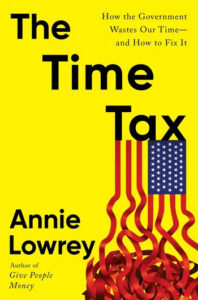
From The Time Tax: How the Government Wastes Our Time—and How to Fix It by Annie Lowrey. Copyright © 2026. Available from Ecco, an imprint of HarperCollins Publishers.