In the 1960s and 1970s, Ursula K. Le Guin wrote speculative fiction shaped by her interests in environments and ecologies, her pacifist anarchist feminism, and her anti-Vietnam War activism. A Wizard of Earthsea (1968), one of the great fantasy novels and still a widely read classic of young adult literature that helped define the category, is about a young wizard coming of age, learning to control his powers, and trying to understand all his relations, including plants, animals, the earth, and other people.
Just a year later came the great thought experiment The Left Hand of Darkness (1969) about the Gethenians’ unique sexual physiology, which involves a sexually active period called kemmer, the only time they are not androgynous and sexually inactive. Then, they can become either male or female, depending on the situation. Le Guin always insisted the environment was just as important as gender and sexuality in the novel. An investigator from another, peaceful world reports that “the dominant factor in Gethenian life is not sex or any other human thing: it is their environment, their cold world.” She adds, “I really don’t see how anyone could put much stock in victory or glory after he had spent a winter on Winter, and seen the face of the Ice.”
Climate change visions of transformed Oregon and California places and spaces show up in the worlds Le Guin imagines.
The Vietnam War provoked Le Guin to write The Word for World is Forest (1972), a work that became a touchstone for James Cameron’s blockbuster Avatar (2009), yet it offers no white male heroes to identify with. Instead, Earth colonists decimate the native world by felling trees, assault native women, and extracting labor from native men, until the indigenous people rise up. Later, she produced The Dispossessed (1974), another foundational work that probes pacifist anarchist ideas through two worlds whose environments and relations to state power and capitalism differ sharply. This brief survey hardly exhausts Le Guin’s vast body of influential novels, short stories, poems, translations, children’s books, essays, talks, and other writings that connect environments and ecologies to gender, race, and sexuality; challenge state violence and techno-fix thinking; and imagine other societies and realms. Always Coming Home (1985), a speculative novel rooted in the Northern California landscapes of her upbringing, stands as perhaps Le Guin’s most ambitious project.
Le Guin was born in Berkeley, California, attended Berkeley High School, and spent summers in Napa Valley, where her father’s Native friends and collaborators sometimes visited. Her father, Alfred Kroeber, founded UC Berkeley’s anthropology department, while her mother, Theodora, authored Ishi in Two Worlds (1961) and other works. Le Guin earned her undergraduate degree at Radcliffe, followed by a master’s in Renaissance French and Italian literature from Columbia in 1952, then received a Fulbright Fellowship to study in Paris. On the journey, she met Charles, who would become her husband, and the couple wed in Paris. Returning to the United States and settling in Portland, Le Guin left academic life to raise their children in a northwest hillside home just down the road from Forest Park, where she resided for the rest of her days.
In the archive, the imprint of California and Oregon—places, spaces, and the more‑than‑human world—emerges vividly in syllabi, class notes, drawings, and other materials Le Guin authored and gathered from workshops she helped organize in Portland, along the Oregon Coast, at the McKenzie River, at the Malheur Field Station, and at Humboldt State in Arcata, California. Le Guin wrote that “the great, improbable impetus” for The Tombs of Atuan (1970) came from “our first visit to Harney County, a high and lonesome land of mountains and great sagebrush plains, of pure skies, far distances, and silence… I knew my novel would be set in that desert… I began to dream my story. The land had given it to me.” Climate change visions of transformed Oregon and California places and spaces appear again in The Lathe of Heaven (1971), The New Atlantis (1975), and Always Coming Home.
Le Guin told the reporter that she could do without people a lot better than she could do without animals, plants, and rocks.
When Mount St. Helens erupted in May 1980, Le Guin watched the spectacle from her bedroom all day, listening to a country-and-western station and only turning on the television later. Soon afterward, she undertook a small research project inviting people to send dreams about the eruption, then gave a talk at the Portland Jung Institute in which she read aloud forty-nine dreams, offering “some random commentary.” She placed notices in Willamette Week and the PSU student newspaper, Vanguard, announcing that she was gathering dreams about Mount St. Helens for an Oregon Friends of Jung meeting and possibly a magazine piece. In a 1980 issue of Parabola, Le Guin published “A Very Warm Mountain,” later reprinted in a chapbook titled The Red Zone (1983) that she and artist Henk Pander created after visiting the blast area sixteen months afterward. Her prose and poetry mourn the dead forest and other living beings on Earth while praising the mountain’s power.
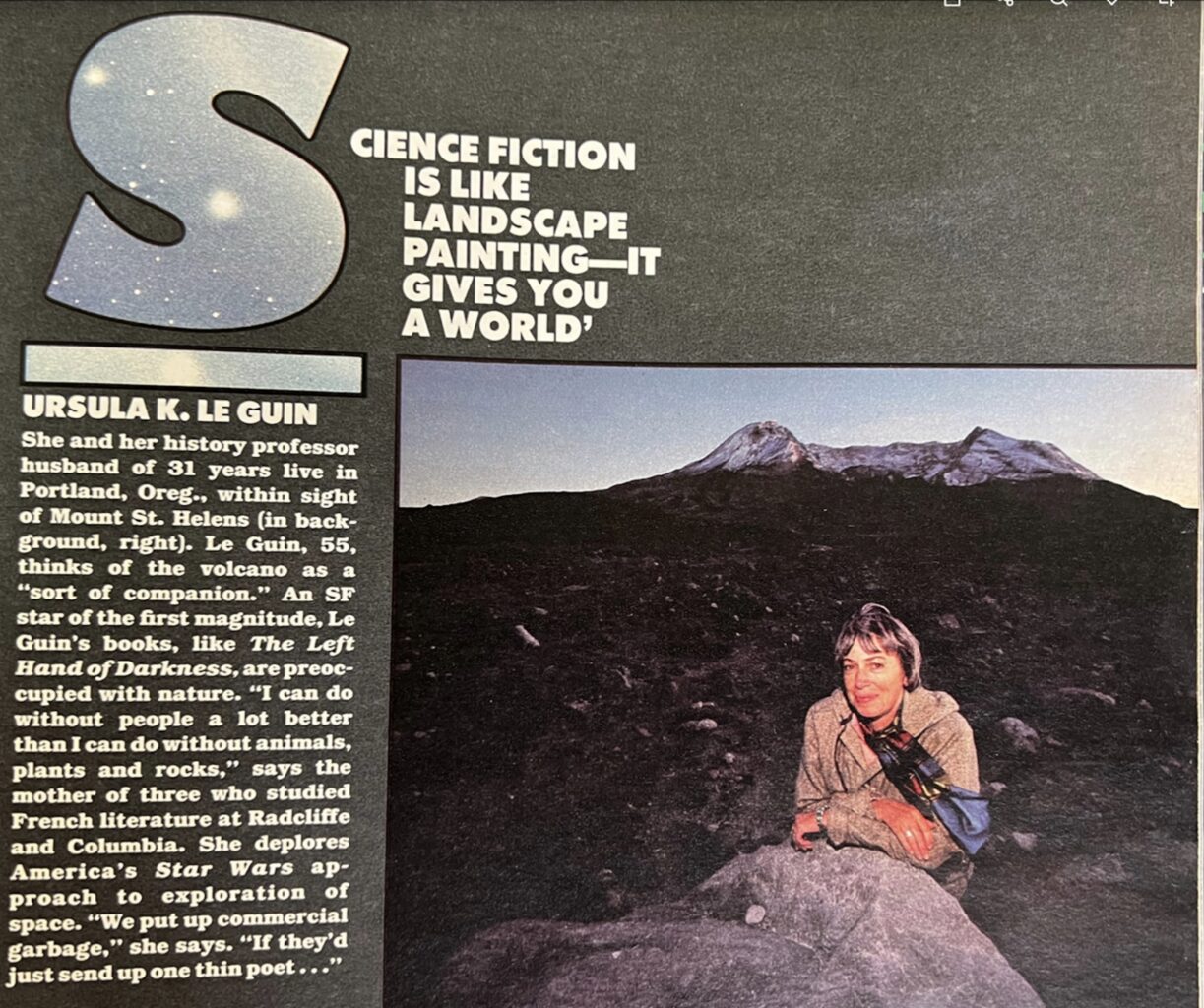
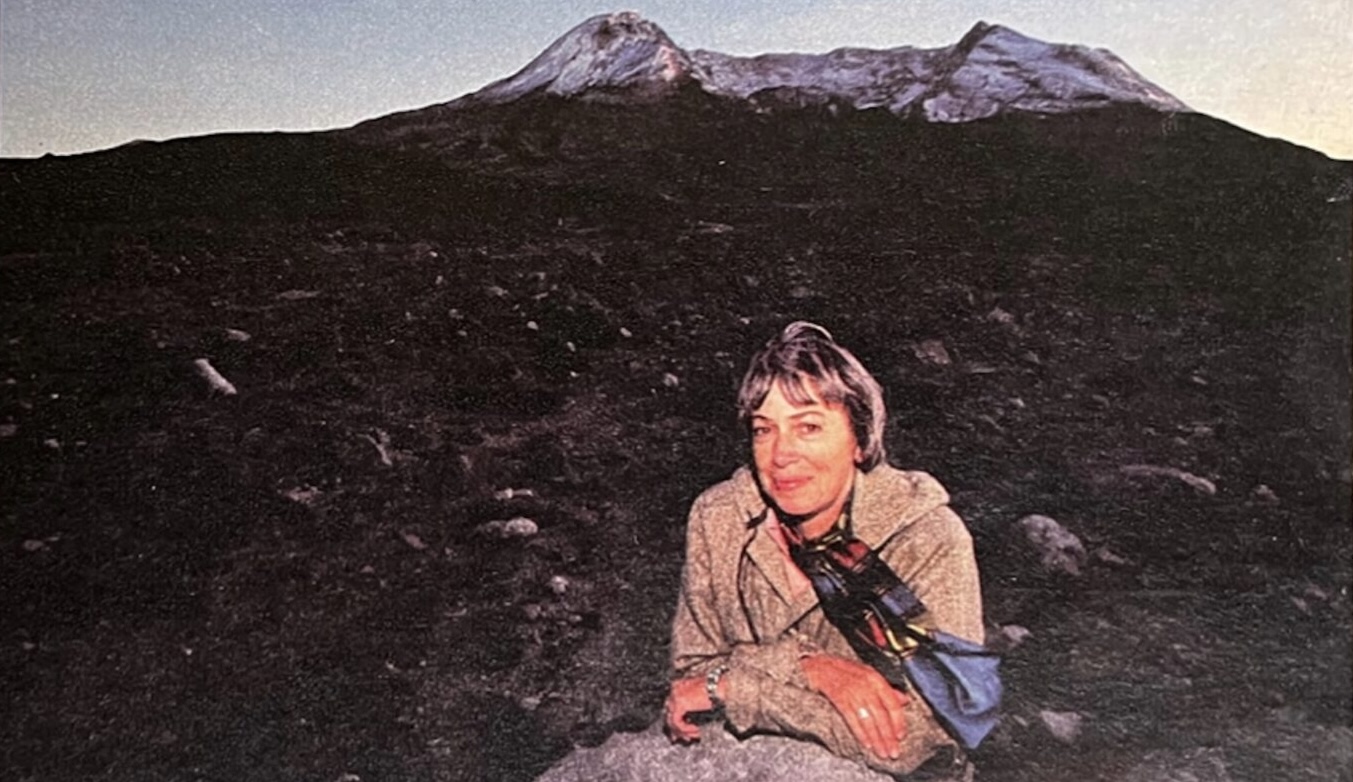
In a 1984 photograph, Le Guin, then fifty-five, smiles at the camera while resting her arms on a large rock before Mount St. Helens. She described science fiction as akin to landscape painting in the sense that it furnishes a world, and she regarded the volcano as a companion of sorts. The piece underscores that Le Guin’s writings occupy themselves with the natural world. She once told a reporter that she could do without people far more easily than she could do without animals, plants, and rocks.
___________________________
From Science Fiction Ecologies: Worldmaking with Butler, Le Guin, and Merril by Shelley Streeby. Copyright (c) 2026. Available from NYU Press.