
On Wednesday, the narrow slice of humanity scattered across rural Russia, northern Spain, eastern Portugal, Iceland and Greenland will experience a total eclipse of the Sun and, if fortune smiles, actually behold it. In Siberia, this ethereal pas de deux will begin just after dawn; in Reykjavik, it will unfold in the late afternoon; and here in Valencia, the celestial duet will pirouette toward the horizon, finishing just before sunset.
This will be the first complete hiding of the Sun behind the Moon on continental Europe since 1999. Total eclipses occur somewhere on Earth every 18 months or so. Yet because vast portions of the planet are covered by seas or non-desert land, they are rarely witnessed by human eyes. (Not a single Spaniard presently living had been born when the Moon last fully eclipsed the Sun in these parts in 1905.)
My solar crew will be a quirky mix: friends who identify as gay living in Valencia, a sprawling Mormon clan who’ve journeyed all the way from Salt Lake City, and me, traveling not far from Greece. Yet whether we’re Mormons, Protestants, Catholics, Jews, Muslims, Hindus, secular, Black, white, Latino, gay or straight—when we gaze at an eclipse, we share something fundamental.
For an eclipse day is a sacred day of Sun reverence.
And it can remind us of the subjectivity and positionality of how we perceive the marvel of the universe—and, paradoxically, the universal face of the universe itself.
“The universe—including the human corners of it—is enigmatic, queer, surprising, and endlessly fascinating. But we physicists are just people, no more, no less.”
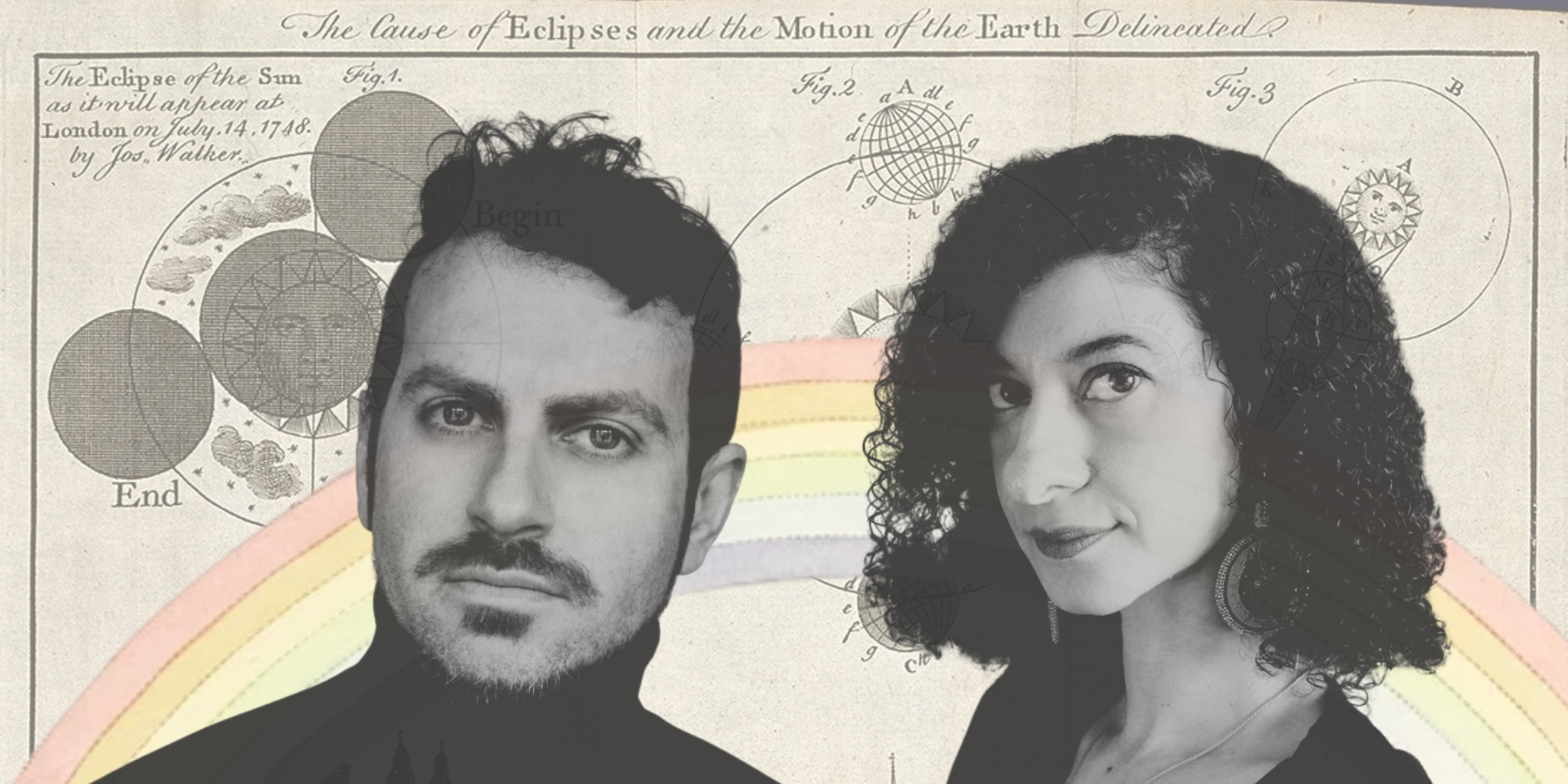
Two beautiful, very readable new books about astrophysics address this sense of awe, which vacillates between identity and infinity. Invisible Rainbows: The Unseen Universe Beyond Our Senses is by Dr. Alfredo Carpineti, a queer Italian astrophysicist and editor at IFL Science, and The Edge of Space-Time: Particles, Poetry and the Cosmic Dream Boogie is by Dr. Chanda Prescod-Weinstein, a professor of physics and astronomy at the University of New Hampshire and a scholar of Black feminist science studies. Both volumes illustrate how understanding the universe depends on who is permitted to study (which, in turn, enables us to understand ourselves beyond our own confines). “There is a bizarre cultural tendency to treat physicists in particular as fascinating enigmas whose brains exist beyond the realm of everyday human politics,” Prescod-Weinstein writes. “This isn’t true. The universe—including the human corners of it—is enigmatic, queer, surprising, and endlessly fascinating. But we physicists are just people, no more, no less.”
“When I look inside and see that I’m nothing, that’s wisdom. When I look outside and see that I’m everything, that’s love. And between these two, my life turns,” the Hindu teacher Nisargadatta Maharaj once said. It’s a phrase that resonates with me as I lift my gaze to the stars and ponder the vast gaps between them (and the space inside the atoms that constitute “me.”) Using queerness, feminism, theoretical physics, Judaism, an Italian fondness for pasta, and the Black radical tradition, Carpineti’s and Prescod-Weinstein’s books guided a lay reader like me through that wondrous space between the self and the cosmos in which “my life turns.”
“As a Black physicist,” Prescod-Weinstein writes while reflecting on Sun Ra’s Space is the Place, “I have tried to grow the seeds that my ancestors passed on to me. The ancestors could fly. I do too, whenever I am able to escape into looking at the universe through the lens of quantum fields.”
Both writers help us sense that when we fix our eyes on the Sun—which I’ll be privileged to do with my naked gaze for roughly a minute of totality—we are not staring at a distant star, nor do we need to keep the physics of looking at it at arm’s length either.
For we live inside the Sun.
And it is our divine right to contemplate this.
*
“Scientific work does not exist in a vacuum,” Carpineti contends in Invisible Rainbows, “its context in the social and historical sphere where it sits, matters.” Dedicated to “all the queer kids reaching for the stars,” Carpineti repeatedly reminds us that “while science is incredibly precious to humanity, it can also be messy and political.” Who observes the natural world, to a large extent, shapes how we understand that world—how we internalize the sense that the “cosmos is within us. We are made of star-stuff. We are a way for the universe to know itself,” as Carl Sagan put it.
“To do cosmology—to study the beginning of space, time, matter—is to be a griot, a keeper of stories and history,” Prescod-Weinstein asserts in The Edge of Space-Time, conjuring Black storytellers in the oral tradition.
But who has not been allowed to study the stars remains a crucial concern, and a recurring theme in both books. Carpineti’s eponymous rainbows become a rich site of inquiry, since rainbows have symbolized wonder for humanity long before the 1939 film The Wizard of Oz and Gilbert Baker’s 1978 flag which later became symbols of gay culture. “The rainbows that you see are just for you,” Carpineti notes, conveying a sense of relativity that is always essential to grasping physics: “No one else in the entire Universe ever has or ever will see that rainbow.” (Referring to “queer phenomenology,” Prescod-Weinstein also emphasizes the importance of “the queer, poetic wonder that is our universe and what we gain when we look at it from the margins.”) Comprised of seven colors, rainbows are a manifestation in the human eye of light that is constantly around us. Indeed, as Carpineti explains, the universe is awash with “seven broad categories” of light: “radio waves, microwaves, infrared, visible, ultraviolet, X-rays and gamma rays.”
Carpineti and Prescod-Weinstein and their interlocutors repeatedly challenge the notion that the universe can be reduced to binary terms.
But, he cautions, “we cannot discuss infrared light and ignore the controversy surrounding the naming of the largest space telescope after James Webb, who was involved in the mass dismissal of homosexual people from the US government in the 1950s.” Prescod-Weinstein notes that when Edward R. Murrow headed the U.S. Information Agency and “wrote to NASA administrator James Webb in 1961 to suggest that the United States send ‘the first non-white man to space,’” Webb allegedly replied that such a choice was “inconsistent with our agency’s policies.”
There is “a tendency to talk about science as if it exists outside of scientists,” while “the reality is that we scientists are story-crafting,” Prescod-Weinstein observes. Yet many griots have been pushed from their place in keeping the celestial narrative.
To this end, Invisible Rainbows and The Edge of Space-Time both offer a corrective to the exclusion of scientists and astronauts who were not straight white men, especially in their choices of interlocutors. In addition to Sun Ra, Prescod-Weinstein converses with physicist Edward Bouchet (“the first African American to earn a PhD in the United States”), poet Natasha Trethewey, sociologist Heba Gowayed, and Star Trek astronauts Lt. Uhura, Lt. Geordi La Forge, and Commander Benjamin Sisko. Meanwhile, Carpineti furnishes a “tasting menu” introduced by “conversations with LGBTQIA+ astronomers from around the world,” paired with queer-coded metaphors such as a disco ball, cocktail recipes and Britney Spears songs, with each interlocutor introduced along with their pronouns. The discussions range from black holes with Dr. Sthabile Kolwa (she/they) at the University of Johannesburg in South Africa, to debated asteroids capable of destroying the Earth with planetary scientist Dr. Ed Rivera-Valentin (he/they) at Johns Hopkins in the United States.
Carpineti and Prescod-Weinstein and their collaborators repeatedly challenge the notion that the universe can be reduced to binaries. If you wish to understand physics, Prescod-Weinstein advises, “You must be willing, like Alice in Wonderland, to go through the looking glass, again and again,” and be “willing to change your worldview when the math, the experiments, and even sometimes theories demand it.” The arguments in The Edge of Space-Time make a compelling case against the current urge to simplify understanding the world into a literal binary code of ones and zeros: the drive toward data centers and the so-called “artificial intelligence.”
Despite their accessibility, both books are challenging at times—especially when explaining the Big Bang and the origins of the universe. But, as Prescod-Weinstein notes, “it’s okay to reread something that feels confusing for you the first time.” Indeed, “We should learn and teach poetry, physics, algebra and other abstract ideas because they train us to think in symbolic and figurative terms” (instead of, I would add, training machines to reduce the complex world to easy binaries). In what reads as a pedagogical critique of “writing” with Large Language Models or relying on apps like “Blinkist” to summarize entire books in 15 minutes—not to mention universities outsourcing education to so-called “AI”—Prescod-Weinstein writes that “Not only is there nothing wrong with learning, there is also nothing wrong with having questions which are not readily answered.”
For “When you know a little about the abstract nature of the universe,” she writes, “it looks and feels different from before—and no one can take that experience away from you.” This perhaps helps explain why, in 2024, the New York State Department of Corrections placed prisons on lockdown and permitted guards to view the eclipse, but tens of thousands of incarcerated individuals were not allowed to see it. (Although six prisoners in New York sued and won the right to view the eclipse on religious grounds, the rest would have to wait until 2079—a 55-year delay—during which most will likely have died.)
*
Plagued by political problems very much of this planet, 2024 proved to be perhaps the most difficult year of my life.
Yet two wonders tempered that heaviness: witnessing a total solar eclipse and the Aurora Borealis for the first time.
I had seen total lunar eclipses before. I still recall the fear I felt witnessing my first one in 1982 as a child. As the Moon turned red, my sister Jinger whispered that it was because the Moon was bleeding and the blood would spill onto the Earth. I cried out in terror, turned away, and hid my head to keep the “blood” from dripping on me. (Prescod-Weinstein is right about the power of metaphor shaping the science we produce; though I never became the astronaut I dreamed of when I attended Space Camp, I am now a phlebotomist who has studied blood as a social scientist for many years, and I often think of the Moon when I draw blood.) And I had witnessed several partial eclipses of the Sun, most recently in 2017—an event that felt like it collapsed the 93 million miles between the Sun and my friends lying on their backs on a Bushwick, Brooklyn rooftop.
“Even though the Sun is about 400 times bigger than the Moon, it is also about 400 times farther away,” which “makes the Sun and the Moon appear almost exactly the same size in our sky.”
But nothing prepared me for the sensation when I lay on the grass in Cape Girardeau, Missouri in 2024, beside my friend Carolyn and her children, gazing through glasses at the Sun and then, as people began to scream in wonder, removing them and looking straight at the Sun.
It felt like gazing into the face of God.
Even as an adult who knew what was happening, I felt the same terror of that little boy cowering from the Moon’s blood. What must this have been like for people who had no idea what was happening millennia ago? It must have seemed like the end of the world!!!!
As I looked up, I began to weep. My friend’s teenage son, likewise overcome, sprang to his feet and began running around like a possessed creature.
I was raised in a tradition of Buddhist-infused Christianity that does not see Christ as the sole key to the divine, but as an example of how each person of any faith (or none at all) holds within themselves the key to the universe’s divinity. Gazing into the Sun’s corona that day evoked the same sensation Jesus conveys in the Gospel of Thomas: “I am the light above everything. I am everything. Everything came forth from me, and everything reached me.”
Meanwhile, “As the Moon covered the Sun, the whole place went silent for a moment before erupting into joyous screams” Carpineti writes of viewing that same eclipse from a beach in Mazatlán, Mexico, 1,750 miles away in Invisible Rainbows. “It felt akin to a religious experience.”
Eclipses spring from a mind-bending cosmic coincidence: the Moon sits about a quarter of a million miles from Earth, while the Sun is roughly 100 million miles away; and, at the same time, the Sun’s diameter (about 865,000 miles across) is roughly 400 times larger than the Moon’s (2,159 miles). As NASA explains, “Even though the Sun is about 400 times bigger than the Moon, it is also about 400 times farther away,” which “makes the Sun and the Moon appear almost exactly the same size in our sky.”
A further poetic accident: because the Moon slowly drifts away from us each year by a few centimeters, its apparent size from Earth gradually decreases, and eventually total solar eclipses will cease to occur. (Do not worry about this within your lifetime, though; it will take more than 600 million years for the Moon to wander so far that total eclipses become impossible.)
When I experienced totality, it filled me with happiness to be alive—a feeling I rarely had in 2024.
But I felt it again later that year, one night in October, a particularly solitary time in Chicago after I had been suspended from teaching. It was during a rare visible appearance of the Aurora Borealis over Lake Michigan. Because not only my eyes but my iPhone were capturing colors beyond ordinary perception, I felt that same sense I had felt earlier, during the eclipse: that we are not merely looking at the Sun. We are inside the Sun. (Perhaps, we are even the Sun.)
“Aurorae can be seen with the naked eye at higher latitudes (and at lower ones if the Sun is in a particularly active portion of its eleven-year cycle),” Carpineti explains. “Charged-up particles from the Sun interact with a planet’s magnetic field, following its lines that go from one pole to the other. These particles, usually electrons, eventually slam into the atmosphere, and, depending on the energy of the charged particles and their interaction with the magnetic field, they can penetrate more, slamming different gases—nitrogen or oxygen on Earth—and produce different colors.”
Like some of the scientists Carpineti speaks with, light itself does not fit neatly into binaries. “Light is two things at once,” Carpineti explains. “Light is waves that travel across vacuum and transparent materials, and light is also particles, which we call photons, delivering energy in discrete packets.”
Seeing the Aurora reminded me that whatever noise plagues us on this planet, we are living inside “a giant bubble around the Sun and its planets, known as the heliosphere,” as NASA explains. This “constant flow of charged particles” from the Sun is called the solar wind, which ultimately travels past all the planets to roughly three times the distance to Pluto before meeting resistance in the interstellar medium.
For everything we eat, everything we do, everything we are is powered by the Sun.
I think of this sometimes when savoring a tomato in the Mediterranean (where, when you cast your eyes toward the yellow disk in the blue sky over Athens, you can imagine why the ancient Greeks perceived it as a golden disk dragged by Helios and his four mighty winged horses). I think of the seed that began in the Earth, pushing up, unfurling its leaves, like solar panels unfurling to power Helios A and Helios B—probes launched by NASA in the 1970s to study the Sun. (Indeed, the only human-made objects to leave the heliosphere are Voyager 1 and Voyager 2—and it took them more than three decades traveling at 38,000 miles per hour to reach interstellar space.)
I also think of this while recalling another excellent book by a gay science writer, Becoming Earth: How Our Planet Came to Life by Ferris Jabr, which explores how life did not merely appear on Earth but emerged from Earth—and, I would add, from our nearest star. (Remember, as Jesus says in the Gospel of Thomas, how we both are and come from the “light above everything,” how Dave Bowman exclaimed “My God, it’s full of stars” in 2001? The Sun can say to us, “Split wood. I am there. Lift up a rock, you will find me there.”)
For everything we eat, everything we do, everything we are is powered by the Sun.
*
In lucid, poetic prose and with helpful diagrams and metaphors, Invisible Rainbows and The Edge of Space-Time invite us to explore our place in the universe—and to cultivate a sense of queer wonder about it. The entry point to doing so may be the grandeur of an eclipse or an aurorae (or the Artemis II mission heading to the Moon).
But the light of the universe is all around us, even when we cannot see it with the naked eye, waiting for us to understand it (and ourselves) more fully at all times.
When Voyager 1 turned back and gazed at Earth in 1990, it revealed a pale blue dot, free of political borders.
And just as the shadow of the Moon will cross many nations without regard to such artificial lines, Invisible Rainbows and The Edge of Space-Time can help us see ourselves as citizens of the cosmos—not of any single country. As Prescod-Weinstein told Reveal, “I think our current ecological circumstances teach us that patriotism conceptually, politically, socially, and from a futurist perspective has very limited value because our ecosystems don’t actually have borders and the ecological impacts of things like bombing Iran and bombing Gaza. Just an hour of a fighter jet in the air, the amount of fuel it uses and the emissions that comes out of it, that is a problem for everybody on planet Earth, regardless of where they are.”
“And so,” she added, “I really think we will gain a lot from understanding ourselves as citizens of Earth. Citizens from a cosmic perspective, I actually think that that’s one of the things the cosmic perspective offers us, is the opportunity to recognize that these social constructs are just that: social constructs, and that they don’t necessarily serve our long-term survival.”