
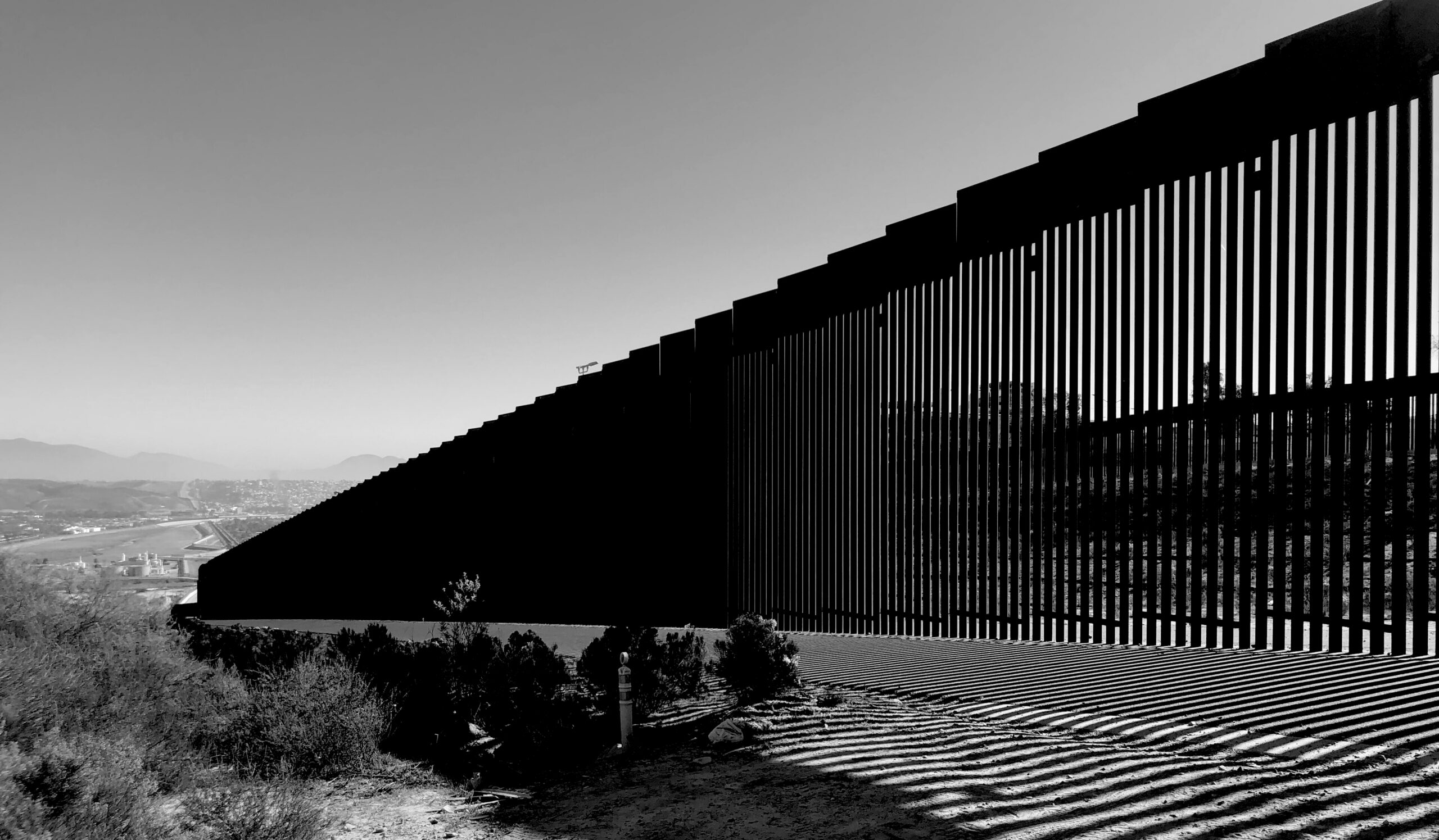
If a person goes unrecorded by official documents, should we be surprised if the struggle mounted against that person also remains unseen?
The harsh truth about deportation is that it is, in essence, a conflict. An American war founded on the same pillars as earlier American wars: genocide, white supremacy, and a tally of bodies. Always the body counts.
As with Vietnam—and Iraq and Afghanistan—the central measure for America seems to be a single statistic: their dead versus ours. A gauge of land won or lost, of shock and awe, of humiliation and pain.
And to those who might insist, Well, if this is a war, there must be two sides. It can’t simply be America against some vague concept, I would point to America’s own wars on other intangible targets: drugs, terrorism, socialism (and its “containment”). It wouldn’t be the first time the United States has aimed its weapons and resources at something without a formal army. And if someone asks, If this is a war, who are the American casualties? I would answer: Who gets to decide who qualifies as American?
The person deported out of the United States remains, in a sense, an American in exile. I am reminded of America’s Civil War—the ultimate conflict over the dignity and place of Black bodies within the American tapestry. And I recall America’s interventions in places like Guatemala, Honduras, Nicaragua, Mexico, and El Salvador. Interventions that helped ignite the mass movements that push people to flee today.
The deaths of deportees are, in effect, part of America’s body count. A self-inflicted wound.
Take, for instance, America’s involvement in El Salvador’s civil war, which stretched from 1979 to 1992. During those years the United States backed a military regime that ruled over a poor peasantry, employing torture, death squads, massacres, and forced disappearances that affected millions, shattered the country, and propelled many to seek refuge northward, largely to cities such as Houston and Los Angeles.
There is broad documentation that American Green Berets trained Salvadoran forces in defeating squads throughout the 1980s at a facility now called the Western Hemisphere Institute for Security Cooperation. The curriculum spanned from executions to torture to extortion.
One Salvadoran special-forces operative trained by U.S. Green Berets was Ernesto Deras. He later used that training to reshape the Los Angeles–based MS-13 gang. Deras is widely credited with imposing structure, organization, and discipline on that gang—many of whose members were deported back to El Salvador, where they formed their own MS-13 cells, further destabilizing a country already reeling from a civil conflict enabled by American interventionist policy.
As recently as 2023, more than 78,000 people in El Salvador were identified as MS-13 members, a statistic that helps illuminate the rise of Nayib Bukele, who became president in June 2019 with a vow to end gang violence. The consequence has been sweeping incarceration—criminals and non-criminals alike—amounting to roughly 108,000 prisoners, about 1.7 percent of El Salvador’s population. Among those confined are deported U.S. migrants. In recent years Bukele has even indicated his willingness to detain U.S. citizens.
Long after the war in El Salvador concluded with the Chapultepec Peace Accords in Mexico City in 1992, the country continues to bear the consequences of American intervention. Echoes from the eighties resurface in the testimonies of asylum seekers at the U.S.–Mexico border today, who report threats of rape, murder, disappearance, and extortion—tamiliar tools of repression once wielded by the Salvadoran military with American training.
It’s no surprise, then, that those deported to El Salvador are killed upon return. For many, deportation amounts to a “death sentence,” a phrase echoed by Sarah Stillman in her extensive reporting for The New Yorker. Her findings have been corroborated by Human Rights Watch, which issued a study tracking deported Salvadorans from 2013 to 2019. The study examined over two hundred deportees: 138 were murdered; seventy suffered abuse or sexual violence at the hands of gangs, police, soldiers, death squads, or partners; about eleven thousand Salvadorans have disappeared in the past decade—more than the total disappeared during El Salvador’s entire civil war.
In Mexico, the U.S.-led war on drugs and programs like the Mérida Initiative have fostered violence and fragility nationwide. The figures are staggering. Mexico’s National Commission for the Search, which tracks missing people, estimates that about 134,448 individuals remain unaccounted for as of now, the vast majority disappearing between 2006 and 2020—the peak years of drug-related conflict under U.S. pressure. This figure likely understates the reality. In the same span, more than 150,000 people were killed, including 124 journalists; many other journalists remain missing. Mexico ranks twentieth worldwide for documented femicides. Consequently, Ni Una Menos—the feminist collective that began in Argentina to challenge complacency around femicides—has taken root across Mexico as well.
According to Mexican groups that assist deportees, such as Otros Dreams en Acción, deportees—especially women—face life-threatening risks soon after their return. The harsh immigration clampdown under Trump has left recent deportees and asylum seekers particularly vulnerable to extortion, kidnapping, and occasional recruitment by certain cartels along the border.
How committed is the United States, really, to fighting drugs or cartels if it is actively funneling vulnerable people, like Diego, into those very markets? Has this war failed by design or by accident? If it is by accident, why keep directing resources and people toward these wars against illicit economies? To what degree does that render us—Americans and our elected representatives—responsible for the genocide of a particular group and ethnicity? The deaths of deportees are, in effect, part of America’s body count. A self-inflicted wound. The loss of talented individuals, the erosion of GDP, and the immeasurable losses: parents, siblings, children, aunts, and uncles—essential members of society whose absence causes financial and emotional damage to others in ways not yet fully calculable. Despite conservative rhetoric about who is or isn’t American, there is a deep awareness among deportees (at least among those I know) that they are, indeed, Americans. Even knowing what the United States will do to them because of their background or origin.
Many observers compare the current moment to a slide toward Nazi-era fascism. They point to the exploitation of racial rifts, mass rallies, the storming of the Capitol, the erosion of truth, and the normalization of state violence in the name of ethnic cleansing—an erosion that becomes systemic, authorized, and accepted. There is a growing fear that this trajectory could culminate in full-blown fascism. It seems that line has already been crossed long before January 6, long before the rise of Trump. After all, he is a product of a larger American history. Perhaps for that reason, the casualty toll continues to rise into the second decade of the twenty-first century. When the machinery runs, we witness a death-making apparatus born from our own image. We count the fallen. We need to count the fallen. We need their fallen.
Diego descends from a long lineage of Totonac healers. He comes from a heritage of medicine people that includes his great-grandfather and grandfather, though his parents moved to the city when they were young and later returned, drawn by circumstance and the pull of kin and tradition. Diego takes pride in navigating both worlds—the ancestral and the contemporary. He cherishes his ability to move through the labyrinth and also through Mercado Sonora, that living relic of history.
He doesn’t hesitate to call out what he sees as scams in Mercado Sonora. The oregano sold as a cure for diabetes, for example. Myrrh that looks too polished to be genuine. Or brujas who claim to know Yoruba magic (What the hell is that?). Or lotions that promise to erase everything. A kind of cleansing, he suspects.
With the panels of the machinery off, we can see the death machine for what it is: a creation built entirely in our image.
He recalls how his grandfather performed spiritual cleanses with a special leaf that grew in Hidalgo (not sage, something else). He would light it, let it burn, and the smoke would drift a blue haze through the air. You could squeeze the leaves, pretend they were cigarettes. He wandered the house with that scent, purging the dark corners that even his grandfather couldn’t reach—the hidden spaces, the shadowed corners. He aimed to drive out the bad ghosts.
The Germans drift apart and then rejoin, photographing sacks of mushrooms from China, bags of rabbit feet, and an elderly woman in a muumuu who proclaims fame and charges five pesos for a portrait, plus five more if you want to use her friend’s bathroom. They stage a show as Diego does—less about pleasing others than about turning a profit. “You wanna see some strange stuff? I’ve got some strange stuff,” they boast.
In moments like these at Mercado Sonora, Diego thinks of Aliana and of the almost absurd ease with which she could sustain herself without the spectacle surrounding Mexican life. She didn’t need to propagate a myth; she lived mostly in truth. Yet she sold his wares, and if the spectacle of Mexico was what Diego was peddling, was she complicit too? Wasn’t the entire enterprise of F*CK LA MIGRA a spectacle? A creation designed for the white gaze. F*ck, of course, was an English term. But was it necessarily limited to a Mexican audience? Could “F*ck” also travel, be understood internationally?
In Mercado Sonora, Diego does not yet realize that his designs will outsell his expectations—threefold, aided by Aliana. By the summer of 2018, she is still alive. Many paths lie ahead: she could manage distribution of his pieces in the United States at prices that match demand. It won’t be until the summer of 2019 that a hat he created, priced at about five dollars, appears on an Etsy page for thirty dollars, run by a woman who labels herself the Texas Huntress. A stranger to him. For now, in Mercado Sonora, the hat exists only as a concept in his mind: a black trucker cap with golden laurels along the brim and the words FUCK TRUMP emblazoned across the front.
So what if Aliana profits from my ideas? Diego wondered. He didn’t mind. She offered space for the deportee community, and he valued volume in his sales. It was all about distribution to him anyway. It could be a mutually beneficial arrangement.
Around this time he began to be haunted by nightmares. He died in his dreams. You aren’t supposed to die in your dreams, he thought. He suspects the dreams began on the flight from the United States to Mexico City in the summer of 2016. He wanted that plane to crash. Somewhere over Texas would do. Or perhaps somewhere beautiful. The Sonoran Desert, perhaps. Or somewhere in the lushness of the Valley of Mexico. He didn’t care. He simply wanted to die. Peace or rage that made him want the plane to go down?
Rage, certainly—he despised the way authorities treated him like a criminal. He wasn’t a criminal. He wanted to die, just to watch them die along with him. Rage.
For a long stretch, his dreams centered on death. It was always him who perished in the end. Then, one night, it was Aliana who died. That struck him as odd, but it was only a dream, dreams come and go.
“Everyone follow Jesus,” Diego says with earnestness. The Germans laugh and repeat the line with exaggerated pride, as if they had invented it. It’s awkward, but it’s a good joke. We follow Jesus.
One of the Germans sets his camera down, steps back into the circle, and bumps two or three of his companions, then strides forward, shouting “Fuck! What the fuck!” in English, of all languages.
We turn our gaze. We see what he sees. A baby Jesus statue with both eyes gouged out, red tears streaming down his cheeks.
Jesus looks toward Diego, who returns the smile, as if to say, I think we did well. And we pause for a moment. The Germans calm themselves, take it all in, and photograph the scene in unison, finally discovering the Mexico they had imagined.
______________________________
From How to Look Away: On American Cruelty and the Refusal to Disappear by Daniel Peña. Copyright © 2026. Available from One World, an imprint of Random House, a division of Penguin Random House, LLC.