
At the outset of his expansive narrative poem “Letter to Lord Byron,” W. H. Auden declares a longing for a form large enough to accommodate a vast swim. In a striking echo, Herman Melville—then a thirty-year-old writer—decided to enlarge and deepen a relatively straightforward maritime adventure, toying with the shadow of his early triumph Typee: A Peep at Polynesian Life (1846). In doing so, he asked what form could best carry such a project and what it might ultimately become.
Today many readers regard Moby-Dick: Or the Whale (1851) as “the Great American Novel,” yet the work has always appeared to be more than a mere piece of fiction. Its ceremonial rhetoric, its persistent philosophical musings, and its towering protagonist—the tormented, vengeance-driven Captain Ahab—elevate the chase after a colossal white whale beyond everyday narrative into a sphere that hovers near Homeric epic, Shakespearean tragedy, or biblical saga, while also weaving in elements of Gothic mystery. Simultaneously, the book serves as a detailed compendium of nineteenth‑century whaling and, in its subplots, a nuanced portrayal of companionship, even affection, between Ishmael, the ex-schoolmaster who narrates the voyage, and Queequeg, a tattooed, former cannibal harpooner. Owing to its staggering polyphonic complexity, Moby-Dick resists any single, definitive reading. To this day, almost every facet of this masterpiece retains an air of ambiguity, a beguiling unsettledness.
What makes a literary work viable as a candidate for the Great American Novel is its capacity to provoke unsettled critical responses. Perfection can be a form of stasis; a substantial heft, breadth, and an engagement with the United States’ past—particularly issues of racial injustice, religious zeal, social conformity, and the rampant growth of capitalism—are essential. Moby-Dick satisfies all these demands, while also embodying what many readers identify as the quintessential American malaise: isolation. Melville himself describes Ishmael, Ahab, and the crew of the Pequod as “isolatoes” in their own way, cut off from conventional society.
Moby-Dick thwarts simple interpretation. To this day, nearly every aspect of this masterpiece remains ambiguous, alluringly unsettled.
Stylistically, this encyclopedic grab bag of genres flows effortlessly from sermons and monologues to high-octane chase scenes and desperate outcries. Its first 20 chapters—out of 135—carry a surprisingly comic register. The opening line, “Call me Ishmael,” introduces a narrator who presents himself as a Byronic outsider. The Old Testament Ishmael was “a wild man,” with the whole world arrayed against him. Yet what does this contemporary wanderer dream of doing when a “damp, drizzly November in my soul” unsettles him? He fantasizes about knocking hats from gentlemen’s heads, as if he were a tipsy member of P. G. Wodehouse’s Drones Club. While Ishmael may pause before coffin-warehouses—coffins, in various forms, repeatedly become a central motif—he remains lightly ironic in tone, with little sense of crushing sorrow or of recounting experiences so harrowing that they would scar him for life. Almost the sole ominous note arrives in his daydream of a procession of whales encircling “one grand hooded phantom, like a snow hill in the air.”
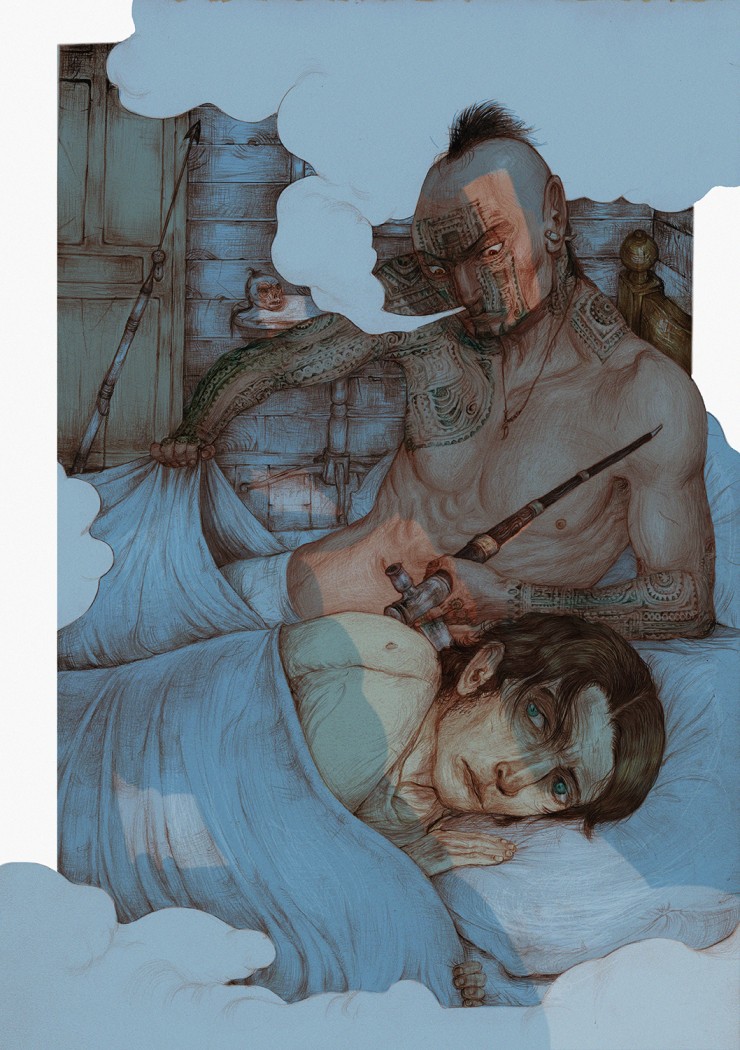
During the voyage to join a Nantucket whaler, Ishmael lodges for a night at New Bedford’s Spouter-Inn, a stay that quickly slides into a stage‑worthy farce. He describes his belabored attempts to sleep in a chair, then reluctantly agrees to share a bed after the landlord’s insistence, only to discover—late at night, in the dark—that his pillow companion is a tattooed cannibal who has spent the evening hawking a shrunken head. While deeper meanings lie beneath the surface, the surface itself remains largely comic. The quarrels between Captain Peleg and Captain Bildad, two Quaker shipowners who preach nonviolence, sit uneasily beside the brutal slaughter of whales. Bildad often recites biblical verses—especially the Sermon on the Mount’s injunctions against storing up earthly treasures—but such scruples quickly give way when he recognizes the cannibal Queequeg’s harpoon prowess.
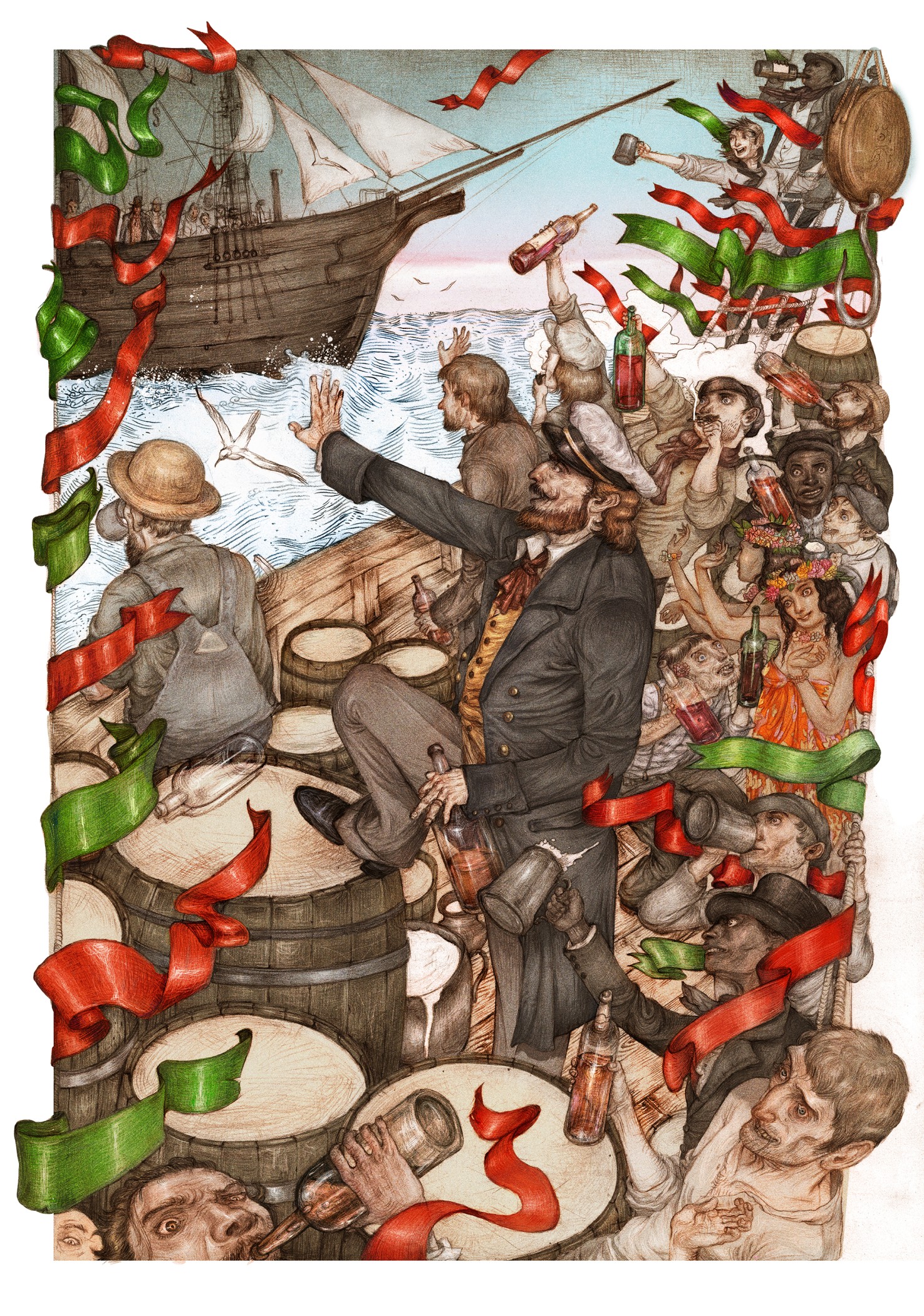
But the moment the Pequod break away from Nantucket on Christmas Day marks a shift: Ishmael recedes, the plot darkens, and ominous signs multiply. In The Confidence-Man: His Masquerade (1857), Melville later writes that “it is with fiction as with religion: It should present another world, and yet one to which we feel the tie.” Some of Moby-Dick’s symbolism is straightforward. The ship’s harpooners represent three distinct non‑European lineages—Queequeg, the dignified Polynesian; Dagoo, the tall African; and Tashtego, the keen‑eyed New England Indigenous man. The remaining sailors—roughly thirty in number—come from a mosaic of backgrounds: Malaysian, Chinese, Sicilian, Irish, Manx, French, Spanish, English, Danish, Portuguese, among others. At a crucial moment, we even learn of Fedallah, a Parsee from Zoroastrian fire worship, who acts as Captain Ahab’s devoted harpooner and as a shadow-self, almost Mephistophelian in proximity to the captain.
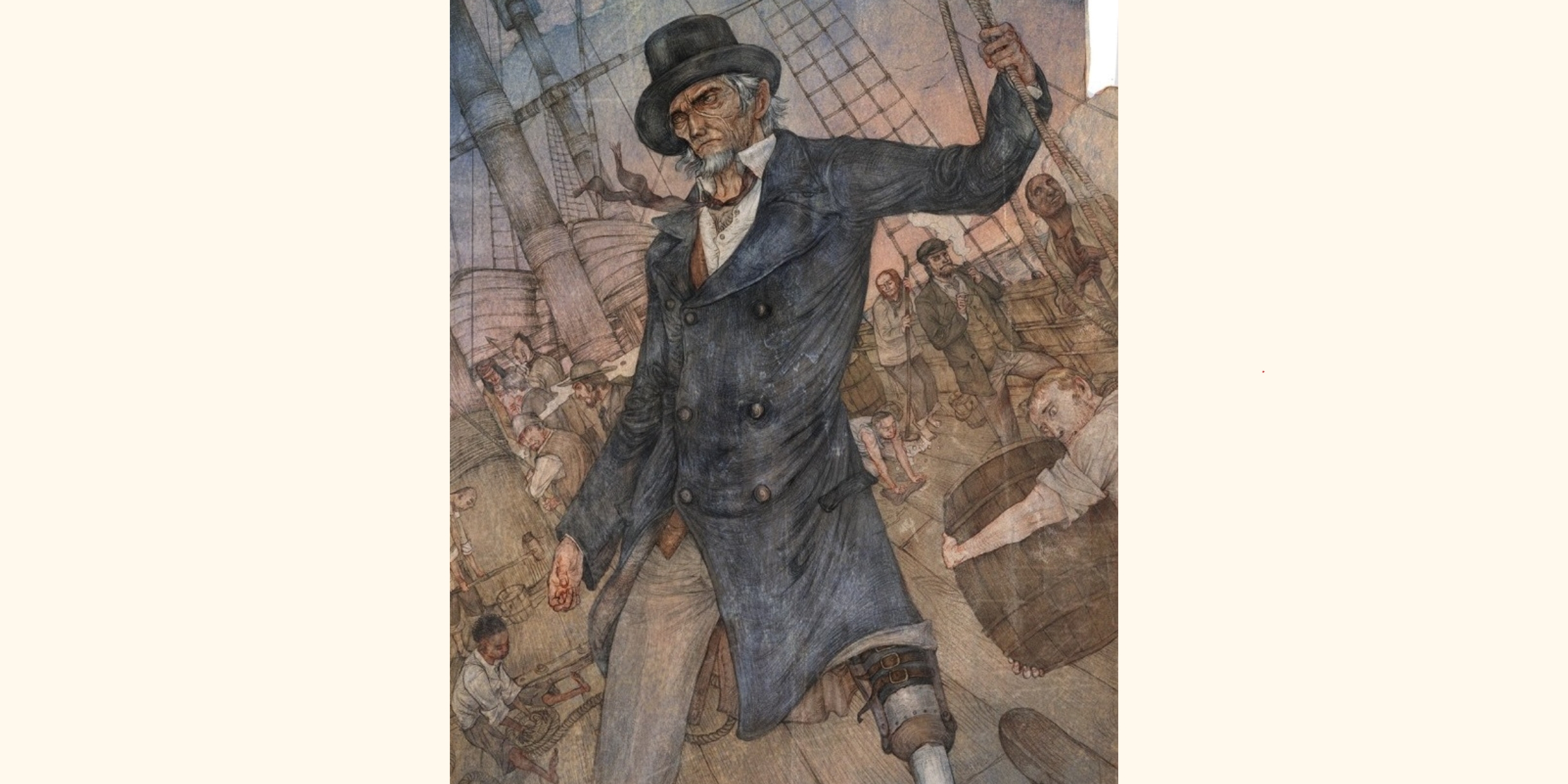
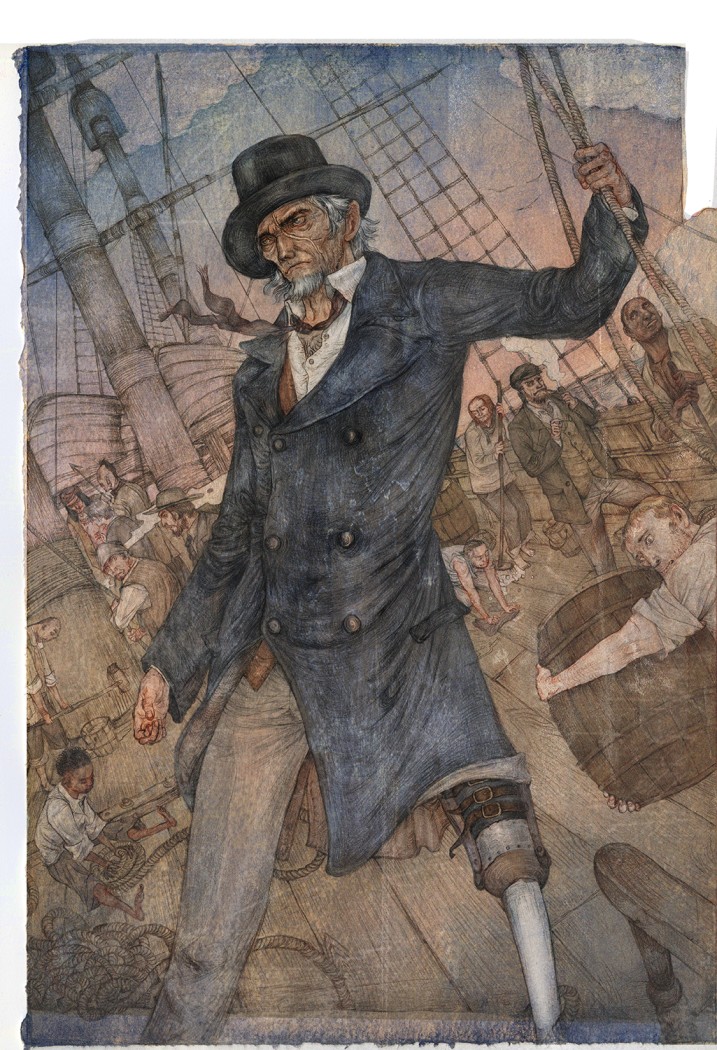
Captain Ahab is, of course, the volcanic force who transfigures the Pequod’s voyage into something deeply singular. From the moment his name is uttered, he exerts a magnetic pull on the reader and on his crew. As Captain Bildad warns Ishmael, “He’s a grand, ungodly, god-like man, Captain Ahab; doesn’t speak much; but when he does speak, then you may well listen. Mark ye, be forewarned; Ahab’s above the common; Ahab’s been in colleges, as well as ’mong the cannibals; been used to deeper wonders than the waves; fixed his fiery lance in mightier, stranger foes than whales.” What exactly are those “mightier, stranger foes than whales”? Ahab bears a scar, described as “a slender rod-like mark, lividly whitish,” extending from crown to foot, which many readers interpret as the mark of Cain.
On a prior voyage, the captain—now in his fifties, with a young wife and child—pursued the enormous, gleaming white sperm whale known among sailors as Moby Dick. That encounter left Ahab without a leg, bitten off at the knee, and he now dons a whale‑ivory prosthesis; hints later surface of sexual impotence. Rather than retiring from the sea, he commits himself to avenging himself on Moby Dick. Could there be a more American motive than this fixation, this relentless drive that will not yield to opposition? He challenges the dogma of conventional Christianity and ultimately treats Moby Dick as the tangible emblem, the outward sign of the universe’s indifference—or worse, its malevolence. The world, in his view, is not what it appears to be. As Ahab tells his practical, sober first mate Starbuck:
All visible objects, man, are but as pasteboard masks. But in each event—in the living act, the undoubted deed—there, some unknown but still reasoning thing puts forth the mouldings of its features from behind the unreasoning mask. If man will strike, strike through the mask! How can the prisoner reach outside except by thrusting through the wall? To me, the white whale is that wall, shoved near to me. Sometimes I think there’s naught beyond. But ’tis enough. He tasks me; he heaps me; I see in him outrageous strength, with an inscrutable malice sinewing it. That inscrutable thing is chiefly what I hate; and be the white whale agent, or be the white whale principal, I will wreak that hate upon him.
Despite these impassioned vows, the fractured Ahab occasionally yearns for the calm and comforts of home, even as he distrusts any tender feelings that could be mistaken for weakness. When the Pequod glides through tranquil seas, serenity feels like a temptation to be resisted. He instead thrives on the thrust of storms and tempests. As D. H. Lawrence observed, “Some souls are purgatorial by destiny.”
When Ahab first addresses the crew about pursuing Moby Dick, his magnetic intensity quickly infects everyone who remains except Starbuck, and soon many join his absolutist crusade. Later, he performs a ritual that might be described as satanic as he baptizes a specially forged harpoon blade in human blood while howling with frenzy, “Ego non baptizo te in nomine patris, sed in nomine diaboli!” Meanwhile, Fedallah—who never consumes food or takes rest—becomes increasingly uncanny, gliding about with ghostly quiet, a tremulous silhouette cast on the deck by an unseen form, yet somehow bound to Ahab. One critic has even described Moby-Dick as a study in demonology.
Other scholars, however, minimize the book’s diabolic aspect, presenting the Pequod’s captain as a laudably daring if flawed heroic overreacher or a modern Prometheus confronting capricious fate and the hostile universe. Moby Dick himself, too, is a creature of multiple readings. “The front of the Sperm Whale’s head,” Melville notes, “is a dead, blind wall, without a single organ or tender prominence of any sort whatsoever.” The whiteness of the creature makes it a blank surface onto which any interpretation can be projected. Is he an innocent victim of human predation, or does he symbolize an inexhaustible, unfathomable void at the heart of existence?
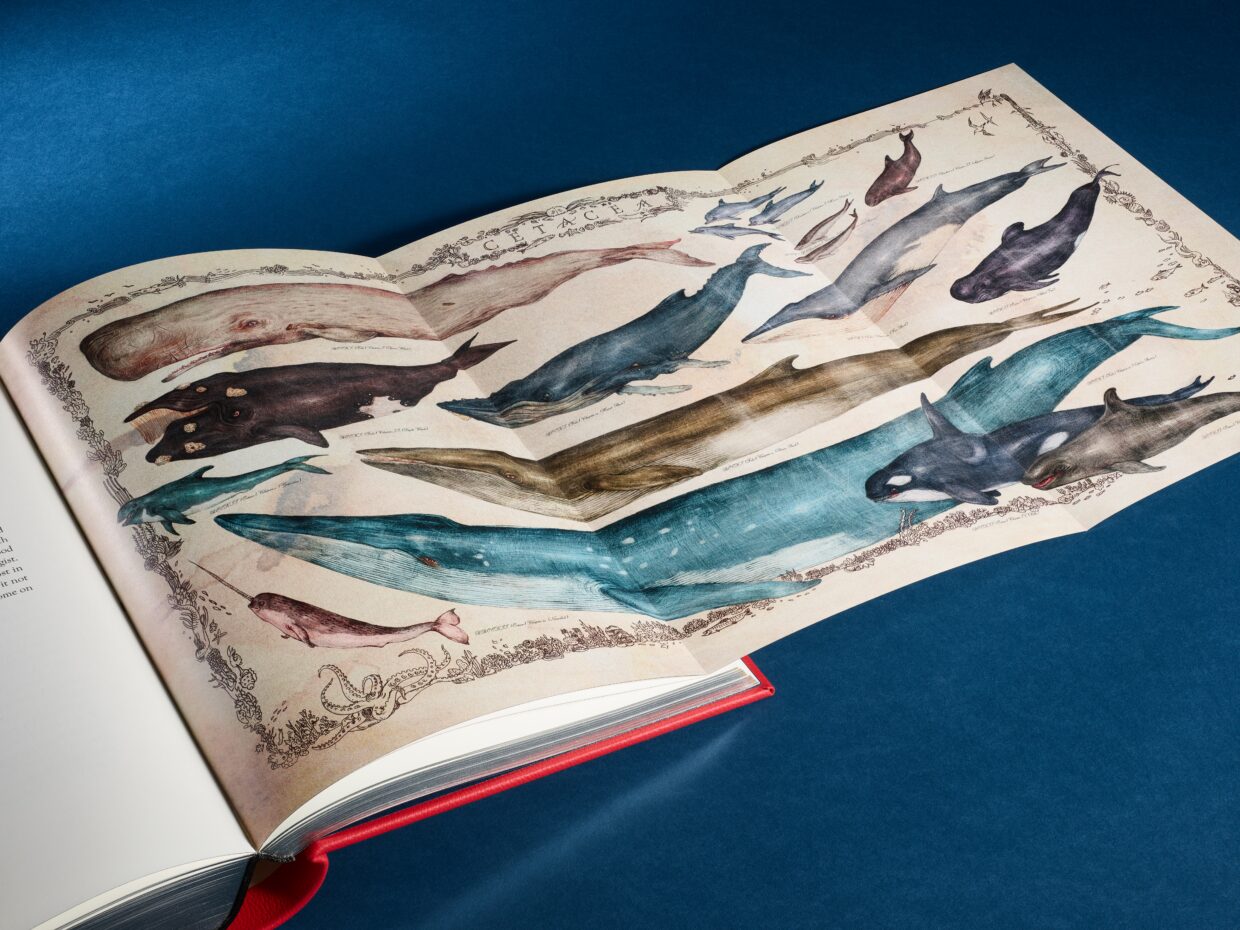
In contrast, the novel itself resists emptiness. It speaks directly to the reader and exhibits borrowings—sometimes close to plagiarism—from a repertoire of around 160 known works (ranging from Shakespeare’s King Lear and Macbeth to the Bible and many maritime histories). Melville’s frequent “info-dumps,” especially the chapters devoted to cetology and the meticulous account of rendering blubber into oil, function in part as factual ballast for the work’s more grandiose Wagnerian scenes or its cinematic depictions of actual whaling operations.
We should remember that whale oil commanded high prices in the early nineteenth century, with the New England market dominating its sales. Yet hunting such enormous creatures carried immense risk, not merely for the oarsmen and harpooners in the small boats—the likelihood of loss for New Bedford’s ships ran at about one in three. The Essex’s catastrophe, when a whale wrecked the ship, is the most famous example (Nathaniel Philbrick’s In the Heart of the Sea offers a praised account of the event). Melville, who was familiar with the Essex and with legends of Mocha Dick, uses such lore to enrich the novel’s world, even as the Pequod ventures into deeper waters. A single chapter about a seemingly ordinary harpoon line can suddenly unfold into a meditation on mortality, as in the following reflection:
All men live enveloped in whale-lines. All are born with halters round their necks; but it is only when caught in the swift, sudden turn of death, that mortals realize the silent, subtle, ever-present perils of life. And if you be a philosopher, though seated in the whale boat, you would not at heart feel one whit more of terror, than though seated before your evening fire with a poker, and not a harpoon, by your side.
For readers who know Melville’s larger craft, that opening clause doubles as a pointed foreshadowing of later deaths and fates within the same work.
Today we tend to look at whales with sympathy, seeing them as majestic beings of beauty and power, often endangered by overfishing and the ambitions of capitalism. Melville registers some of this sentiment as well; in the “Grand Armada” chapter he depicts a vast pod of whales in a protective, familial light, circling their young and wary of the ship and its boats. When Flask, the third mate, kills an old, blind whale with one fin, he adds a bitter aside: “For all his old age, and his one arm, and his blind eyes, he must die the death and be murdered, in order to light the gay bridals and other merry-makings of men, and also to illuminate the solemn churches that preach unconditional inoffensiveness by all to all.”
Such empathy seems distinctly modern, yet so too do some of the novel’s other elements, including the intimate, often coded, cross‑cultural bond between Ishmael and Queequeg. Its presence isn’t explicit in explicit terms, but the scent of it lingers from the Spouter-Inn’s first night: Ishmael recalls Queequeg’s arm draped over him in a way that suggests more than mere companionship. Their shared mat crafting becomes a ritual through which their bond—indeed, a broader kinship among all people—expands, even as the narrative remains studded with sexual undertones in passages such as the Whitmanesque chapter “A Squeeze of the Hand”: “Let us squeeze hands all round; nay, let us all squeeze ourselves into each other; let us squeeze ourselves universally into the very milk and sperm of kindness.” In the end, Ishmael survives by clinging, metaphorically, to Queequeg’s coffin repurposed as a lifeboat.
From letters Melville sent and from his eventual acquaintance with Nathaniel Hawthorne, we learn that he believed the project near completion by August 1850. That summer, after reading Hawthorne’s Mosses from an Old Manse and meeting the author, Melville resolved to revise and expand the novel to resemble nothing less than “a democratic tragedy of Shakespearean heft.” The result, focused and rising in oratorical cadences, achieves passages of singular power—speech that has the capacity to shake readers’ souls when Ahab speaks:
What is it, what nameless, inscrutable, unearthly thing is it; what cozening, hidden lord and master, and cruel, remorseless emperor commands me; that against all natural lovings and longings, I so keep pushing, and crowding, and jamming myself on all the time; recklessly making me ready to do what in my own proper, natural heart, I durst not so much as dare? Is Ahab, Ahab? Is it I, God, or who, that lifts this arm?…By heaven, man, we are turned round and round in this world, like yonder windlass, and Fate is the handspike.
After completing Moby-Dick, Melville published three more novels—Pierre: Or the Ambiguities (1852), Israel Potter: His Fifty Years of Exile (1855), and The Confidence Man: His Masquerade (1857)—as well as a collection of shorter fiction, including Bartleby the Scrivener, in which a clerk repeatedly declares, “I would prefer not to.” Yet by his forties, Melville’s career as a fiction writer was largely finished. He continued writing poetry, served as a customs inspector in New York, and produced the manuscript of a poignant novella, Billy Budd (1924) posthumously. Overall, he drifted into relative obscurity, a fate he sensed early on: “Though I wrote the Gospels in this century, I should die in the gutter,” he wrote in one letter.
Yet there are occasional resurrections. By the 1920s Melville’s work was being read anew, studied, and discussed. T. E. Lawrence (Lawrence of Arabia) proclaimed a desire for his own Seven Pillars of Wisdom to be as monumental as The Brothers Karamazov, Thus Spake Zarathustra, War and Peace, or Moby-Dick. By the 1950s, Melville’s star had not only risen again but was entering a blazing ascendancy with no sign of dimming.
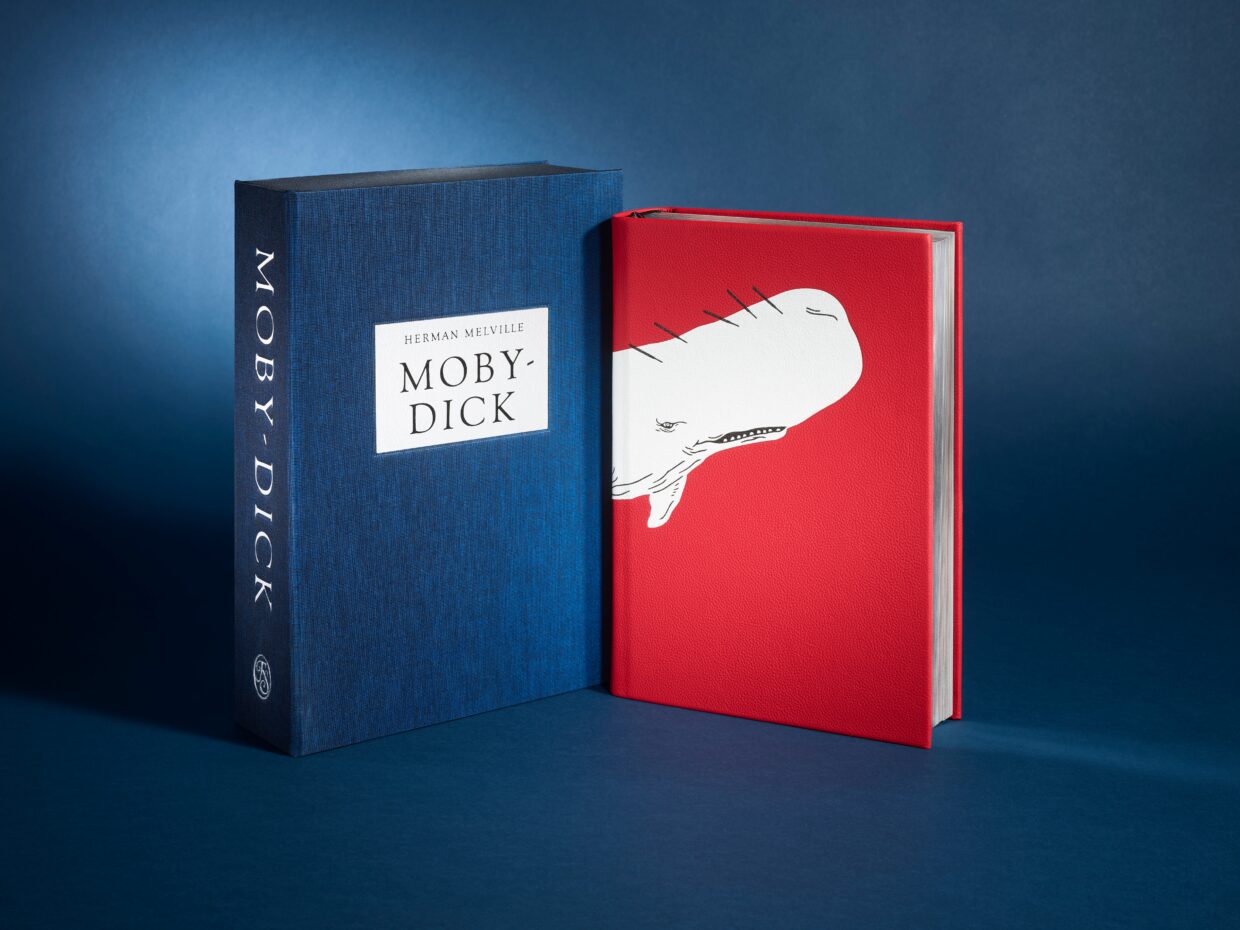
Paradoxically, however, the book’s ascent to “the Great American Novel” may have dampened the enjoyment of regular readers, who could be daunted by its formidable reputation. Yet Moby-Dick is a work to be read, not merely studied in classrooms. This Folio edition, beautifully produced and richly illustrated, invites readers to experience the work in its own terms, without the burden of scholarly apparatus. Readers may eventually seek out a multitude of critical essays or Melville biographies, but that can wait. For now, shipmates, turn to the opening line and embark on the voyage: “Call me Ishmael.”
____________________________
From Moby-Dick, The Folio Society. “Introduction by Michael Dirda for The Folio Society’s Limited Edition of Moby-Dick.” Illustrations © Mu Pan 2026.