
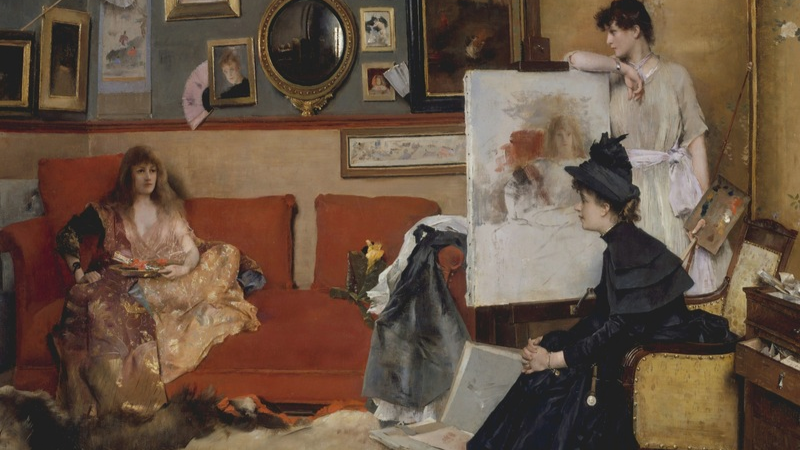
Is it telling that my attention was habitually drawn to the amateurs? When I reflect on the literary portrayals of artists that have moved me most, they tend to exhibit a cluster of shared traits: frustrated striving, a stubborn commitment to a vocation that borders on self-deception, perseverance in the face of others’ indifference, and the unpredictability of any reward.
The blueprint for this preference appears in the shy, thwarted Lily Briscoe in Virginia Woolf’s 1927 novel To the Lighthouse. Lily dreads the judgment Mr. Ramsay would inevitably cast upon her painting if he were to view it, yet she is also overwhelmed with melancholy as she imagines the likely fate of her work—“rolled up and stuffed under a sofa”—a common destiny for women artists. For Lily, painting is at once a source of pleasure, a “dancing rhythmical movement” Woolf renders with tactile clarity, and a battlefield against “an ancient formidable enemy.” Lily’s inner life is consumed by this ambivalence, yet it remains unclear whether she is truly a gifted painter, and it seems certain that her work will never be shown.
Woolf treats this psychic drama with a seriousness and tenderness that feel generous. What matters isn’t the merit of Lily’s painting but the depth of her devotion. In the past I have tried to visualize Lily’s picture through my knowledge of British art, collecting the various ekphrastic fragments Woolf places within the narrative and attempting to reconstruct an equivalent image. I remain unconvinced by the easy parallels drawn between Lily and Woolf’s sister Vanessa Bell, who enjoyed a more professionalized and privileged career than Lily. (Only a few years after To the Lighthouse came out, Woolf penned a forward for a solo Bell show on Bond Street. Bell was a reputably discussed artist, a topic at dinner parties. This isn’t Lily’s path.)
Lily is probably another follower of British Post‑Impressionism, but that isn’t the point Woolf finds compelling about her painting. The meaning resides largely in the emotion and intelligence Lily brings to her process, in the craft, and in the persistent interweaving of her creativity with her becoming. Her amateur status makes this struggle even more poignant. Her striving isn’t about winning acclaim or proving that her sacrifices were worthwhile (she remains unmarried, deemed unmarriageable in part because she won’t subordinate her creative work). Her painting concerns the subtle inner connections between herself and what she calls, in the novel’s triumphant final pages, her vision.
Art makes her happy, it puts her in a curious and purposeful relationship to the world, and that’s enough.
I have always admired the modest yet stubbornly utilitarian portrait of artistic personhood that Lily embodies. Her embarrassment at the thought of her work being seen, alongside her drive to keep creating, resonated with me. I found myself a little embarrassed by the idea of writing fiction and felt steadied by Lily’s own discomfort.
It was also true that I hoped Hannah, the fictional artist who leads my debut novel, Venus, Vanishing, would begin as a self‑taught amateur with little prospect of commercial or critical success. When I began drafting the book in earnest, other fictional amateurs joined Lily in my imagination.
There is the romantic, impulsive Dora from Iris Murdoch’s 1958 novel The Bell, who abandons her studies for a disastrous marriage. At first, Dora’s art isn’t central to the plot, serving instead as a shorthand for her capriciousness and dreaminess, her naiveté. That changes when we accompany Dora into the familiar rooms of the National Gallery, where she discovers “something real and something perfect” in a Gainsborough painting.
At the novel’s close, after the usual Maelstrom of Murdoch’s plots has cleared, and inspired by this revelatory encounter, Dora returns to painting, even as she recognizes her “very meagre talent.” Art makes her happy, it places her in a curious and purposeful relationship to the world, and that is enough. The amateur is freed from the pressures of exhibition and sale, but that freedom can just as easily breed bitterness as happiness.
In Elizabeth Jane Howard’s 1950 debut The Beautiful Visit, the young heroine becomes the companion to an aging fantasist, Mrs Borders, who fills the hours and every wall and drawer of her home with watercolors. This amateur becomes a specter of squandered time, energy and imagination. Her watercolors of “sunsets, flowers, churches, buildings, the sea and bits of the room” are abundant and repetitive, and, as the narrator notes, “bad,” though there is “something almost lovable in her assurance of their quality.”
Yet the narrator’s opinion of Mrs Borders’ benevolence soon shifts. Howard delights in rendering the excess and redundancy of Mrs Borders’ work as something uncanny, even terrifying. Hung on every available surface of the room, “their already impressive number […] multiplied” by the reflective glass in which they are framed, the watercolors create a suffocating atmosphere and underscore how the unnamed narrator is entrapped within her employer’s mind as much as within the house itself.
What if more of Lily’s life had granted her this ecstatic feeling of agency, this satisfaction, this gratitude, this accomplishment? Perhaps, I thought, I could write my way into this experience to honor Lily and all her amateur literary sisters.
There are other amateurs too, especially in fiction from earlier eras. Jane Eyre paints watercolors and tells Mr. Rochester that happiness can be found in the act. Edna Pontellier in The Awakening also paints “in an unprofessional way,” and although she is said to possess “natural aptitude” with brushes, she simultaneously resents her own lack of expertise and resists praise for her efforts.
All these amateurs are women, which is no accident. Even when aspiring female artists could apprentice with a male relative who was an artist, or later enroll in an art school, up through roughly the mid‑twentieth century they were seldom encouraged to professionalize. If they sought to forge a name for themselves, they risked marginalization, exclusion from galleries, prurient press attention, and public ridicule. Women weren’t viewed as capable of genuine creativity: they were considered imitators, derivative; painting was a pastime rather than a route to greatness. “Women can’t write, women can’t paint,” as Charles Tansley insists to Lily in To the Lighthouse. Lily’s anxieties are not delusions of persecution; they are grounded in the real constraints faced by women who dared to pursue artistic ambitions in the early twentieth century, when desires were expected to bend toward home and family.
I could have sought additional fiction to locate examples of professional women artists. Yet, as an art historian, it was perhaps inevitable that I would turn back to research to locate the true beacon for Venus, Vanishing. The German artist Lotte Laserstein (1898–1993) produced striking depictions of self‑possession, desire, and creative authority in the early decades of the twentieth century in Berlin, often placing herself within intimate, everyday and subtly erotic nude scenes. A favorite of mine is her 1929 self‑portrait, I and my Model.
Laserstein presents herself at work, looking out at the viewer while her model gazes back over her shoulder, a collaborative force in the artwork rather than a passive subject. Laserstein projects a defiant, unwavering belief in herself that I realized I could never find among my cherished amateurs. I wanted Hannah’s lineage to begin here—in Laserstein’s steady, unflinching gaze. Whenever I study this image, the same line from To the Lighthouse always surfaces: Lily, triumphant at last, as she lays down her brush in exhaustion, “Yes, she thought, laying down her brush in extreme fatigue, I have had my vision.” What if more of Lily’s life had granted her this ecstatic sense of agency, this sense of fulfillment, this gratitude, this achievement? Perhaps, I thought, I could write my way into this experience to honor Lily and all her amateur literary sisters.
__________________________________
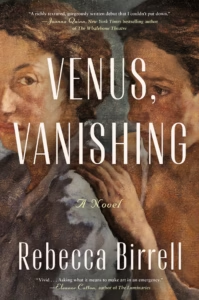
Venus, Vanishing by Rebecca Birrell is available from Henry Holt and Co.
